
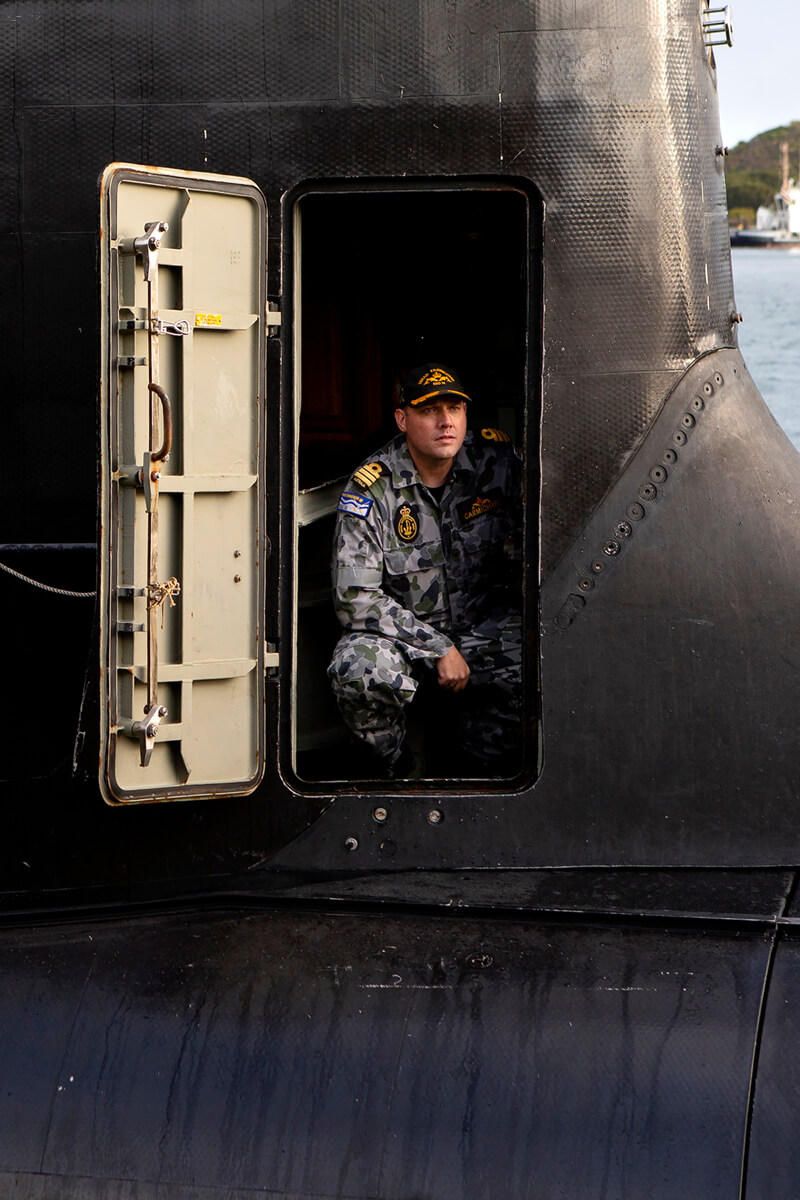
Speaking last week, Defence Minister Richard Marles called the Collins class submarines “Australia’s most important military platform”.
So it’s more than disturbing to read the ANAO Audit report on the Defence leadership’s disastrous management of the Collins fleet’s life extension program (the “LOTE”) over a decade. That’s the program whose purpose is to keep the Collins submarines capable and reliable for a decade beyond their planned 28 year life, which HMAS Farncomb, reaches this year.
It’s not the politicians this time
Mr Marles, in a nakedly political speech for the Lowy Institute, made the problems with the management of Australia’s only actual submarines all a product of political leadership. That’s just not true. It’s true that politicians have been a key factor in the flip-flopping around the future direction for Australia’s submarine fleet: shifting from ponderously exploring every conceivable conventional option, to Japanese subs to French subs to the AUKUS nuclear subs. But even on this, the politicians have been joined eagerly by Defence officials cheering on the different options at different times.
When it comes to how the existing Collins fleet is managed, however, the Audit report lays out very clearly that it has been senior Defence officials – notably those in charge of submarines (the various Chiefs of Navy who are the Capability Manager for submarines and the Vice Chiefs of the Defence Force who are in charge of defining and funding the force) – who offered up the plans to upgrade the Collins subs by replacing their entire propulsion system and power system. Ministers of both parties have accepted the Defence leadership’s advice throughout the decade—when they were provided with it.
And the report shows that those senior Defence officials knew of Defence’s inability to address the design difficulties and technical risks in their plan for years before they informed Government ministers.
Here’s an example from the 2019 Submarine Advisory Committee (the SAC), a small group of experts explicitly appointed to provide unvarnished advice to senior Defence leaders. The SAC advised the Chief of Navy Mike Noonan, the CDF Angus Campbell and the Secretary of the Department of Defence Greg Moriarty that “In our view LOTE is the biggest challenge facing the submarine capability in the 2020s. Re-design of the entire Collins propulsion system, integration into the platform, then implementation without impact to availability is a significant task, far greater in scope and complexity than the large number of smaller projects integrated to date.”
In July 2023 that same SAC advised the Chief of Navy Mark Hammond, CDF David Johnston and Secretary Greg Moriarty that “that the planned scope for the LOTE was incompatible with the two-year full cycle docking schedule using current processes. Proposed novel methods added technical risk rather than resolving schedule constraints. Efforts to upgrade ageing systems introduced further reliability challenges, and the organisation lacked experience in managing such changes within tight timelines”.
Reams of information was available to senior leaders, they just didn’t use it
This advice was consistent with the work of a bewildering and overlapping set of teams, bodies and oversight outfits looking at the Collins upgrade effort over a decade. Here are most of the major ones: the peak Defence Investment Committee, the Submarine Advisory Committee, the Submarine Enterprise Board, the LOTE Integrated Program Team, the Technical Advisory Panel, Capability Manager Gate Reviews, LOTE scope reviews, and various independent oversight outfits like Independent Assurance Reviews. This internal Defence planning and external advice and review was supplemented by industry reports and work by Saab-Kockums, the original designers of the Collins, back in 2014, and by ASC – the company actually responsible for planning and implementing the LOTE work on the submarines.
The report shows that Defence had more than enough information sharing and advisory structures – it just lacked senior decision makers who took in the information provided to them and made sensible decisions based on it.
A core problem was that the basic idea was conceptually flawed: to replace all the big mechanical systems – the main motors, diesel generators, and power system in the Collins subs – with different new systems common to those being fitted to the French Attack class subs program that started in 2016.
Even if it had worked, it would have resulted in a less capable submarine that needed to snort more frequently and so be more vulnerable. But that was best case: the technical risk in fitting these novel new systems to the existing boats were proving insurmountable. Years of engineering design effort were failing to reduce the risks or deliver feasible work packages able to be put into each Collins as they entered their next two year refit period.
Just as tellingly, despite this, Defence never fully assessed the risks and lack of benefits of pursuing commonality with Attack in the LOTE either before it embarked on this pathway, or after the risks became clear, or – and this is simply beyond belief – even after the Attack class was cancelled. One of the alleged benefits of installing Attack-common systems on the Collins was to ‘de-risk’ the Attack program, yet Defence did not reassess the LOTE when Attack was cancelled in 2021. Nor did Defence fully explore alternative approaches to the LOTE.
We only know about the scandalous mismanagement of the Collins subs upgrade because of the independent work of our national audit office – that same office that Defence is starving of information when it comes to reporting on the top 30 major projects Defence is spending all our money on, resulting in the cancellation of the ANAO’s annual major assessment of Defence’s major programs.
A slow motion train wreck in plain sight
So, what does the Audit report reveal about the planning around our Navy’s 6 Collins submarines? Well, it shows that as far back as 2014, a Saab-Kockums study for Defence had advised the organisation that “replacing major systems — such as the main motor, diesel generators, and power conversion and distribution system — would require design work comparable to that of a new submarine build and a funding profile consistent with a new acquisition”. But that’s just what Defence decided to do with the Collins LOTE when it began in 2018, using blind faith in the benefits of “commonality” between Collins and the new Attack subs as the rationale.
By May 2020, the problems were clear. As a Defence risk assessment stated in May 2020:
“The highest design risks identified related to the replacement main motor and control system and the diesel generators. The assessment identified that:
- an additional eight cubic metres of space would be required to accommodate the new equipment, increasing the extent of changes required to the submarines’ general arrangement;
- the increased power consumption of the replacement propulsion system would require additional cooling, with potential implications for the submarines’ signature and other key operating characteristics; and
- the replacement diesel generators were smaller and less effective at clearing toxic gases, increasing the amount of time required for ‘snorting’ — a process involving the submarine rising to periscope depth and extending its snorkel mast to exchange air.”
Each of these problems alone seem enough to radically change course with the LOTE plans:
8 additional cubic metres inside a submarine is a huge issue. As the assessment says, that means changing the ‘general arrangement’ of the entire submarine. In layperson’s language, this means shifting everything else in the submarine around to create the extra space. It’s like putting a billiard table into a small but crammed hoarder’s house. And it changes the fundamental balance and performance of the submarine. That’s a massive redesign task.
Changing a submarine’s signature and operating characteristics because of increased power consumption and increased cooling is very bad news for the crews of the subs, because it means the submarine’s signature is more obvious to adversaries hunting it and the subs performs worse than before.
And the last change that requires more “snorting” time to exchange air should have been a killer blow. Remember people like Prime Minister Morrison, various CDFs and every Chief of Navy since AUKUS was announced solemnly telling us that the huge problem with diesel electric subs like the Attack class or Collins was the time they need to spend snorting or surfaced compared with nuclear subs, because this is a core source of vulnerability. And yet, Defence’s LOTE plan for the Collins was to increase this vulnerability over a period in the 2030s and 2040s when potential adversary submarine detection capabilities are expected to improve significantly.
Why bother busy ministers – or taxpayers – with essential advice about a critical military asset?
By 2020, the problems had become inescapable, but Defence senior leadership still did not provide this advice to their portfolio ministers even after the Attack subs program was cancelled in 2021.
As the ANAO puts it at paragraph 23 of its 86 page report: “Following the cancellation of the Attack class program, Defence did not clearly advise government of the implications of continuing the original LOTE delivery approach. Nor was government presented at that time with alternative delivery options or a reassessment of the Life of Type Extension strategy. In contrast, senior Defence leadership was progressively informed of the significance, challenges and risks that had been transferred to the LOTE project. (See paragraphs 2.45 to 2.66)”
While Defence senior officials’ failed to advise their ministers in any timely or proper way, the Government commissioned the Valdez report – an independent report on the planning around Collins by a former US Navy official – which advised the two current ministers Pat Conroy and Richard Marles of the failing LOTE program in May 2024 (the ministers continue to keep this information from the Parliament and the public after two years – indeed the ANAO report is the only public disclosure around the contents of the report). Nevertheless, Defence has continued to spend more of the $1.56 billion that was approved for the program.
A cancellation celebrated as a triumph
After $693 million in wasted expenditure, the LOTE program has now collapsed under the weight of its own planning and technical failures, with Mr Marles left pretending that just doing sustainment and routine upgrades through the normal full cycle and mid-life upgrade programs will be enough to keep the ageing subs both reliable and capable for more than a decade longer than planned. That is very hard to believe – remember that the Attack class sub program was cancelled because we were told that a brand new diesel submarine was going to obsolete on delivery in the 2030s.
Defence’s official response to the audit report, apart from meekly accepting all five damning recommendations to take the issue off the front page, is a mystifyingly illogical set of statements:
“The strategic necessity of sustaining Collins class availability remained constant, while the delivery environment evolved significantly following changes to Australia’s future submarine program.
In the event of strategic shifts impacting programs, Defence’s primary focus has been to maintain continuity of capability and avoid a capability gap, which has, in practice constrained the extent to which comprehensive reassessment of underlying assumptions, risks and alternative options could be undertaken.”
So, Defence is claiming that the ‘strategic shifts’ that impacted the Collins program somehow made it smart to NOT comprehensively reassess underlying assumptions and risks, and NOT look at alternative options. Somehow in Russell Hill’s twisted logic, the cancellation of the Attack program is an excuse for not reassessing a program strategy that was from its outset intimately linked to the Attack program.
That is the opposite of what competent management of the subs program should have required in these circumstances. The strategic shifts and impacts made it essential to reassess the plans for Collins. But Defence simply did not do this – and now seems to think that by repeating the word “strategic’ in this nonsensical response to the audit, everyone will agree and move on. The sheer incoherence of Defence’s thinking shows the extent to which it is captured by its own unexplored and unsubstantiated assumptions.
Taxpayers are left with sets of new main motors and generators that now won’t be fitted to the submarines, and maybe even some expensive optronics masts that were meant to replace the old-fashioned periscopes on the Collins. Reuse seems unlikely. But this waste of at least $693 million isn’t the main problem: the problem is having a fleet of ageing subs that have to stay in service for a decade or more longer than planned while depending entirely on the standard maintenance regime to keep them capable and available now that the planned major upgrade and reset in the LOTE has failed.
The consequences – other than promotions all round
For ten years, Defence has persisted with efforts to upgrade and extend the life of its 6 Collins submarines in a way that we now know that any rational decision maker would have understood was technically and physically extraordinarily risky to do, and for a result that would have made these submarines less capable and more vulnerable. This is an extraordinary situation given that, out of all the platforms and weapon systems the ADF operates, both Australia’s military and political leadership place the highest priority on submarines.
So, if there was any area where Australian taxpayers should expect focus, professionalism and competence, it is with the management of this key military asset. The damning but low-key prose in the audit report shows we have been disappointed in that expectation.
Where are we left in the wake of the cancellation of the ambitious LOTE plan and the “sustainment focus” Mr Marles announced last week?
With six Collins submarines that are getting increasingly fragile and vulnerable over the time they remain in active service with the RAN. And that could be 10 or 15 years from now. Any idea that spending what we are now every year on these subs’ maintenance (roughly $800-1,000m per annum, or $11 billion over the coming decade) just doing standard full cycle and mid cycle dockings is sufficient to keep subs designed in the 1980s and built in the 1990s and early 2000s reliably available and at the leading edge of regional submarine capability over this time is simply nonsense. But that is what Mr Marles in his speech tried to tell us was “a thoughtful plan”.
At least Defence and the Government are no longer bandying about terms such as the Collins being ‘regionally superior’ at a time the PLA Navy is launching more nuclear submarines than the US with technologies and design features that rival the USN’s Virginia class.
As an example, the audit report tells us that, while replacing the entire propulsion system has turned out to be a failure, the risk with retaining the existing main propulsion system and generators is ‘high’. So, the Government will be sending submariners to sea in submarines whose propulsion systems are at high risk of failure – or not sending them to sea because of this risk. And there is likely to be a consistent pattern of fragility and risk in other components and systems across the Collins fleet over coming years.
We know what the result of similar ageing and fragility has been in the ANZAC frigate fleet: frigates have been retired early, before their replacements arrive, when inspections revealed problems, leaving capability gaps at a time of growing regional danger. Stand by for a similar path for the Collins, with corroded boats being retired before their replacements arrive while Defence proclaims this a victory for commonsense that allows them to focus their effort in a rapidly dwindling rump of Collins boats.
No amount of false triumphalism from Mr Marles in his bizarre speech last week about his commitment to “a thoughtful plan for the life of type extension for the Collins fleet” can dress this result up as a success.
And none of the political arm waving can obscure the fact that the actual stewards of our submarine fleet – the leadership of the Defence organisation, including the Secretary that presided over this trouble for ten years (now appointed ambassador to the USA), and the newly promoted CDF who served between 2018 and 2026 as the Deputy Chief of Navy, Fleet Commander and then Chief of Navy (the Capability Manager for the submarines) – have failed to manage a critical national military asset effectively.
Some obvious questions arise. Will any of the senior officials responsible for this scandal suffer any consequences, or will they continue to be rewarded and promoted?
And how can Australia’s Defence organisation and Navy claim to be at all capable of building, managing and operating nuclear powered submarines, given the decade long mismanagement of our existing 6 diesel electric submarines? How can the Australian people and Parliament trust them on the AUKUS program when they comprehensive deceived themselves and withheld advice from government on the failing LOTE program?
Both our UK and US AUKUS partners will be reading this Audit report on the Collins submarines, and both can’t help but notice the extent and length of organisational and leadership failure it diagnoses.
This is not just a national embarrassment; it’s a huge vulnerability in our nation’s defence capability and a symptom of systemic weakness in the institutions trusted to build military power to keep us secure in a dangerous world.