
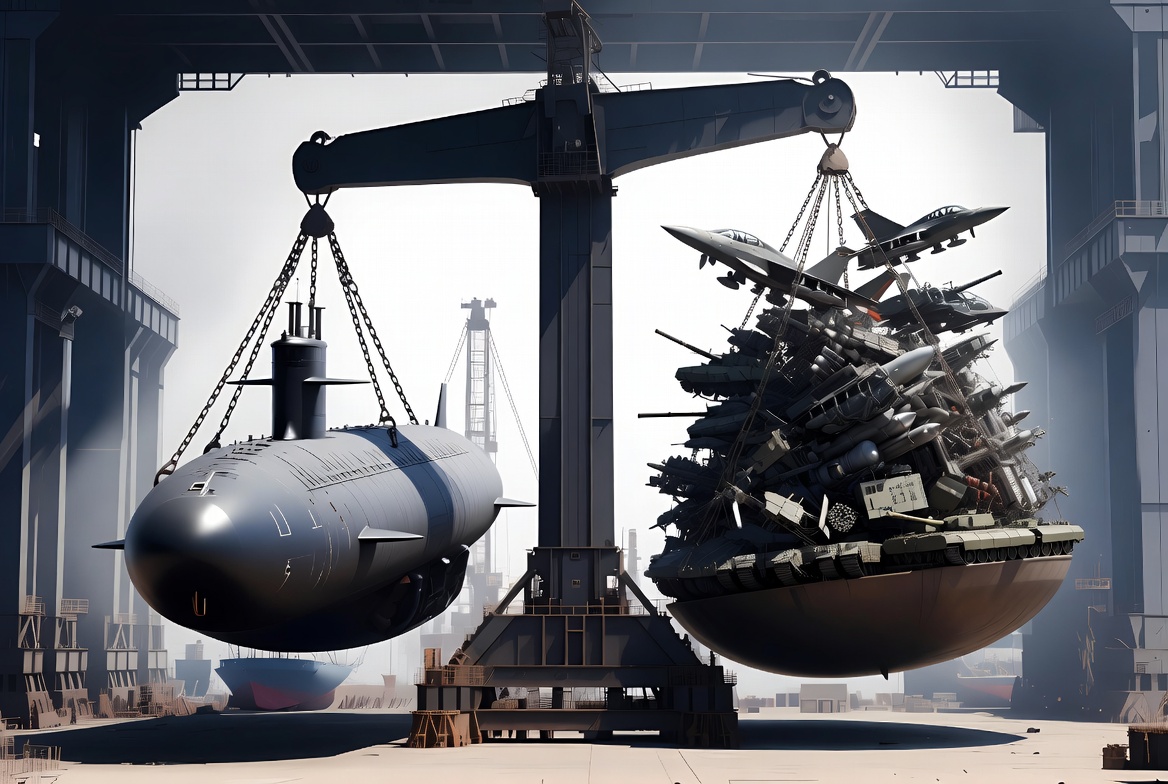
Three months ago, I asked how many American nuclear-powered submarines it would take to open the Strait of Hormuz. For the record, the US has around 52.
Some called this question ridiculous. It seems the point flew over their heads. Of course the question is ridiculous. That’s the whole point: that’s not what SSNs are designed to do.
Let me phrase this a little more obviously. How many submarines does it take to put out a bushfire? To fight crime? Treat cancer?
AUKUS will cost Australian taxpayers around $23,750 each. Every single Australian taxpayer has already sent $233 in non-refundable, untraceable donations to the UK and US to help their lagging submarine industrial bases. (For comparison, a new hospital costs taxpayers about $96 each).
So far, the donations haven’t helped. The US and UK submarine construction rates are slower than ever and the UK Secretary of Defence just resigned for lack of funding.
For all that, Australia may get two deployable submarines.
In the world of defence, nuclear powered attack submarines – SSNs – can do many things, but they can’t defend tankers against cheap drones, they can’t remove sea mines, they can’t provide air defence against ballistic missiles, they can’t seize and hold territory. Nor can they change the mind of insurance actuaries pricing risk into shipping premiums.
Of course they can’t. They’re submarines, not air defence batteries or mine warfare ships.
Even though American nuclear-powered submarines played an active role in the conflict with Iran, the US couldn’t field enough minehunters or adequate air defence munitions. Hence Iran was able to close one of the world’s most vital waterways for months and force the US into a deal widely seen to favour Tehran.
Similarly, Ukraine has used drones and strike weapons to force the Russian Navy to retreat from most of the Black Sea and even strike Russian tankers in the Mediterranean. Russia has around 41 nuclear-powered submarines. Ukraine has none.
You don’t need to be a naval expert to see the problem here. Nuclear submarines are designed for specific tasks. They can’t do everything.
So what can they do? Well, according to naval experts, they will locate and track adversary task groups that might threaten our sea lanes of communication, which carry 99 per cent of our trade. They will also collect intelligence, deploy and support special forces, and transit from Sydney to Perth in half the time of a conventional sub.
Great. Those sea lanes pass through a few narrow straits: Sunda, Lombok, Malacca, Vitiaz. If those look worryingly like Hormuz, that’s because they are.
How will our nuclear-powered submarines protect ships from sea mines laid in those straits? From long range sea drones or airborne strike weapons? From non-state actors firing missiles, as the Houthis do in the Red Sea?
The answer is they can’t, as we’ve all seen in the Middle East over the past few months.
Now I’m sure it would be wonderful to have new submarines that could transit from Sydney to Perth in half the time of a Collins class. It would also be wonderful to buy myself a Lamborghini that could do zero to sixty in 2.2 seconds, but it doesn’t make sense if I can’t drop the kids at school or even afford petrol.
(It would be especially egregious if I bought the Lambo without consulting anyone in my household, which is essentially how AUKUS came about).
The reality is that every dollar put into AUKUS must come from something else. We may get nuclear-powered submarines – and right now that’s a big maybe – but we will not have adequate air defences or minehunters. We will have fewer infantry fighting vehicles, fewer self-propelled howitzers, no sovereign wideband satellite communications, a smaller defence estate, lower sustainment budgets for aircraft, limited munition stocks, fewer anti-submarine warfare frigates, an inadequate fuel reserve. The list goes on.
Our defence budget is finite. Not only are SSNs limited against the capabilities employed by Iran or Ukraine, the cancellation of other acquisitions, delays to existing acquisitions and falling sustainment budgets are taking their toll on the rest of the defence force.
I’m sure maritime experts will provide the usual rebuttals: I don’t understand the intricacies of naval operations and the versatility of SSNs, nor do I have sufficient or relevant experience or expertise to make this argument.
At risk of overusing the metaphor, that’s like the Lamborghini dealer telling me I don’t understand cars or I’ve never driven a car quite like this one. Sure, but I do understand practicality and my own budget. It is also undemocratic to gatekeep the wisdom of AUKUS behind some requisite degree of naval expertise, or hide its material and opportunity costs behind the opacity of government.
Other common rebuttals: Hormuz and the seas around Ukraine are totally different and not at all comparable to our own geography; AUKUS is necessary to protect our trade and our national interests; it’s not about China, it’s about “a regional military power with the ability to threaten our trade at scale”.
Those points are either self-contradicting or simply repeat the government’s talking points.
As the government itself claims, AUKUS is the most complex endeavour Australia has ever undertaken as a nation. Every Australian should all be able to ask: is it worthwhile?