
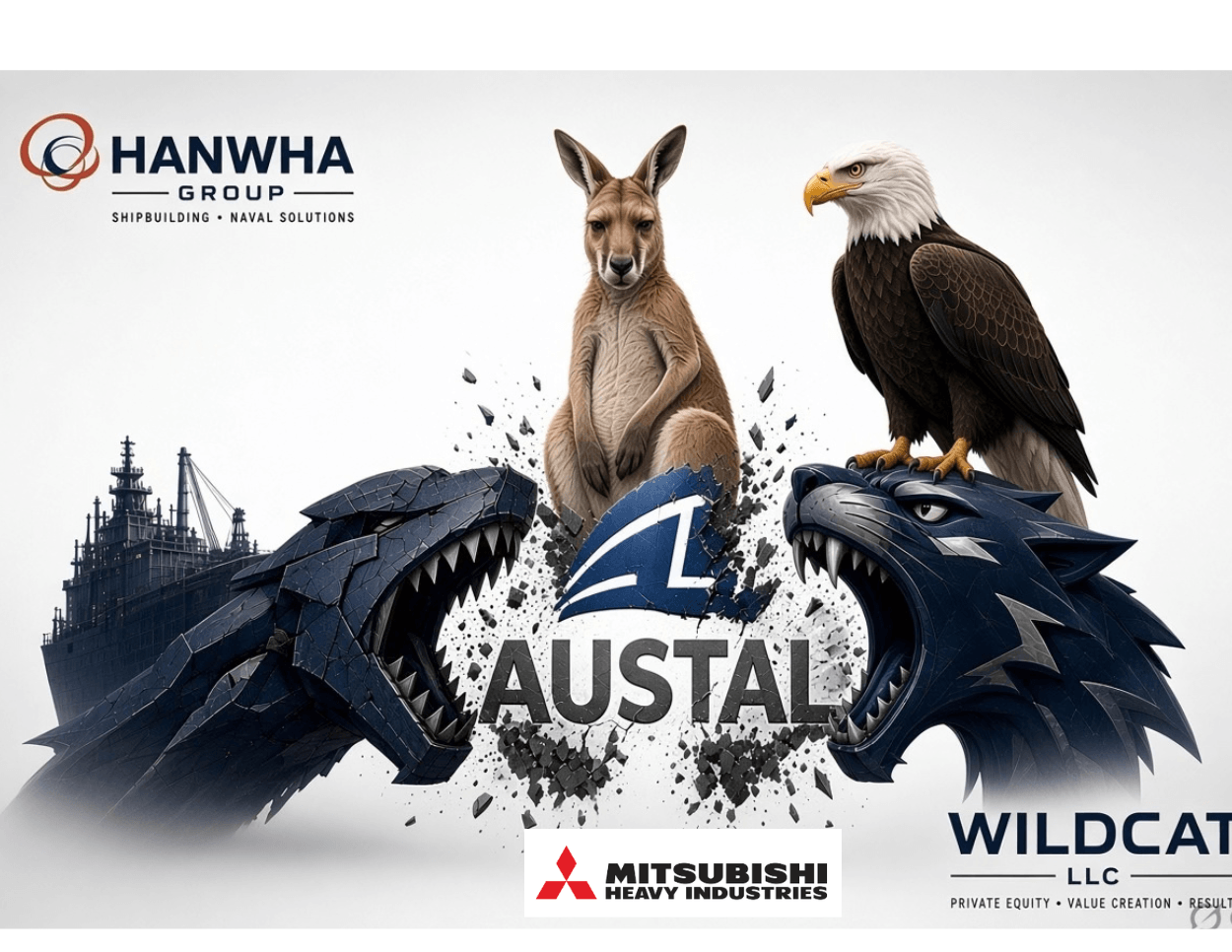
Who owns and controls Western Australian shipbuilder Austal matters to Australian, American, Japanese and South Korean national security. And there’s an arm wrestle that looks like turning into a mud wrestle over that question of ownership between Korea’s Hanwha Group and a low profile US private equity company, Wildcat.
Who cares who owns the private company that is Austal? Australian taxpayers should and so should ministers Richard Marles and Pat Conroy and the hard heads in the national security agencies. That’s because Austal is on the hook to deliver billions of dollars worth of vessels to our Navy and Army and is emerging as an important supplier to the US nuclear submarine builders that are central to AUKUS.
Austal is the Australian Government’s chosen strategic shipbuilding partner. Based in WA, the company has Defence order books running into next decade between the contracts to build 8 large and 18 medium ocean-going landing craft for the Australian Army (total value just over $5 billion), combined with its partnership with Japan’s Mitsubishi Heavy Industries in what looks like an at least $20 billion project to build 11 Mogami class frigates for the Navy.
The US Government cares too. Austal is also building modules for US Virginia and Columbia class nuclear submarines at its yard in Mobile, Alabama, along with other US Navy and US Coastguard contracts. Austal has had some challenges shifting to steel production in Alabama, with contract losses and construction delays affecting some of this US government work and putting pressure on Austal finances. Austal needs to not just deliver on its current US contracts but to recover fast and well. That’s because of the opportunity for the company to play a bigger role in a rebuilt US national shipbuilding sector for both surface ships and submarines, and potentially contribute to the long term AUKUS program.
This complicated picture got more tangled, though, with the breakthrough decision in 2025 by the Albanese Government to choose Japan’s Mogami frigate for the Australian Navy. That gave Tokyo a keen interest in who makes the decisions around the Austal boardroom and who inside the company sees what data, when, about Mitsubishi’s cutting edge Mogami frigate design.
Right now, Austal Limited is a publicly listed company that owns and controls both its Australian and US operations. Twiggy Forrest and South Korea’s Hanwha Group are its two major shareholders, Mr Forrest holding just over 19% of its shares, with Hanwha currently owning just under 10% but cleared by Treasurer Jim Chalmers last December to increase its holding to just under 20%.
On top of its Austal parent company holdings, in August Hanwha made a $1.7 billion bid to buy Austal’s US operations, based in Alabama.
A cashed up private equity firm, US-owned Wildcat Infrastructure LLC has now leaped into this crowded picture by launching a competing $1.87 billion buy out bid for Austal’s US operations.
What might the best outcome be for Australia – and America, Japan and South Korea – out of this 4 nation muddle?
Well, the Australian Army and Navy are relying on Austal’s Western Australian yard to build the landing craft fleets and the Australian-built part of the Mogami project. Canberra also has an interest in Austal US being successful in helping US nuclear sub builders Huntingtons and Electric Boat lift US sub production and help put AUKUS on a more secure path.
So, Australia’s interest is in whichever ownership structure makes program delivery smoothest. It was a surprise that Treasurer Chalmers waved the Hanwha share buy through last year, given the complexities this almost certainly creates around the Mogami program. In a way then, a US bid for Austal US might have the side benefit of letting Hanwha exit stage left from Austal and look for other paths to build its Australian presence.
Tokyo has to be concerned about the industrial security and intellectual property risks involved in the Austal-Mitsubishi tie up over the Mogami program. It’s hard to not see South Korea’s Hanwha’s boardroom presence as a negative for Tokyo, given the history of political and industrial rivalry with Seoul and South Korean companies.
Washington won’t care too much about the Australian Army’s landing craft, or even the commercial issues involved in Japan’s Mitsubishi Heavy Industries working with Austal given Austal’s Hanwha presence. But Washington does care – a lot – about the success of the shipbuilding Austal USA is doing for the US Navy and Coastguard, and has enormous stakes in the security and success of Austal as a supplier of nuclear submarine modules.
Seoul will almost certainly back Hanwha’s bid to not just increase its ownership stake in parent company Austal Limited, but to take over Austal US as part of the strategic push of South Korean firms into US shipbuilding in recent years. This push is both a commercial one and a highly political move given US President Trump’s drive to get South Korea and other allies to invest in ‘reshoring’ of US manufacturing capacity, and his Administration’s efforts to revitalise US shipbuilding.
Hanwha brings technical excellence to shipbuilding, which is an obvious benefit to Australia and the US. But naval programs, particularly nuclear submarine programs, are about more than just commercial and technical excellence.
No one is saying this out loud, so I will: the nuclear submarine work Austal is doing for the US Navy is probably a deal breaker for the South Korean bid. South Korea is a critical ally for America (and Australia) in our region because of its technological and military power and creativity and because of its location and history. But getting right into the heart of the most sensitive part of US undersea technology through buying into Virginian class and Columbia class module production is about a lot more than technical capacity
If Tokyo is a bit exercised by the industrial technological and security issues South Korea’s Hanwha brings to the Austal-Mitsubishi partnership, Washington — read the Pentagon — will be obsessed with whether or not now is the right time to bring a South Korean firm into the middle of America’s supply chain for its critical ballistic missile and attack class nuclear submarines. It’s one thing to have Donald Trump agree to South Korea building its own nuclear submarines (as he did late last year), but an entirely different thing to think about South Korea as a key supplier for US subs.
Summing this up, I’d expect the US Navy and the Pentagon to be very encouraging around Hanwha playing a growing role in US shipbuilding, but not even lukewarm about this starting with America’s nuclear submarines. And Canberra will get that memo at some point too.
That sounds all very neat, if a bit politically difficult given Hanwha’s Austral US bid, but the flip side of the Wildcat bid needs thinking through too.
Wildcat is a family-run firm, headed up by Eric Nicolaides. It makes long term investments in companies, instead of doing asset stripping that private equity got famous for. Public details on the firm are slim, however it’s focused on energy and infrastructure investments to date, so defence shipbuilding is a new business area for the company.
Being a US firm will make security issues around Austal USA’s nuclear submarine program simpler but not remove the need for a thorough security check into the company and its people. If that all checks out and it’s clear that Wildcat has the financial heft and long term intent to make Austal USA succeed and grow, then a green flag to their bid from the Pentagon could end the mud wrestle.
Right now, though, there’s more confusion than clarity around Austal’s ownership and operations. The bids have been good for the share price, but the outcome of this ownership tussle matters to 4 nations and 4 navies. Maybe the Pentagon will bring the clarity that Canberra hasn’t to Austal – and AUKUS.