
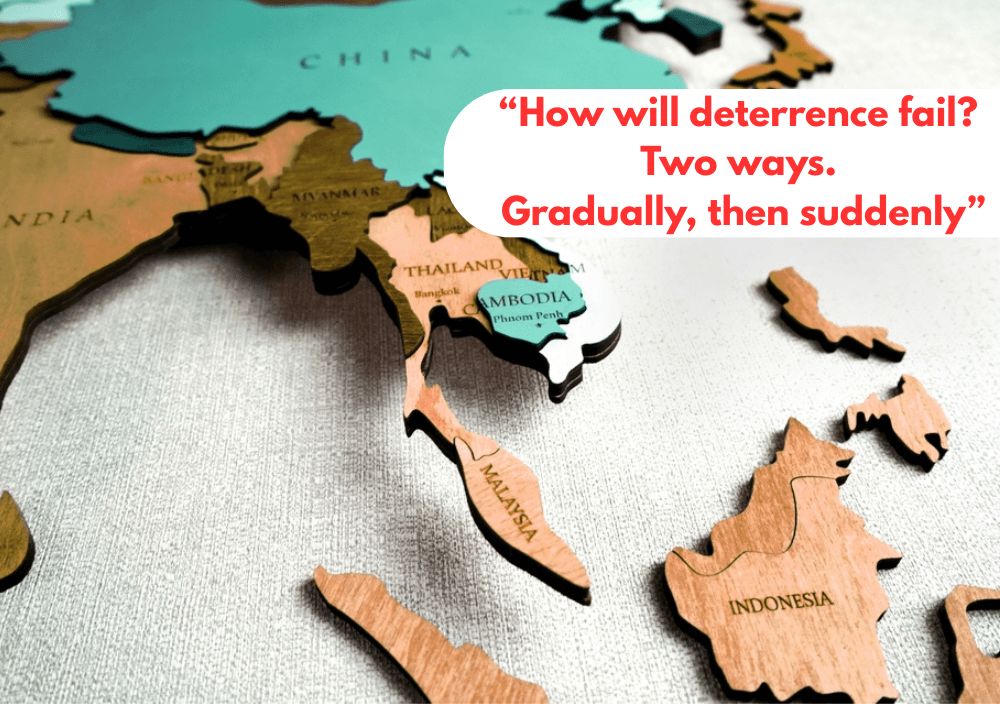
“The situation of our time
Surrounds us like a baffling crime.
There lies the body half-undressed,
Until the mystery is solved
And under lock and key the cause
That makes a nonsense of our laws.”
W.H.Auden, January 1, 1940
A mystery of our time is what the United States is doing to its role in Asia or Europe. The clues, though, are adding up.
Europe confronts the NATO heartache of the US as an ally that walks away from the alliance. See NATO’s dilemma in one line: “A deterrent based on someone who may not show up is no deterrent at all.”
Asia is further along the loss road, having seen the US concede the role of regional hegemon. G2 anyone?
Now Asia wonders if the future being delivered by Donald Trump is an America unwilling to play the role of THE balancer. Will the US even play merely as one among several balancers? As the MAGA tax drags at America’s surging economy, the MAGA mystery bothers and baffles Asia.
Zack Cooper crams a lot of the problem into the headline “Asia After America: How U.S. Strategy Failed—and Ceded the Advantage to China,” in his Foreign Affairs essay lamenting a “perpetually distracted” America assailed by a tsunami of self-doubt. As Washington’s economic and political engagement in Asia recedes, Cooper judges, “military deterrence is all that remains of US strategy in Asia. But the United States’ traditional approach to regional security, weakened as it has been, is increasingly courting danger.”
Cooper’s fear is that China will “pick off US allies and partners one by one. Many of these countries are already rethinking their alignment decisions and concluding that Beijing may be a more appealing partner—or an inevitable regional hegemon.”
A lot of rethinking is going on around here. The currents Cooper identifies—an America that must retrench–surged through the Shangri-La defence dialogue in Singapore, as Asian leaders struggled with the meaning of the times.
The keynote address was from To Lam, President of Vietnam and General-Secretary of the Communist Party, He identified three foundational crises:
- A crisis of international order: “rules are still invoked, yet their binding force erodes.”
- A crisis of development models: globalisation, trade and investment flows, technology diffusion and supply-chain integration as the engines of growth “are now under unprecedented strain.”
- A crisis of strategic trust: “a silent yet dangerous crisis because it causes states to interpret one another’s actions through the lens of mistrust and anxiety.”
To Lam’s answer was a traditional call for the centrality of the Association of Southeast Asian Nations. ASEAN could “functions as a framework for cooperation, dialogue and balance,” he said, to ensure that “competition does not slide into confrontation, that lines of connectivity do not become lines of division, and that one nation’s security does not become another’s insecurity.”
Neither China nor the US were named by Vietnam’s president, but he made this plea: “What the region seeks is neither the mere presence nor absence of any major power. What it seeks is responsible commitment. We recognise that competition is an enduring reality of international relations, but competition must be bounded by law, guided by transparency and exercised with restraint.”
By contrast, no ASEAN politeness from Gilberto Teodoro Jr, Defense Secretary of the Philippines, Speaking in a Shangri-La session on “a fragmenting world,” Teodoro attacked China with gusto. He noted that this year marks the tenth anniversary of the South China Sea Arbitral Award that gave an overwhelming judgement in favour of the Philippines, invalidated major elements of China’s expansive maritime claim, and threw out China’s “historic right” of sovereignty.
The Nine-Dash-Line was dashed in law, but in the decade since Beijing has kept dashing on in the South China Sea, seeking to draw new lines.
Teodoro said China’s “denial of the tribunal’s jurisdiction and validity of its award is contrary to international law. Instead of honouring their obligations under UNCLOS, the PRC exhorts the Philippines to ‘return to the path of negotiations’.” He said China uses a “talk and take strategy.” Beijing viewed negotiations not as “a path to conflict resolution but a means of gaining advantage. And we will not be deceived.”
The tone of the times at Shangri-La was met by a relatively measured speech from Pete Hegseth, the US Secretary of War. At the dialogue last year, Hegseth was a rampant hawk, notably casting aside strategic ambiguity to proclaim that America would go to war to stop China invading Taiwan: “If deterrence fails, we will be prepared to do what the Department of Defense does best—fight and win—decisively.”
That was last year. This year Hegseth may have switched the name of his Department from Defense to War, but he was in a less war-like mood. Hegseth made no mention of Taiwan. “US relations with China are better than they have been in many years,” he said. The language for allies and friends was sterner. No more military freeloaders leaving it to the US and much more burden-sharing.
The first question to Hegseth from Japan’s Defence Minister, Koizumi Shinjirō, praised the US speech as “strong, not quiet,” but pointed to Asia’s worries: “I safely feel the unwavering commitment by the United States. But sometimes I feel some countries might underestimate the US commitment. Can you give us the message to assure the region? And also, when tensions occur between allies and like-minded states, even tensions that are slight, there will be someone attempting to drive a wedge between us.”
Reassurance is asked for because faith in US commitment is shaken.
We are still much better placed than when Auden wrote his New Year Letter in the early months of World War 2. But today’s mysteries mean many would understand Auden’s bafflement at the crime of the times:
O “Who is trying to shield Whom?
Who left a hairpin in the room?
Who was the distant figure seen
Behaving oddly on the green?
Why did the watchdog never bark?
Why did the footsteps leave no mark?
Where were the servants at that hour?
How did a snake get in the tower?
Delayed in the democracies
By departmental vanities,
The rival sergeants run about
But more to squabble than find out…“
This is the final of Graeme Dobell’s four part series of reports for SAA on the Shangri-La defence dialogue held in Singapore by IISS.