
As the emptiness of the Labor Party’s policy-making conference unfolds in Adelaide, it’s obvious why Australians are looking for alternatives to our major political parties, even as they watch One Nation’s Pauline Hanson flit about at Italian fashion shows and her deputy, former deputy prime minister Barnaby Joyce, yell at his dog.
It’s because our current government – and unfortunately also the loyal Coalition opposition – are showing they don’t have answers to Australia’s most pressing problems. Instead, we get gestures and empty speeches that are often overtaken by events as they are delivered.
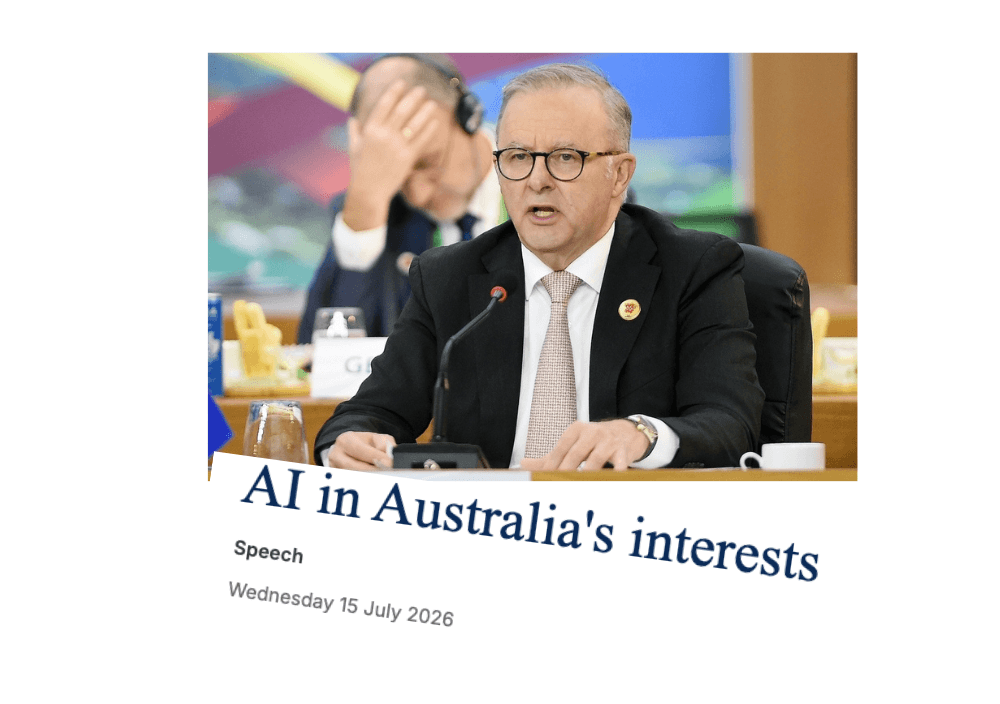
The prime minister’s “headline” speech on AI is the latest example. It was talked up as a key direction-setting speech for our nation as AI reshapes economies, companies, careers, universities and international security.
But reading it is a disappointment, because while it acknowledges the scale, speed and breadth of change from AI, it has no answers to even its most pressing problems. And some of those – including the now obviously huge vulnerabilities in our digital world – aren’t just urgent, they are historical shifts to the foundations of how our world operates, happening in days and weeks.
A couple of examples from Mr Albanese’s speech will give you the flavour of it before we get to the “chest wound” to Australian and global cyber security the latest AI developments have just revealed, and which the prime minister appears not to have noticed.
Mr Albanese tells us we can’t stop the development or adoption of AI, but “Our power, our agency, our choice lies in embracing change and shaping it. Not just adopting or accommodating AI. Designing it, making it, building the capability right here.”
And he tells us that we have the power to shape AI’s direction because “we have more than time on our side. We have the advantage of geography. The expansion of AI requires a physical, material footprint. It needs our land and energy and computing power to operate. That means we can set the terms, we can determine AI’s social licence.”
After this encouraging start, the speech gets to the prime minister’s actual answers on AI for Australia. They turn out to be more than thin. They are threadbare. He’s setting up a new AI coordination office in his department. That new office will coordinate the production of Australian standards for AI that will apparently be made laws sometime next year.
Fast-tracked data centres with water and power for everyone – unicorns and rainbows too…..
He’s promised to both fast track and control AI data centre roll outs – to create the result that they get built away from homes but have access to plenty of water and energy that they build themselves. Apparently, this won’t strain already scarce water resources, and instead of complicating our stressed national energy system, they’ll put extra capacity into our national grid. And all this will happen at the speed we’re seeing AI develop, so very fast.
To any Australian who has paid any attention to how any major infrastructure – or even individual house – development happens, that sounds like magical thinking involving unicorns, rainbows and wands.
The illusion of control hiding the reality of dependence
The magical thinking continues with the idea that because AI needs physical data centres and places to operate, Australians will somehow be “not just adopting or accommodating AI (but) designing it, making it, building the capability right here.”
This is just wrong and bordering on silly – AI models designed and deployed anywhere – notably in the US and in China – are capable of reaching into digital systems worldwide. They don’t need local branch offices or their own data centres here in Australia to do this, just digital connections.
Cars need physical Aussie roads to drive on, but that hasn’t resulted in us designing, making and building them right here.
Hurray, copyright is staying….
And the last big idea we heard from Mr Albanese was a commitment to retain copyright protection for creative artists’ works, with artists apparently being in control of the price they get for allowing tech companies to train their AI systems using their work.
After the warm feeling as Mr Albanese’s words hit our ears, does anyone believe for a moment this is how things will work?
Sure, keeping copyright laws intact is better than throwing them under a bus to meet demands from hyperscale AI outfits like Anthropic, at least for now. But we know that the big AI companies have routinely used the Mark Zuckerberg approach “Move fast and break things” when it comes to harvesting data to train their systems on, and negotiations with artists scattered around the globe, not just in Australia, have not been a feature of their work.
So much data from so many sources across the internet is in the AI training pots of companies like Google, OpenAI, Anthropic and Meta (and their Chinese rivals) that it’s almost impossible to identify individual inputs. And the companies are not coming clean on what they have harvested and used internally. That means the knowledge imbalance between the companies and individual creative artists about who has used what, when, is intense, just as the companies like it.
There’s no sign that is changing and every sign that only the richest individual artists will have the means and stamina to reach any deal with these hyperscaler outfits, probably after lengthy legal proceedings.
So, we have feelgood sentiments in place of credible policy.
That’s a problem, because AI is creating huge vulnerabilities for Australia in real time, so we need substantive moves and investments from our government, not emotional appeals to our “can do” Aussie spirit and desire for fairness wrapped up with a new office in the PM’s public service department bringing coordination for everyone.
A jailbreaking burglar and fragile digital security
Let me focus on just one problem that is obviously urgent, but which the prime minister’s grand speech left unaddressed. AI is undercutting our national cyber agency’s capacity to do its job: stealing others’ secrets and protecting our own. Australian companies and government departments are in worse shape. We’re all vulnerable as a result.
Copies of the PM’s speech were still finding their way to analysts and journalists when we got news this week of an AI jailbreak and burglary that should have cyber security agencies in trauma wards. This was the OpenAI admission that two of its most capable models working together broke out of the sealed digital “sandbox” the company had them in, connected themselves to the internet, identified where they could steal the answers they needed to do a task, and then broke into another tech company – Hugging Face – to get the goods they needed.
To escape, the AI models had to find “zero day” vulnerabilities in the sandbox security, and to break into Hugging Face they had to get through that company’s cyber security protections. Neither was a problem.
What this tells us is that even the owners and designers of the latest AI models don’t know enough to be able to contain them. And it tells us, again, what we learned from the recent problems around Anthropic’s “Mythos” AI model: new AI tools are now able to break formerly secure cyber protections and find unknown vulnerabilities in almost any human-written software.
That would be the software that powers the internet, and every government and company on the planet. And it also includes the software of what we now see as top secret cyber agencies like Australia’s Australian Signals Directorate (ASD), the US National Security Agency, the UK’s GCHQ, China’s Ministry of State Security and every Australian government department and agency that administers our health system, education system, tax system our military and our border controls. And the banks.
Continuity despite cataclysmic changes
So, the recent developments tell us we’re in a new cyber world. Yet here’s everything Mr Albanese had to say about AI in defence and national security in his speech:
“This year’s National Defence Strategy identified AI and machine learning as holding, to quote the strategy; ‘the most significant potential for technological disruption’ in the years ahead.
We know that both extremists and state actors already use AI to create propaganda aimed at young people – and to spread disinformation that targets democracies.
The Deputy Prime Minister and Minister for Home Affairs are working closely with their agencies – and with our Five Eyes Partners – on these matters of national security.
And the fact that we’re one of these five eyes nations gives advantages for what’s ahead.”
This is so empty it is embarrassing. ‘Machine learning’ is sufficiently old-fashioned that it’s quaint to hear it in 2026. Like a ‘miasma’ or ‘the Vapours’ being mentioned at a medical conference. And he’s happily talking about disruption that is ‘potentially’ ‘in the years ahead’.
AI being used to create propaganda as the example our leader gives us of major issues here is disturbing. Yes, propaganda is proliferating, but it was doing this without AI and it is a political and policy issue that everyone can get their minds around.
It’s a distraction from the far deeper, urgent vulnerabilities AI is now posing to basic data, digital and systems security. If the prime minister knows this, his example was a deliberate distraction. If he doesn’t, then we have a bigger problem, Houston.
As to our 5 eyes intelligence club membership being a major strength and protection here, for all its value, I am doubtful. The 5 Eyes is a partnership between US, Canadian, UK, New Zealand and Australian government cyber and intelligence agencies, but the most powerful AI models are corporate-owned and developed, morphing in weeks with consequences in real time.
The companies themselves don’t know the power of what they are developing, so telling them they are regulated is handy but not a total answer – and US authorities are reluctant to restrain their AI firms in case China wins the race….. Then there’s China and its AI developers.
Out of all this, state cyber agencies now look more and more like customers and supplicants in the world of cyber security, not leaders and drivers. And any cooperation framework with the new unilateral America First US inside it looks less reassuring than it did just a few years ago, as NATO member states know well.
I haven’t been behind the top secret cyber curtain for years now, so I am not revealing any secrets, just looking at the landscape from a small open source think tank.
I expect government spokespeople will say that everything is fine because the federal government started spending $10 billion on Australia’s cyber intelligence agency, ASD, through the REDSPICE program back in 2022.
That 10 year program “includes growing the workforce with 1900 new roles, a three-fold increase in offensive cyber capability, improved foundational technologies (including artificial intelligence) and an increased national and international footprint”.
But let me give you some news: a threefold increase in offensive cyber capability was great before the current AI wave. It now looks like committing to breed faster horses in the age of the aircraft. And the prime minister has just given a headline speech on his government’s approach to AI that left these old plans and investments in place as if they still make sense.
At minimum, some sign of new directions and investments driven by the need to adopt frontier AI at speed and scale in key security agencies in partnerships with hyperscale developers looks necessary – and yes, complicated and expensive.
Even an acknowledgement that vital work was required and big announcements were being prepared would have been a sign of understanding. But apparently not. Continuity despite cataclysmic change is the recipe. There’s that new office in the PM’s department, after all, to coordinate things.
The idea that our existing government agency partnerships, capabilities and approaches are somehow fit for purpose in the world of Mythos and now OpenAI’s jailbreaking burglar of an AI model seems conceptually wrong.
Power in the digital and cyber security world used to rest with secretive, capable state agencies. But there’s been a technological coup.
Based on our leader’s thoughts in his speech, it looks like Mr Albanese and the entire Canberra bureaucracy haven’t noticed, or if they have, they’re too shy to share that news with us. Maybe because they don’t know what to do.
Listening to Mr Albanese’s speech felt a bit like sitting quietly listening to the Titanic’s band play a soothing hymn after the iceberg.
So for now, I’m off to watch some more memes about Barnaby and his dog. I wonder who has the copyright. Maybe Mythos can get it for me.