
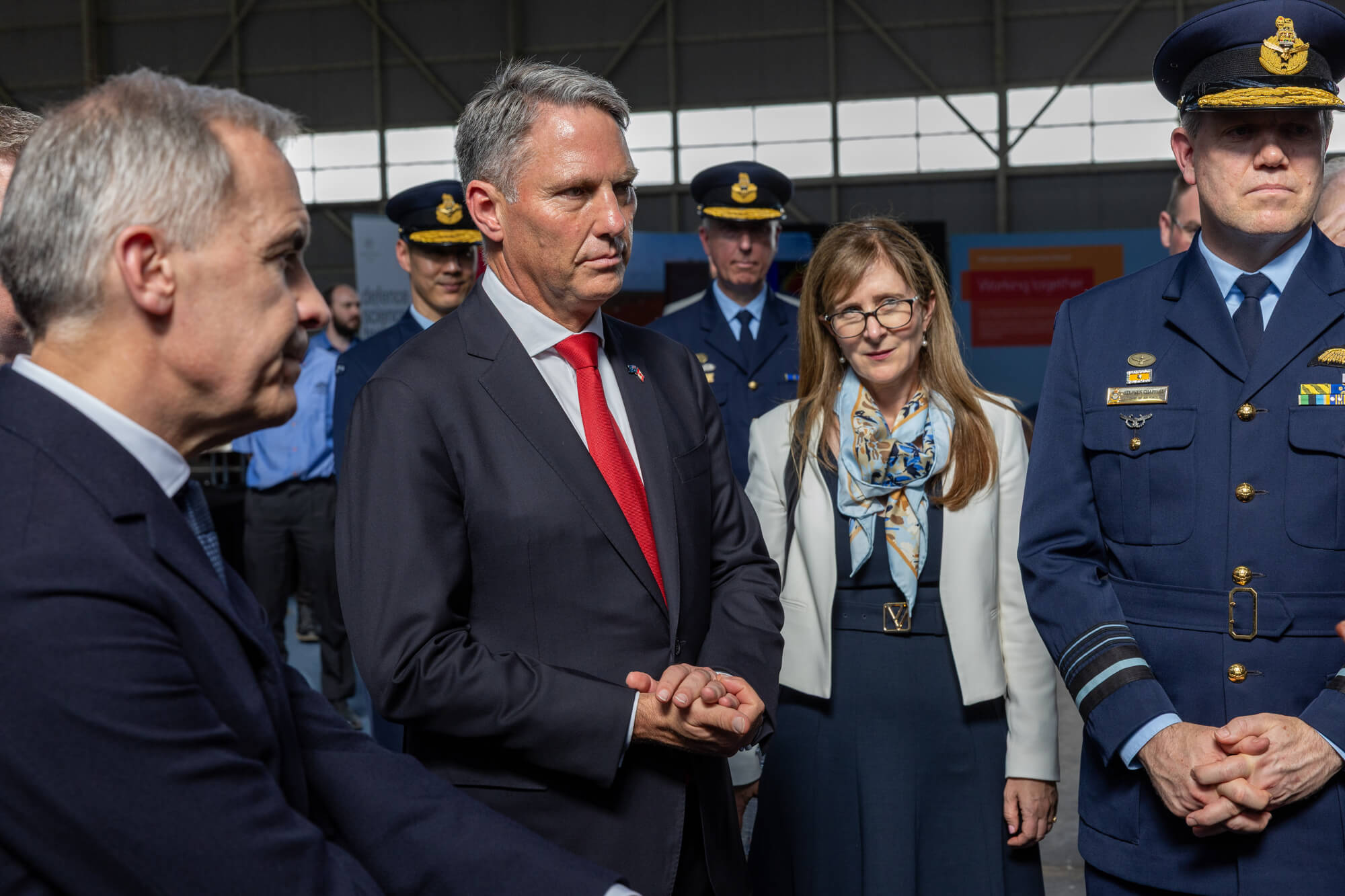
There’s something very familiar about the Albanese government’s new 2026 National Defence Strategy, launched yesterday by Deputy Prime Minister and Defence Minister Richard Marles. It continues the trajectory first set out in the previous Coalition government’s 2020 Defence Strategic Update that our strategic circumstances are declining, the world is becoming more uncertain and armed conflict is more prevalent.
Each high-level defence policy document since then—the 2023 Defence Strategic Review, the 2024 National Defence Strategy, and now the updated NDS—has stated that things have gotten worse since the previous one. The new NDS assesses that, ‘the deteriorating trends in our strategic environment that were identified in the 2024 NDS have broadened and intensified… We have entered a more dangerous and unpredictable era.’
However, like previous strategic assessments, this one does not raise the possibility that our great and powerful friend, the United States, may itself be contributing to that unpredictability. Indeed, it was a suggestion that Mr Marles refused to entertain in the Q&A after his speech. And the NDS intones the traditional view that, ‘the United States is our closest ally and principal strategic partner. Our Alliance [with a capital ‘A’] contributes to the peace and stability of the region.’
Mr Marles also refused to concede that the rules-based global order was beyond salvage—although his NDS is less optimistic, stating the global order is in transition with the coming decade ‘likely to be defined more by fracture, rivalry and disorder.’
Overall, the Albanese government, in public at least, has not had its Carney moment.
The response to growing threats, in the Albanese government’s world view, is to help the US, particularly in balancing the growth of China’s power. We need to do more to contribute to ‘collective defence.’
Here too, there is a sense of the familiar in the 2026 NDS. The steady but not spectacular upwards trajectory in the defence budget continues with a further $14 billion over the four years of the forward estimates and $53 billion over the next decade beyond the funding line set out in the 2024 NDS, which was itself an increase over the funding line left by the Coalition government.
Certainly at a time when the effects of the current fuel crisis are giving Treasurer Jim Chalmers a major headache, the fact that defence funding has not only been preserved but increased is a win. Credit where credit is due.
Nevertheless, there seems to be some creative accounting going on here. Let’s take 2028-29 as an example. The government claims that it has now increased defence funding by $9.1 billion for that year to $73.3 billion. But the Coalition’s Defence Strategic Update planned $70.0 billion for that year, suggesting an increase of only $3.3 billion.
Putting perplexing details like these aside, the real question is whether the government is spending enough. Here again is another familiar feature; despite the repeated warnings of increasing uncertainty and danger, the growth trajectory of the defence budget is still relatively flat as a percentage of GDP. The defence budget has stagnated between 1.9 and 2.1 percent of GDP for nine years. Since the major injections of ‘new’ funding is still several years away, we won’t get beyond that band for another two years. There is still a lack of urgency.
We should however acknowledge the government’s impressive sleight of hand in distracting us from this. It now says that according to NATO’s definition of defence spending, Australia is actually at 2.8 percent of GDP, not the much humbler 2.08% produced by our traditional way of counting. Since the government hasn’t said what’s included in that new figure, it’s impossible to confirm. But by our boring old method, progress remains slow.
There are more familiar features when we look at what the money is being spent on. The insatiable demands of the AUKUS nuclear-powered submarine program continue to grow. It’s already at $3.9 billion this year, at least six years before we get the first submarine. However the NDS’s planned spending over the coming decade is now estimated to be $71-96 billion. At that rate that one single program will hit $10 billion a year by the early 2030s.
The flip side of this rapid growth is the continued lethargic increase in spending on ‘the small, the small, and the many’—the cheap, disposable drones that have become a core feature of conflict over recent years. Combined they are only getting $2.2-3.1 billion over the decade, around one-thirtieth of the submarine program alone. Surely the time has come for a more fundamental rebalancing between the exquisite crewed systems that still dominate the government’s spending plans and the mass-producible systems that dominate battlefields around the world?
Finally, in a truly bizarre decision, air and missile defence was cut from the previous NDS. The folly of that has been exposed by wars in the Ukraine and the Middle East where actors without capable air defence suffer massive losses. Fortunately, that capability has been restored in the latest NDS. Hopefully Defence will pursue its acquisition with more urgency than characterises much of the strategic thinking on display here.
This article was first published in The Australian.