
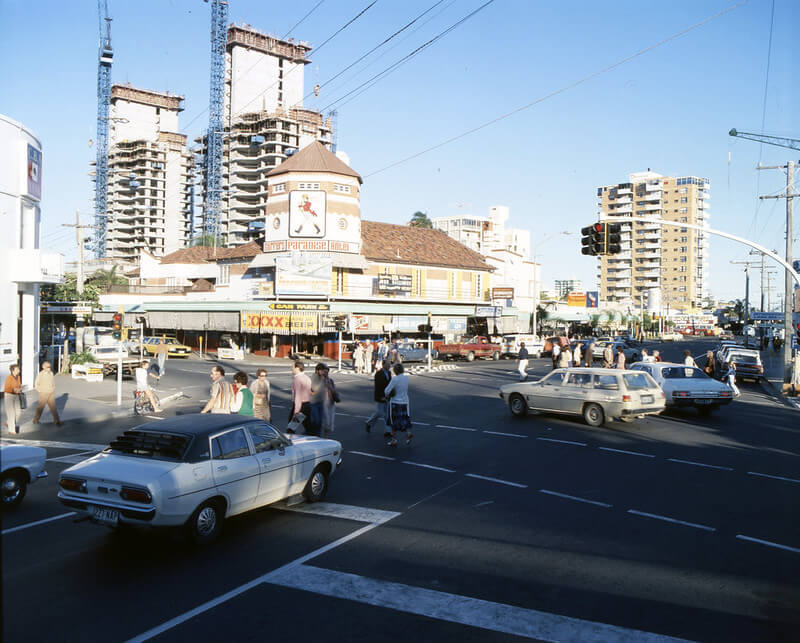
When Australia had something like a monoculture, it rested on a firm foundation.
Trouble was, that foundation was racist, even if that old culture wasn’t truly mono, whatever its monotony.
You have to dig deep to find any mention of a “monoculture” in the politics of the Australian Commonwealth. The headline term—widely used and easily understood—was “White Australia.”
Pauline Hanson’s call for monoculture is rooted in the relative uniformity of the White Australia era. Hanson attacks “the utterly flawed policy of multiculturalism,” saying Australia is “multiracial” but should be “monocultural.”
The difference Hanson draws between multiracial and multicultural is strange semantics as an attack weapon. Amid her confusion, though, lurks fascinating change.
What’s surprising is how Hanson’s demonising of multiculturalism quickly turned into a pothole for the Liberal leader, Angus Taylor. He dodged the monoculture confusion—be it rabbit hole or black hole—but had trouble embracing multiculturalism, displaying a poor grasp of a proud Liberal achievement.
Hesitation never suited former Liberal Prime Minister Tony Abbott, and he is typically forceful now in arguing that “multiculturalism has failed, and diversity is not our strength.”
Abbott doesn’t fall for the monoculture mirage, but worries Australia is changing too fast rather than evolving smoothly: “For many years, migrants to Australia were expected to integrate from day one and to assimilate as soon as possible. But lately, under the doctrine of multiculturalism, migrants have been encouraged to keep their culture. Indeed, the old view, that migrants should be grateful for gaining a better life in Australia, has become: Australians should be grateful that migrants have given us a more diverse society.”
Hanson’s monoculture demand, Taylor’s writhing and Abbott’s lament are arguments about what Australia was and what it has become. Those who don’t remember the complexity of their history are more likely to distort it than repeat it.
The monoculture idea is a mirage, projected on the Australia that was formed in 1901 and existed to the 1960s and 70s. The international face of that nation was White Australia; no mirage there. The sign on our front door read, “Whites only.” Australia entered the 20th century so determined to be white that even Aborigines were expected to die out. White Australia was racist in theory and practice. Colour mattered. Discrimination expressed a deep consensus. The policy was enforced with brutal consistency.
White Australia was a mix of racial prejudice, economic self-interest and geographic fear. The language of racial contamination mixed with the dread of cheap Asian labour and military conquest, a potent mix which patterns our history.
The domestic culture of those decades, though, was far from “mono,” with its dictionary meaning of “one, single, only.”
White Australia was monochrome but suffered a deep sectarian division. The differences between Catholics and Protestants ran through politics and everyday life, from government departments to the Australian cricket team. The religious taunts of the school ground—Proddie dogs versus Catholic frogs—echoed through the society.
The most bitter political battle in our history—the unsuccessful conscription referendums of World War 1—was fought across the religious schism. The Catholic Archbishop Daniel Mannix led the opposition against conscription, making him what the Australian Dictionary of Biography judged “the most revered and reviled figure in Australian history.” The Protestant attack was that Mannix showed how Papists and Irish Catholics could not be trusted to fight for King and country. Mannix also played a leading role in the great Labor split of 1955, which kept the party out of office for a generation; Catholics in Labor had to choose between their church and party.
Even the Anglican side of sectarian Australia was far from mono, woven from Puritanism, Anglo-Catholicism, Celtic mysticism, Evangelicalism, Christian Socialism, and fed by streams from other doctrines.
The fading passions of the sectarian divide coincided with the moment when Australia made a fundamental policy shift, to kill the White Australia policy. We turned towards racial equality and multiculturalism.
The process began quietly as administrative change under Liberal Prime Minister Harold Holt, in 1966, and then was proclaimed loudly by Labor’s Gough Whitlam, from 1972. A momentous swing of the policy wheel was done in well under a decade, and Australia sailed smoothly on a different course.
Holt and Whitlam overturned the discriminatory principles of one of the first laws of the Commonwealth Parliament, the Immigration Restriction Act 1901. Abandoning the monochrome saved Australia from being thrown into the international tumbril that came for South Africa’s apartheid regime.
Deposing Whitlam in 1975, Malcolm Fraser picked up the multicultural banner as a powerful expression of Australian identity. That has been the consistent view of Australia’s leaders ever since. Releasing a Multicultural Statement in 2017,Malcolm Turnbull declared: “Australia is the most successful multicultural society in the world.”
The Labor and Liberal parties can claim equal ownership of the end to our racist policies, replaced with a non-discriminatory immigration system.
Seldom do nations so quickly cut away a central element of their history to go in the opposite direction. Australia would become colour-blind in selecting its new citizens, interring discrimination. From trade policy to race, the culture of protection and exclusion expired.
The push-and-pull in multicultural Australia became about broader ideas. The policy axis from assimilation to acceptance intersects with the line running from integration to individual choice.
The simple proposition that modern Australia is a nation of migrants has many meanings. White Australia is dead; but questions from that era persisted. How is Australian identity to be achieved or expressed? Part of the old answer was “assimilation.”
In the 1960s, assimilation was under attack from the post-war generations of migrants and their children, but also from indigenous Australians. Public policy for Aborigines was overtly assimilationist. If indigenous Australians were not disappearing as a race, as earlier policy had assumed, then they would be absorbed into the broader society.
In the 1970s, the melting pot of assimilation was dropped as a policy prescription for the original Australians and new Australians. Yet the attempt to replace assimilation with multiculturalism is still fraught.
Fraser nominated the growth of genuine multiculturalism as one of the greatest achievements of his government. Pride in his Scottish ancestry, Fraser said, had never weakened his feelings for Australia. At the opening of the Special Broadcasting Service in 1980, he declared: “We used to have a view that to really be a good Australian, to love Australia, you almost had to cut your links with the country of origin. But I do not think that is right and it never was right.” Multiculturalism, Fraser judged, could be a force for understanding and unity.
Migration flows followed the multicultural maxim. By 1984, the Asian intake overtook migration from Europe.
In 1988, parliament received a report on immigration from a committee headed by Professor Stephen FitzGerald, the academic who was Australia’s first ambassador to China. Many of its findings echo today.
FitzGerald called for a coherent philosophy which showed how immigration gave economic and social benefits, and contributed “to a culturally enriched Australia, to openness, tolerance and sophistication, to economic independence, to creativity, and to a racially diverse, harmonious community.”
But this was not the way many Australians saw immigration, FitzGerald found. Instead, public support was wavering and consensus was at risk: “Community attitudes to immigration, even those of its many supporters, reflect confusion, anxiety, criticism and scepticism.” Immigration was highly political, even volatile, because it was about change to the society and to personal worlds.
Australia, though, had done extremely well in managing this change. Despite Asian immigration there had been no race riots, no disruption to social cohesion and harmony, FitzGerald reported: “The extraordinary capacity of Australia to take in large numbers of people from different cultural and ethnic backgrounds and new source countries is not given sufficient credit. On this issue, it really ought to be cause for self-congratulation, not self-doubt.”
FitzGerald pondered the directness and creativity of Australian language as an asset for immigration. The word “ethnic” was both an honourable adjective and a pejorative noun, while “Anglo” could be an insult to a fifth generation republican Australian. The dynamic of Australian speech meant only context and inflection determined whether “bastard” was an expression of hate or love.
Only in Australia would you find an official report – presented to the minister and tabled in parliament – which gently touches on the light and shade of “bastard” in discussing the vocabulary of immigration. Surely any bastard would have to concede this as evidence of a distinct and vigorous Australian culture!
One other great bit of Oz speech, I submit, goes to the heart of our multiculturalism. The idea of a “fair go.”
This wide brown land of far horizons understands the blessing of a “fair to middling” result, while always demanding a “fair suck of the sauce bottle.” After all, “fair’s fair.” The fair go is about what’s just, reasonable and equitable.
The fair go ethos flows through the principles of an agenda for a multicultural Australia endorsed by the Hawke government in 1989. The three dimensions were cultural, social and economic:
Cultural identity: the right of all Australians, “within carefully defined limits,” to express and share their individual cultural heritage, including their language and religion.
Social justice: the right to equality of treatment and opportunity, and the removal of barriers of race, ethnicity, culture, religion, language or gender.
Economic efficiency: the need to use all skills and talents, regardless of people’s background.
The agenda put an equal emphasis on the obligations and limits of multiculturalism, calling for “an overriding and unifying commitment to Australia, to its interests and future, first and foremost.”
Being an Australian meant accepting the basic structures and principles of the society – the constitution, rule of law, tolerance and equality, Parliamentary democracy, freedom of speech and religion and English as the national language. The right to express your own culture and beliefs involved a reciprocal responsibility to accept the right of others to express their views and values.
Seldom do public pronouncements so clearly point to the conceptual struggles writhing beneath the policy blanket.
Multiculturalism must be defined and limited by a commitment to Australian norms. Yet all the government pronouncements on multiculturalism over the decades show an Australia becoming more relaxed about diversity and difference, stressing not culture or race but institutions and principles—and many different people. The harmony of the nation no longer rests on race and cultural conformity.
Multiculturalism has fared well in the land of the fair go.