
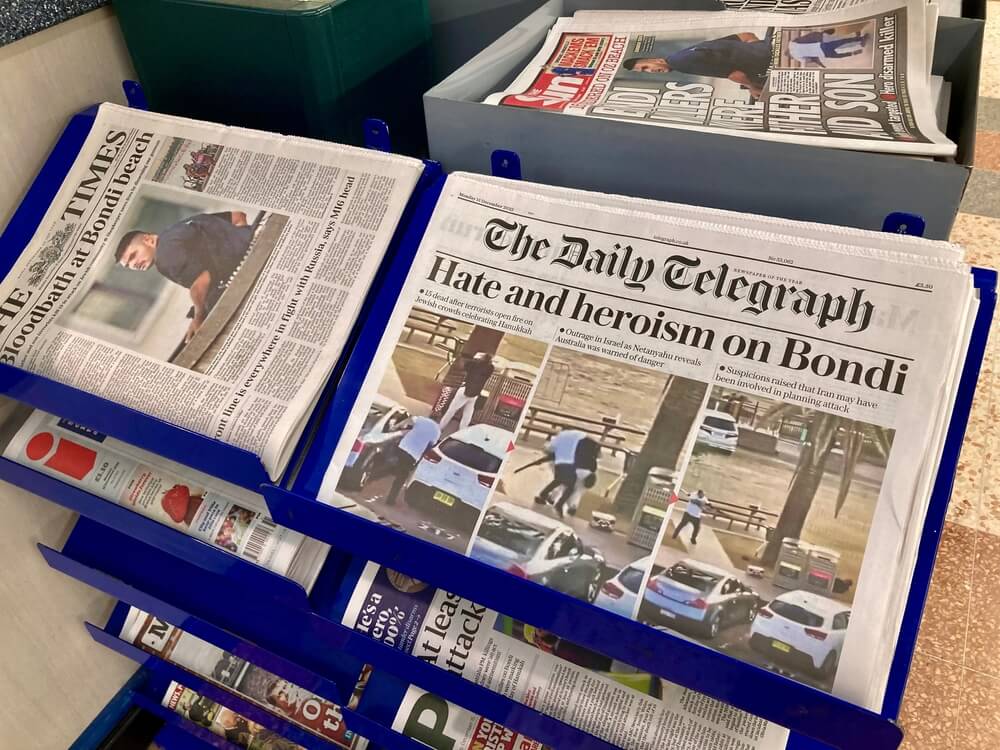
Royal Commissioner Virginia Bell faces her first test on Thursday with the reception of her interim report on the horrific Bondi shootings. It’ll have been a rushed effort to get the core information needed to deliver this first report by the April 30 deadline. That’s because Prime Minister Albanese only bowed to public pressure to set up the inquiry on January 8. Even then, the prime minister insisted on trying to fold his earlier, in-house look at the events by former mandarin Dennis Richardson into the royal commission.
That political face-saver went wrong after it became obvious the type of insider look Richardson was leading didn’t fit with the more formal, forensic approach of a royal commission. And perhaps the senior mandarin found not being the boss a bit difficult too, who can tell? Richardson quit very publicly, giving a series of interviews that ventilated his views as well as telling the public just how much it costs to get a former senior public servant out of bed to review stuff – $5500 a day is the going rate, it seems.
What have we lost without the Richardson report? Well, as a trusted insider in the Canberra machine, he was well-placed to quickly get hold of necessary information, partly because he might know where to look. And an internal classified report would have had cooperation from officials without them worrying about potential legal liability or risks to reputation that public hearings might bring.
So, he could have rapidly made recommendations about things like security at Jewish places of worship and schools, and maybe pointed to cracks and shortfalls in more blunt and abrupt ways than a Royal Commission might. What was done and not done to look at threats domestically, given the ripple effects globally from the 7 October 2023 Hamas atrocities is an obvious area of interest. But even the most capable insider would necessarily bring a bunch of their own prejudices and assumptions to the work. And a closely held internal report would not have generated the public trust that an open Royal Commission can.
What can we expect from Commissioner Bell’s report? We know it’s going to focus on only one of the four priority areas set out in the Letters Patent that established it: the “circumstances surrounding the antisemitic Bondi terrorist attack on 14 December 2025”.
That’s the ground around how the attackers managed to prepare, plan, train, acquire weapons, including alleged travel to the Southern Philippines to train with extremist Islamist groups there – all without flagging the interest of state or commonwealth police or intelligence agencies.
There’ve been no public hearings yet, so Commissioner Bell will have relied heavily on documentation produced by NSW and federal agencies responding to notices from her. It means whatever is in this interim report won’t be her final word. More will be discovered and assessed as the commission runs hearings and data and issues come to light.
But some meaty and maybe even controversial observations have probably found their way to the printer in the last few days. We’ll be reading them around midday on Thursday.
One finding that seems hard to avoid is that our collected state and federal security agencies failed in plain sight at Bondi beach on December 14 and 15 Australians died as a result. Of course, the only criminals (apart from any accomplices who remain unknown) were the alleged murderers on the beach that day. No one should expect the inquiry to find any lack of diligence or hard work from security officials.
However, the two alleged killers included a son who had come to the notice of ASIO a few years ago and so was a known name connected to Islamist extremism, however indirectly. And the father had recently been granted a firearms licence and then bought additional firearms, including high-powered shotguns. Lastly, the father and son had travelled to the Southern Philippines apparently without family – and the Southern Philippines is better known as a terrorist training hotspot than a vibrant tourist destination for single men.
Commissioner Bell will be careful to not produce any material that might prejudice the criminal trial of Naveed Akram. But that shouldn’t stop her from identifying important gaps in the state and federal approaches to counter terrorism that must be closed. It’s hard to believe that the cooperation between the NSW police, the federal police and ASIO was seamless and successful on everything that may have helped identify and interrupt the attackers.
Key pieces of underlying work don’t seem to require legions of people in dark coats with intrusive surveillance warrants and interception equipment. ASIO must keep a database on Australians with links to extremist groups. The NSW Police keep a firearms register of owners and should know when new purchases are made. Customs and immigration authorities get travel data from people leaving and entering the country, including if they are travelling to or from somewhere like, say, the Southern Philippines.
So, this looks more like a problem about three standard government datasets being kept in good shape and connected in ways the public would expect to be automated, even before AI came along. When the same names pop up in them, that should cause some interest to be taken to see what the dots might be connecting.
Of course, all of that would only have provided the seed information for investigative work. No doubt NSW and federal officials get a lot of false alarms, and hindsight gives clarity that the messy real world simply does not.
So, the inquiry might also already have a view on the relative resourcing and priority that’s being given to preventative counter terrorism work at the state level and in Canberra. Given ASIO boss Mike Burgess’ public statements about the rising problems of counter espionage and countering foreign interference, along with cybercrime, it’s reasonable to expect Commissioner Bell to have some thoughts about whether the counter terrorism focus has been diluted or muted within particular agencies.
The good news is that royal commissions tend to employ fiercely forensic minds – the highly effective Hope Royal Commissions into our intelligence agencies are a good example. They don’t have vested interests in anything but following the trail of evidence to whatever conclusions it produces. Senior egos in state and federal agencies don’t matter much – as former Treasury head turned bank board chair Ken Henry found when he was devastatingly cross-examined by a senior counsel during the banking Royal Commission.
If Virgina Bell’s interim report shows some of this fierce independence and clear judgement, we’ll know it is on the right track. And we should then expect a more rigorous, detailed and useful final report – along with some fiery and contested hearings. If all this results in a safer, more respectful and tolerant Australia, we will all be glad Mr Albanese found the courage to establish this royal commission.
A version of this article was first published in The Australian.