
The 2026-27 Defence Portfolio Budget Statements (PBS) are a very strange document. In fact, we’ve never seen anything quite like it. There are a couple of reasons for that.
The first is the paradox that in an age of increasing defence budgets, funding actually goes down in 2026-27 from 2025-26.
The second is that it manages to make the 2026 Defence Strategy’s $14 billion funding increase over the four years of the forward estimates, well — and this is a little awkward — disappear….
So let’s unpack this extraordinary document. As always, our apologies for all the numbers, but it’s hard to talk about numbers without actually mentioning some numbers.
The planned defence budget does go down from 2025-26 to 2026-27, from $63,243.9 million to $62,595 million. That’s a decrease of around 1% in nominal terms and 3.5% in real terms. It’s the first nominal decrease since 2012-13, when the Gillard government cut the defence budget in an ultimately vain attempt to get the budget back into surplus in the wake of the global financial crisis (Ah, surpluses. Remember surpluses?).
But the reason for that decrease, is not (primarily) because funding for 2026-27 has been cut. It’s because money has been brought forward from later years and pumped into 2025-26, making that year much bigger than had originally been planned in the 2025-26 budget just a year ago.
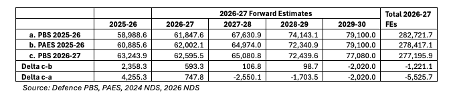
We got a first inkling of this reprofiling in the mid-year budget update, the 2025-26 Portfolio Additional Estimates Statements (PAES), but the new PBS moves another big tranche of money forward into the current year’s spend. The result is that the 2025-26 budget has grown over the course of the year by nearly $4.3 billion, from $59.0 billion to the $63.2 billion figure above. See Table 1 below.
Table 1: Comparison of Defence portfolio funding lines
That’s propelled defence spending to 2.13% of GDP in 2025-26, the highest percentage since 1992-93 after which governments of both persuasions started to harvest the post-Cold War peace dividend. Since we are traditionalists, we are using the old-fashioned way of determining defence spending as a percentage of GDP, not the new-fangled (and ultimately unsubstantiated) way that somehow follows the ‘NATO methodology’.
So what has this bonanza been spent on? In general, we are fans of bringing money forward—after all one of our criticisms of the 2024 National Defence Strategy is that the ‘new money’ was well off in the future and there was very little the near term. So in a time of strategic uncertainty, or indeed collapse, spending money on capability now rather than later is a good thing. But opinions may be divided on whether this is being spent well. We’ll look at the main muscle movements.
First, in the PAES $2 billion was brought forward ‘to support increased preparedness and capability acquisition.’ That sounds nice, but neither the Government nor the Department of Defence have ever said what exactly this was spent on and our investigations of the PAES were largely fruitless. So we can’t really say what we got for the $2 billion. If it had been tangible military capability, it’s hard to believe the Government would not have celebrated it, though, so that’s an indicator.
The PAES also brought $1.2 billion forward into 2025-26 and 2026-27 for the nuclear submarine program. It appears that perhaps around $450 million of this was specifically in 2025-26. If you like AUKUS, you’ll like that. If you don’t, well you won’t.
The 2026-27 PBS also brings forward another $900 million into 2025-26 as a ‘working capital reserve’ to provide Defence with enough cash to meet financial commitments when they fall due for payment. This was on top of $700 million for the same purpose in the 2025-26 budget. Essentially that’s $1,600 million to pay for stuff already ordered; it’s a cash flow adjustment so Defence can meet its obligations, not money to acquire new capability.
The 2026-27 PBS also brings for another $1.8 billion in capability spend into 2025-26, but nearly all of that, $1.7 billion, is for nuclear-powered submarines (SSNs).
It probably won’t surprise people that the big winner out of the reprofiling is the AUKUKS nuclear-powered submarine program. In the 2025-26 budget, DEF 1, the submarine program, planned to spend around $3.3 billion. That would already have been by far and away the most money Defence had ever spent on a single project in one year. But in the 2025-26 PAES that grew to around $3.9 billion. And the incredible expanding blob grew even further, with it reaching more than $5.4 billion based on the information in the 2026-27 PBS. It’s an inconceivably large amount of money considering we are best case six years away from getting the first submarine.
That huge, $2 billion growth in spending on the SSN subs program seems to be largely driven by cash contributions to the US and UK’s submarine industrial bases, although there are no numbers stating contributions to date in the budget documents. According to Defence officials, however, there is still around $USD1 billion to go to the Americans and around half of the 2.4 billion pounds to the UK outstanding. Despite this, planned spending on DEF 1 goes down to around $2.8 billion in 2026-27, presumably because much of the remaining contributions are planned to be made beyond that. But based on the AUKUS cash explosion in 2025-26, this coming year may yet grow above the planned $2.8 billion.
So, a lot of money has been moved into 2025-26, but it had to come from somewhere, and that somewhere is largely the forward estimates years between 2026-27 and 2029-30. So those years are not as big as originally planned. Interestingly, the funding for 2026-27 has grown beyond what was planned for that year in both the PBS 2025-26 and the PAES 2025-26, but because 2025-26 funding has grown so much, we are in the situation described above where there is a decrease from 2025-26 to 2026-27. It is quite an unusual situation.
The result is that while defence spending hits 2.13% of GDP in 2025-26, it falls back down to 2.02% in 2026-27 and 2.05% in 2027-28, putting us in the territory we’ve been in for nigh on a decade, hovering around 2%.
But I can hear you saying how can that be the case? How can there be a decrease? Mere weeks ago the Government announced a $14 billion increase to defence spending in the 2026 National Defence Strategy.
Well, Defence Minister Richard Marles truly is the great prestidigitator – or a magician skilled not so much at pulling rabbits out of hats, but more around stuffing them back in again. We have noted previously how through skilful sleight of hand he managed to make a smallish number look much bigger by turning our 2% of GDP defence spend into 2.8% simply by pulling the NATO methodology out of the hat. Now he has gone one better and made a large number, well, disappear completely!
If we compare the funding line that came out of the 2026 NDS (namely the forward estimates from 2026-27 to 2029-30 presented in the 2026-27 PBS) with the funding line for that same period that existed before the NDS (namely the funding presented in the 2025-26 PAES—see the note at the end of this piece), we don’t see a $14 billion increase. It’s quite a bit smaller than that. In fact, it’s a $1.2 billion decrease. See Table 1.
Umm, what? How does a $14 billion increase evaporate and become a $1.2 billion decrease? Let’s step through it.
First of all, there really is new money in the 2026-27 PBS as a result of the 2026 NDS. There’s around $6.8 billion for sustainment and capability over the forward estimates, although a footnote states that this includes new investment for two ‘marquee’ projects, the General Purpose Frigates and our old friend the SSN program, confirming that shipbuilding is eating all the new money. There’s also $178 million for the PukPuk Treaty with Papua New Guinea. So that’s around $7 billion in new money.
However, Mr Marles’ $14 billion included $5 billion in ‘alternative financing’. That’s money that the private sector may be induced to invest in defence (on the promise of nicely profitable returns). It’s not a government appropriation so it doesn’t appear in the PBS. But that $5 billion gets us to $12 billion of the $14 billion.
The $14 billion claimed in the 2026 NDS also includes money from the divestment of estate as an outcome of the recent audit of the Defence estate. The process is being managed by the Department of Finance, and while any funds raised are earmarked to return to Defence, there’s no number for that yet in the PBS. The audit expressed an ambition of a return of around $2-3 billion. So that would get us to around $14 billion, of which only half is actual funding in the PBS.
But if there’s $7 billion in real money, why does the planned funding still go down by $1.2 billion over the forward estimates? Well, the Lord giveth and Lord taketh away.
First, the lords of the global economy have seen fit to strengthen the Aussie dollar against the greenback. Defence now needs fewer Aussie dollars to buy US military equipment and in keeping with long-standing government policy, its funding has been reduced on a ‘no win, no loss’ basis. And it’s a pretty big reduction—$3.2 billion over the forward estimates. On paper, at least, that has no impact on Defence’s buying power.
Then the lords of the Departments of Treasury and Finance (or their lords in Cabinet) decided to increase the savings to be harvested from external labour. The 2025-26 PAES announced Defence savings of nearly $1.6 billion. The 2026-27 PBS increases and extends those savings sought from Defence by a further $2.9 billion over the forward estimates. It does seem like it is open season on contractors in Canberra at the moment.
Then there are the bring forwards. The $1.8 billion in capability (of which $1.7 billion is for the SSNs alone) going into 2025-26 has to come from somewhere, and it’s being ‘reprofiled’ from the forward estimates’ years.
That’s $7.8 billion in big muscle movements. There’s also a bunch of rats and mice in the various adjustments, but when you add them all up, the $7 billion in new money actually becomes a net $1.2 billion decrease over the forward estimates. We clearly are living in dangerous, uncertain times.
So to recap, it is indeed an unusual document. $14 billion gone in the blink of an eye. Some of it never really existed, like the alternative financing, some of it has been handed back to government in the form of savings, some of it like the foreign exchange is simply an accounting adjustment, and some of it has been spent earlier in the form of suitcases of cash donations going to the US and UK to build their submarine industries.
Note:
The PAES 2025-26 document doesn’t provide a top level funding line over the forward estimates, but only for 2025-26 itself. We’ve reconstructed its funding line for the 2026-27 forward estimates based on its Table 6 which lists budget measures and adjustments, as well as including the 2024 National Defence Strategy’s figure for 2029-30. This is the baseline we used to generate the decrease in funding over the forward estimates of $1.2 billion compared to the 2026 NDS/2026-27 PBS.
If however you take as the baseline the 2025-26 PBS, the decrease is even larger at $5.5 billion.