
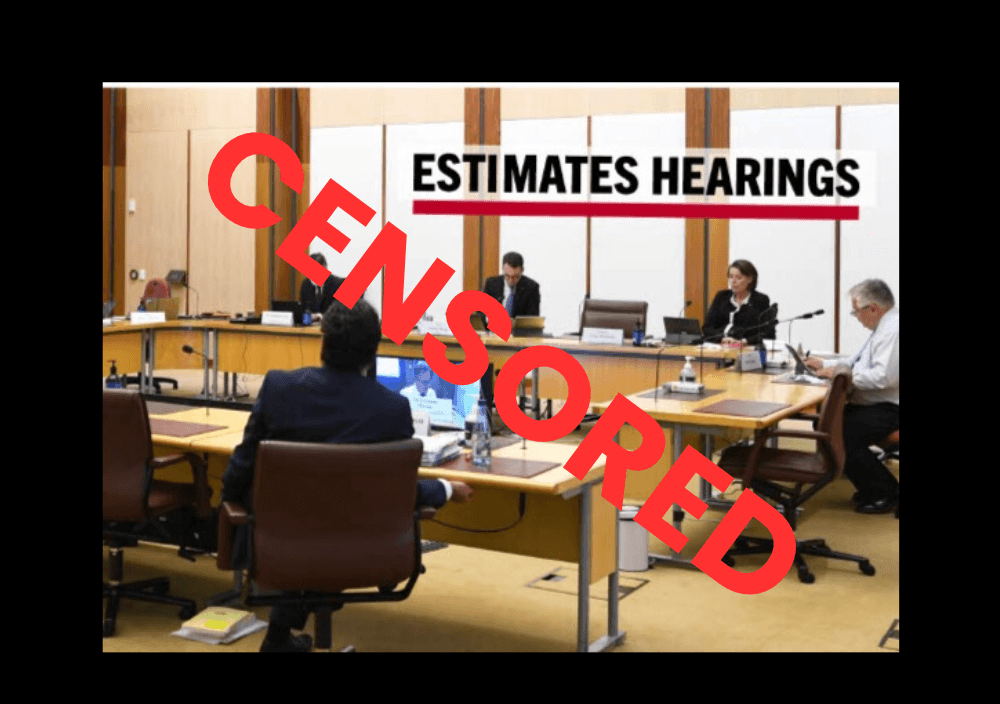
This is NOT a Submission to the Parliamentary Joint Committee Inquiry into the operation and effectiveness of the behaviour codes
A funny thing happened on the way to the Parliamentary Inquiry into behaviour standards in Australia’s Parliament.
The assembled leadership of Australia’s Public Service spun the focus away from how people working in the Parliament House building treat each other and turned it into a vehicle for controlling and limiting how Public Servants’ testimony in open parliamentary hearings should be used and publicised.
They put forward a submission setting out how limits should be placed on Parliamentarians who transmit the bureaucrats’ words and testimony outside the Parliament through things like social media.
In short, they seek to censor Parliament based on their claim that ordinary Australians seeing how our nation’s Public Servants perform in these hearings and how they explain their work exposes those public servants to ridicule.
I had not expected an inquiry into how the treatment of people whose workplace is the building to be turned into a vehicle for censoring the workings of our Parliament.
I was even more surprised at the sheer chutzpah and poor judgement of the Public Service leadership in proposing how they thought the Parliament’s use of testimony to it and interaction with the public should be controlled and limited.
So I wrote a submission to the Committee that directly engaged with the Secretaries’ outrageous proposals and arguments and sent it in. My surprise grew. Because I was advised that the Committee, which had accepted the oddly-directed Secretaries’ submission, had rejected mine which engaged with the same issues and arguments.
Yes, the Parliamentary Committee is considering the Secretaries’ censorship proposals and has rejected one proposing to keep our Parliament open to the Australian public, free of censorship.
As I wrote in the failed submission, “The most interesting thing to watch in the aftermath of this disastrously misjudged and wrongheaded attempt (by the Public Service Secretaries) to censor the workings of our Parliament is what happens from here – in the Committee’s report and in the workings of our Public Service departments and agencies.”
So, to help the inquiry from afar, I am publishing the Submission I provided, but in the form of something that is:
NOT a Submission to the Parliamentary Joint Committee Inquiry into the operation and effectiveness of the behaviour codes
The first part is reproduced below, with the full document available here.
“Thank you for the opportunity to make this submission into this important inquiry. [This was written before I received the unhappy news]
The inquiry has unexpectedly turned into something with importance to Australian democracy far beyond the internal operation of Parliament House as a workplace for the elected representatives, employees and staff who work there.
This is because of the intervention of the collected Commonwealth Departmental Secretaries in their extraordinary submission to the inquiry (Submission 11) setting out measures they propose to control how officials are questioned when appearing before Parliament, along with proposals to control how what officials say and do when testifying before Parliament can be used in public communication and public debate.
The Secretaries, writing collectively as the “Secretaries Board” appear to conflate rigorous questioning of Australian Public Servants who appear before inquiries with bullying. Their submission, while purporting to support the rigour and scrutiny that forensic questioning by our elected representatives provides, seeks to constrain and undermine this by characterising such questioning as not showing sufficient respect for themselves and other members of the Senior Executive Service of the Commonwealth public service.
The root cause of what the Secretaries are so concerned about is a simple one: the words, performances and behaviour of public servants appearing in open Parliamentary hearings. This material, when seen by members of the public on various media, including social media, has resulted in the officials being criticised and at times ridiculed. But it is not the act of disseminating this material that is the cause of the alleged problems, it is the material itself. Without the embarrassing words and poor performance, the public criticism would not occur.
Improved performance by our public service officials and open, honest answers to forensic questioning, are the right remedies here. It is extraordinary, for example, that it takes 4 months to get a simple “No” in answer to a question about whether the NSW Police were consulted before the Defence Department decided to sell a facility the police use, with a further lengthy period of questioning 4 months later (one hour into the parliamentary hearing on 4 September 2026) finally winkling out the answer which should have been provided by the official months earlier. (In this case, no one was consulted by Defence prior to its decision about that particular facility or other facilities, so the answer was obvious from the start.)
This type of performance by officials is not unusual, but it is the problem. The problem is not members of the public reacting badly to hearing of it.