
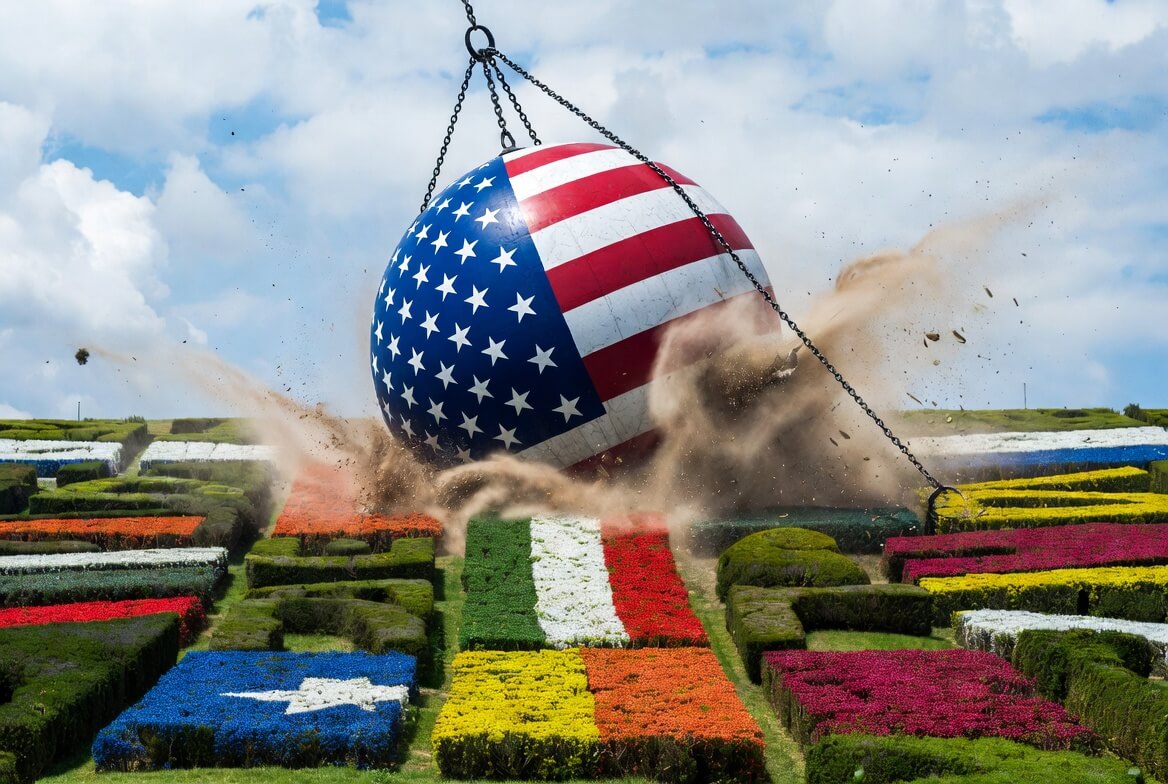
The mail arrives, yet the world spins awry.
The global rules-based order, which has underpinned Australia’s security and prosperity for decades, is in transition. The end state is difficult to predict. While there will be elements of continuity, the coming decade will likely be defined more by fracture, rivalry and disorder. – Australia’s National Defence Strategy, 2026
The international order sags and shifts and splinters in sorry ways.
Australia’s words about a global system of “fracture, rivalry and disorder” are description, not prediction.
Who gives the orders? Who follows orders? What is the nature of the order, ranging from trade to wars?
Start the answer with a dose of optimism. Much order still works.
The General Postal Union established in 1874 continues to deliver, no matter what the distance. Earlier ages would be agog at the global reach of the simple letter. To double the amazement, produce the phone-as-computer we all carry in our pockets. Distance and time compress as information whizzes. Every previous age would be in awe of the golden age of globalisation that’s now receding.
The order we have suffers even as it delivers enormous benefits. Those benefits—past, present and possible—mean we have entered an ad hoc era of patches and fixes, to keep important bits ticking or intact. Workarounds become system essentials. We are in a time of ordering rather than order.
See how patching operates with the World Trade Organisation, the body designed to set the rules and judge the disputes of international commerce. The WTO is “a bit of a mess these days” and “largely dysfunctional,” judges the Washington economist, Marc Levinson.
Yet with the notable exception of Donald Trump, Levinson writes, “faith in the benefits of a globalised economy is very much alive around the world. The international value chains that define modern manufacturing are not breaking apart, and the number of containers passing through the world’s ports reached a record level in 2025. Rather than stifling trade, the WTO’s decline has fuelled an array of less sweeping agreements intended to lower barriers to trade and foreign investment.”
Short of the optimum, reach for options. More ad hoc than the great multilateral promise of the WTO, but that’s where we are–amid barriers, breaches and government intervention. Lots of fixes needed. Keep the mail and merchandise moving, despite the messiness.
The “peace” deal between the United States and Iran is an agreement built on mends, make-dos and mistrust. But the workaround looks like it might get twenty percent of the world’s oil flowing through the Strait of Hormuz.
All sorts of fixes are needed because we are mourning a glorious time after the end of the Cold War, when tech and trade flooded across borders and peace was on the rise. We had a “Belle Epoque” that ran from 1989 to the global financial crisis (America’s 2008 economic nervous breakdown). While the Belle Epoque that spanned the forty years before World War 1 was a European experience, our two decades of golden globalisation was enjoyed by the whole world, and much still glows.
The biggest challenge of this century will be to do a better job of avoiding the world wars Europe imposed on the last century. The dire trend is that combat deaths around the world in the past four years have been the highest since the end of the Cold War. As The Economist editorialised, “Smarter tech is making war a dumber choice,” yet leaders are still drawn to the dumb: “Bullets and bombs killed nearly three-quarters of a million people in wars between 2021 and 2024. Many more died from the indirect effects of conflict, such as hunger and disease.”
The Peace Research Institute Oslo adds up the figures in a report on combat trends since 1946, finding that “2025 was one of the most violent years since the Cold War, with 65 active conflicts across 35 countries – the highest number recorded since 1946 – and more than 255,000 fatalities.” The Institute said international conflicts had doubled from four in 2024, to eight in 2025, noting “several latent border conflicts which have become violent, reflecting the current growing global tensions.”
Australia’s region feels the rumbles because of this judgement: “The Asia-Pacific can no longer be classified as fully at peace.” That is the first sentence of the annual Asia-Pacific Regional Security Assessment issued by the International Institute for Strategic Studies. The study says Asia faces a “combustible mix.”
The mix is potent because Asia has the power to reshape a global order created by Western/European ideas about the role of the nation, the purpose of the state and the rights of the people. To restate the questions, who gives the orders and what’s the nature of the order?
“The crisis in the concept of world order,” Henry Kissinger declared in 2015, is “the ultimate international problem of our day.” Kissinger’s book World Order called for “a reconstruction of the international system” because global rules and norms had to be based on “common convictions.” Instead, Kissinger worried, “a multipolarity of power” produces “a world of increasingly contradictory realities.”
The ultimate international problem Kissinger described keeps growing. With plenty of new shoves from Donald Trump, we are going deeper into The post-American world, the title of Fareed Zakaria’s 2008 book, published amid the great financial crash, describing America’s relative decline and “the rise of the rest.”
The rise of the rest is the point. After the bipolar Cold War frigidity, America basked in its unipolar moment, coinciding with the golden globalisation based on America’s idea of how the world works and trades. Since the financial crisis, globalisation has become slowbalisation.
The multipolar era is upon us in all its fascinating messiness.
America is still a military superpower, but as Zakaria argued nearly two decades ago, “in every other dimension—industrial, financial, educational, social, cultural—the distribution of power is shifting, moving away from American dominance. That does not mean we are entering an anti-American world. But we are moving into a post-American world, one defined and directed from many places and by many people.”
Trump’s “America First” policy is a declaration that the hegemon is declining back to the status of normal big power, worried more about itself than the international system it once ordered.
In the unmaking and reshaping of the global order, Trump is the first president of the post-American world.
What Trump has done within the US—smashing at laws, norms and institutions—he repeats internationally, battering at everything from the United Nations to the WTO to NATO. Many regimes around the world are happy to follow Trump’s lead. Helping the US president dismantle the order created by the US means others have less to fear from Washington, and less reason to follow US orders. Trump’s war against Iran showed the limits of US hard power. His words hack at US soft power, sapping the international influence of America’s culture and values.
Multipolarity means every nation is constantly re-ordering its choices on the issues and partners that matter. A term borrowed from financial markets—“hedging”—has become the new normal of international relations. States hedge to seek options, balance risks and protect interests. The hedging dance calls for continuous attention and lots of motion.
Writing in the journal Foreign Policy, Suzanne Nossel flips the discussion of superpower “hegemony” to the new age of hedging which—with elegant wordsmithing and an added “d”–she dubs “hedgemony.” Nossel argues this is not a tactic limited to emerging powers or a response to particular geopolitical shake-ups:
Hedging has become central to international relations, shaping how powers great and small approach trade, technology, finance, energy, and security. States are no longer hedging within a system that is episodically volatile but out of a recognition that there no longer is much of a system at all. The rise of what we might call “hedgemony” is both a response to the reshuffling of the global order and an accelerant of this transformation. Although these moves are being pursued by individual governments in search of stability and security, the net result may be a world that is less predictable and even more dangerous.
Hedging is both tactic and strategy for an era busy working on “ordering” because of the fracturing of the liberal international order. The “ordering” analysis comes from Bruno Maçães, a Portuguese academic and writer who served as Portugal’s Secretary of State for European Affairs (2013-15).
“The age of world order is finished,” Maçães writes. “What we have now is ordering, world building, a process without end.” If a world order is a snapshot, ordering is a never-ending film. He argues that principles of change and choice are thinner but now more durable that the norms of the liberal order. Maçães offers two principles of ordering:
- Technological revolutions reshape global hierarchy: the country that wins the tech race moves to the centre. China’s arrival as an economic power, Maçães writes, launches a revolutionary project to reshape the global system to place China closer to its core.
- Every country is free to choose: “China is now the largest trading partner of more than 120 nations,” Maçães observes. “Most of them do not want a bloc; they want optionality.” Ordering is about getting competing offers, not being conscripted. This is “a standing election in which the great powers must canvas continuously for support.”
Our multipolar time is much like the soccer World Cup: the competition engrosses the globe, many more teams are on the pitch, little nations can take on the giants, and it’s hard to predict the leaders, much less the winners. Three nations host this tournament, run by a body with four official languages (English, French, Spanish and German). Notably, China did not qualify for this World Cup, but Xi Jinping has ordered catchup on the football front, along with all the other international expansions.
The biggest difference between the World Cup and our world order, is that soccer still follows the rules. Players must obey the referee’s whistle; unlike the world game, the world order has a problem with referees and rules.
We have no ref’s whistle to police disintegrating international laws and norms and habits. With no referee, nations must try to do the ordering even as the run around the pitch. It makes for a chaotic game. Many can score, but fouls and rough play abound.