
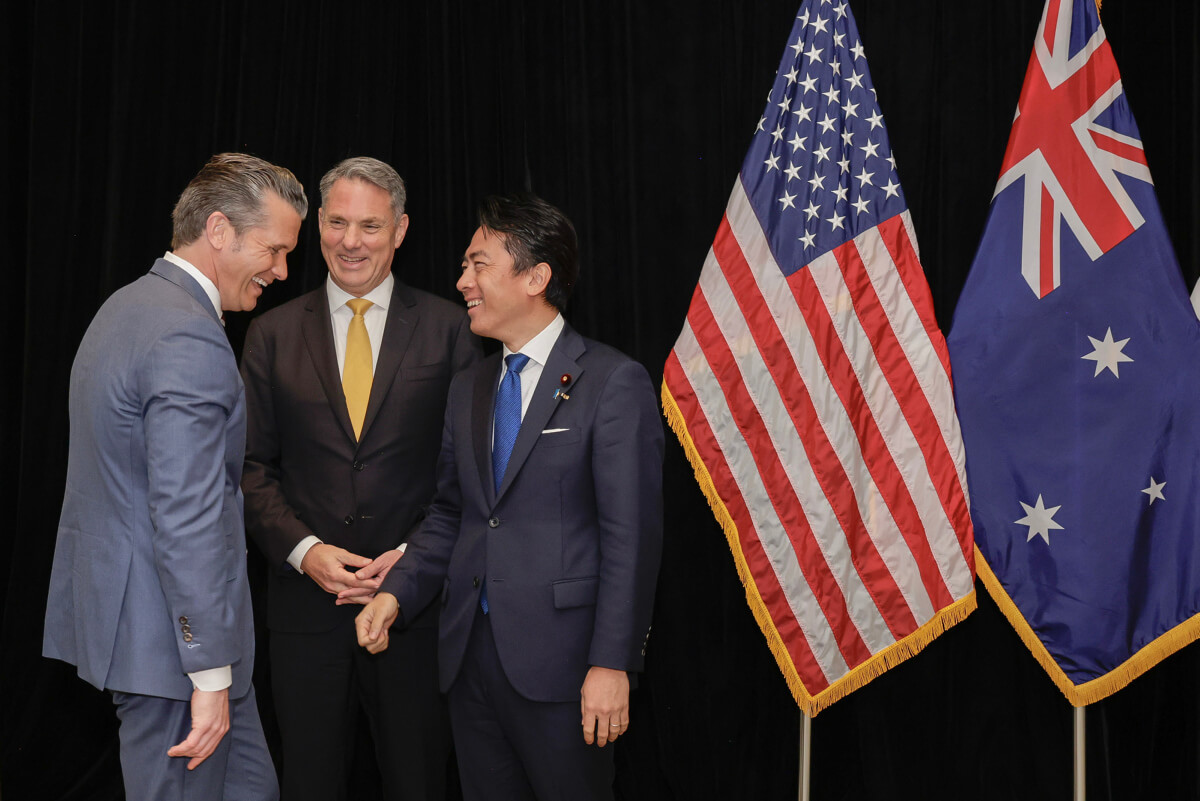
Australia has just been touched by an old alliance habit—the kick from Washington for being a military freeloader.
The free rider whack was one of only two references to Australia made by the US Secretary for War, Pete Hegseth, on stage at Singapore’s Shangri-La defence dialogue run by the IISS think tank.
Canberra can take minimal comfort that Hegseth’s boot was aimed at New Zealand, but by the time the kick landed Australia got its share. If the ally doesn’t spend enough to share military capabilities, Hegseth said, “our alliance is meaningless.”
For that “Ouch” moment, the ANZUS band had briefly reunited. Along with all the mateship stuff, another ANZUS tradition was America lectures to the “needy” twins, Australia and New Zealand (the exasperated eagle could peck at the kangaroo and kiwi as well as carry them).
The kick moment in the Hegseth Q/A session was set up by his speech promising new forms of partnership, based on “America’s national interest” and what a “return to realism means for the most consequential region in the world, the Pacific.” On a style note, Hegseth preferred to talk about the Pacific (18 speech mentions) rather than Asia (7 mentions), with no use of the Indo-Pacific; the Pacific century usages of the 20th century still rhyme for some Washington speechwriters.
Familiar tropes of the Trump administration were polished. Allies must share the military burden to get “a durable peace in the Pacific.” This was not a burden America can or should carry alone, Hegseth said: “No freeloading”.
Allies must do more to get a favourable balance of power, Hegseth said: “For too long, the security of this region has rested disproportionally on American military power, while many of our allies and partners allowed their own military power to atrophy. That’s a bad deal for the American taxpayer and its an unsustainable crutch for our allies and partners.”
Hegseth came to Singapore to both praise and push allies. He promised no more preaching, then delivered plenty of sermons. Such duality is to be expected from the man who holds the job of US Defense Secretary, but prefers to be called the Secretary of War. Where previous defence secretaries might preach about principles and democracy, this war secretary preaches about power and who has to pay for the weapons, beyond those US taxpayers.
In his speech, Hegseth listed partners that were showing the proper “realist mindset.” Such a listing of friends is a standard element of the annual US defence secretary speech to Shangri-La. Hegseth, though, offered an unusual hierarchy: South Korea was on top, followed by the Philippines. In third spot was Japan, praised by Hegseth for its “defence transformation” and “critical shift.” The judgement line he offered was: “We have the highest expectations of our Japanese allies.”
Australia was in fourth spot, getting this praise from Hegseth: “Australia is stepping up. Together, we are expanding the rotational presence of US forces and collaborating to ensure our defence industrial base build and sustain weapons required for a high-end fight. We appreciate Australia’s investment in real combat power and the commitment to integrate more deeply with the US joint force.”
The next mention of Australia arrived during questions, and the tone shifted. What started off as a kick aimed at New Zealand on the military spending expected from a friend, expanded to include Australia’s Defence Minister Richard Marles.
The spark was a typically blunt question from the New Zealand journalist, Anna Fifield, who noted that New Zealand had not been mentioned in Hegseth’s list of partners and allies. Her preface was New Zealand’s plan to raise defence spending from 1% to 2% of GDP over the next eight years. This, she noted, is “a long way from 3.5 % [of GDP]. Would you consider New Zealand to be a free rider?” Here was Hegseth’s response:
“New Zealand, I appreciate the question. Listen, if I’m being honest, 2% percent is not enough. So 2% is freeloading. But I don’t have anything against New Zealand. I want partners to step up. I didn’t intentionally leave it off my list. I look forward to working with the new defence minister there, [Chris Penk] and enhancing those capabilities. I think that relationship has been a very fruitful one for a very long time. But I think as my friends Richard Marles and [UK defence secretary] John Healy know, I’m probably the most blunt with our closest friends. About what our capabilities are and where they need to be to ensure that we’re locking arms and shields, considering the threats of the world. And you can’t just say, ‘Oh, we’ve been friends for a long time, so let’s work together.’ We’ve been friends for a long time, so you better have the same capabilities we do, because if we don’t our alliance is meaningless. And that’s the kind of realism President Trump has asked me to inject into all relationships.”
In a following Shangri-La session, Australia’s Richard Marles was asked about defence spending and told the dialogue: “Burden sharing has been a point that has been made by successive administrations of the United States, really since the Second World War. Yes, we are very much seeing it. We saw it today in the speech that was made by Secretary Hegseth. But you can look at successive comments that have been made by successive US administrations over a long period of time. Obviously, from an American perspective, it’s completely understandable that would be the position America would have. We totally accept the legitimacy of the burden-sharing conversation on the part of the US, and we seek to engage with it.”
Listening to Hegseth’s kick and the gentle duck by Marles, my mind turned to Robert Menzies, who claimed ANZUS as one of his greatest achievements as Australia’s longest-serving prime minister (even though he was sceptical about the alliance at its creation).
In his book on the Menzies era, one of the few negative notes struck by former Prime Minister John Howard is the judgement that Menzies was a military freeloader in the 1950s and into the 1960s: ‘In a sense, one of the benefits of ANZUS was that, in financial terms, Australia’s defence came cheaply.’
So, the burden-sharing argument rates as familiar alliance argy-bargy. In this, if little else, Pete Hegseth is a traditionalist.
Graeme Dobell is writing for SAA from Singapore, where he is participating in the IISS Shangri La Dialogue 2026.