
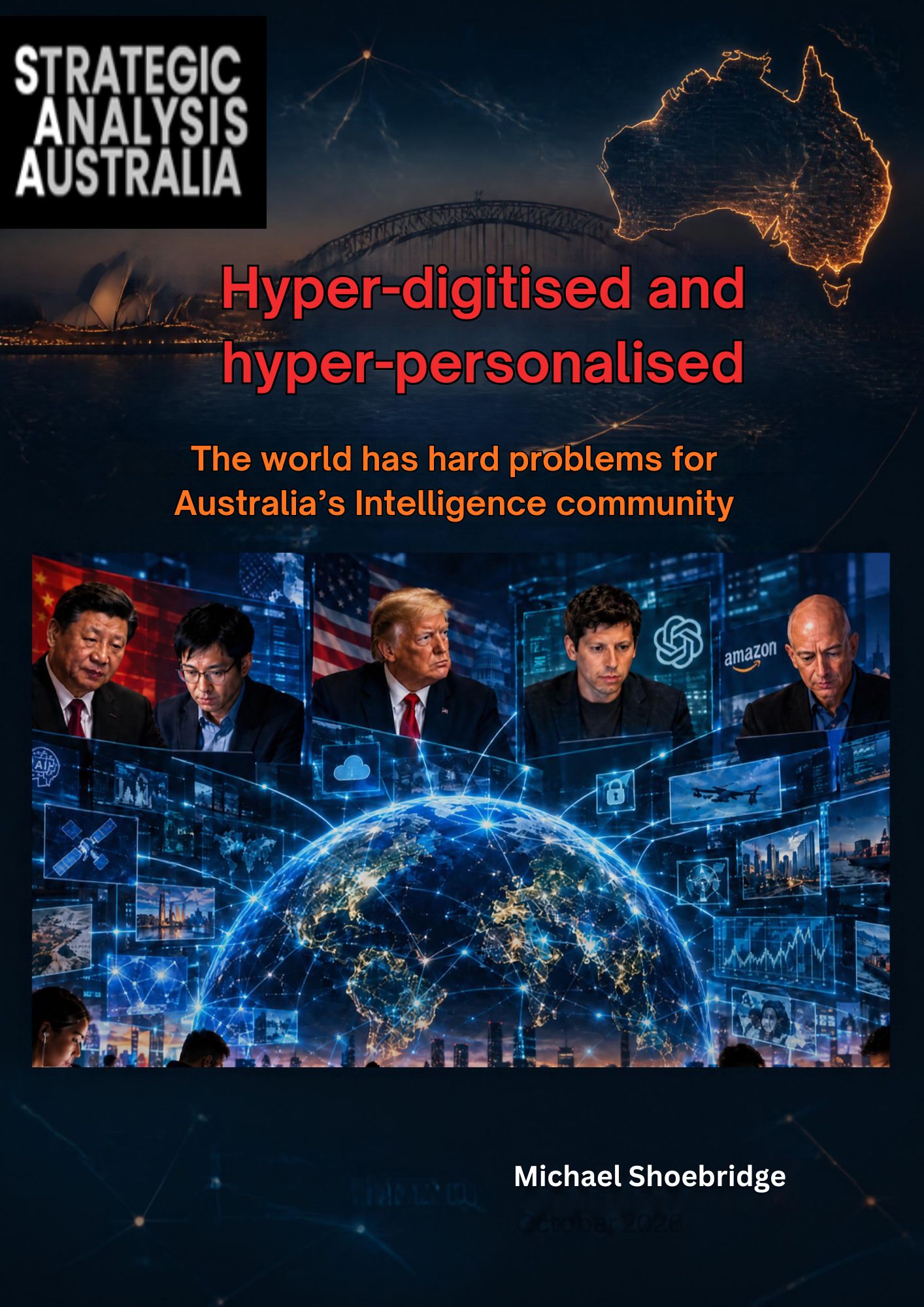
This is an extract from SAA’s new report, which you can read here as a PDF.
The intelligence challenges of the last decade haven’t gone away. But the world has become faster, more digital, more personalised and less predictable – and core assumptions that previously underpinned Australia’s (and other nations’) intelligence community are dangerously outdated. They need to be challenged and changed.
Intelligence agencies have spent the past decade grappling with profound changes: the explosion of open-source information, the rise of secure cloud computing, the digital vulnerability of human intelligence operations, the challenge of quantum decryption from quantum computing, and the persistent problem of seams between agencies and partners, both within countries and between them (even for the closest of partnerships).
Those problems of speed versus institutional stovepipes and seams haven’t gone away. Instead they have been joined by a new set of challenges that are more consequential for the world of Australian intelligence.
Artificial intelligence is changing the nature of cyber threats, information warfare and decryption. Digital power is increasingly concentrated in a tiny number of companies and individuals.
Political power is becoming more personalised — and in key centres (notably America, but also in parts of Europe) is being less informed and shaped by the institutions that wrap around leaders. Long-standing international partnerships are fracturing. China is a major centre of digital systems and technology, as more of our physical world goes digital and becomes software-defined. The assumptions Australia has traditionally made about the United States and its intelligence relationship with us are breaking down in obvious ways that officials and ministers are reluctant to confront.
People and whole nations face two digital worlds – one China-centred and one US-centred. There are no other sources of broad digital power on the planet – not in Europe or India, or even in the advanced economies of Japan and South Korea. Many governments and economies, including Australia’s, are intermingling both US and Chinese digital technology, often without policy forethought for the wider consequences.
This new landscape means Australian intelligence agencies need to think hard about what they collect intelligence on, who they collect it about, and how they do so. I’m not focusing here on the lists of intelligence priorities people like ASIO boss Mike Burgess set out – non-state actors, foreign interference, cyber agents, violent extremists and terrorists, I’m looking at big new drivers and trends changing the globe and the way our economies run and our governments and its agencies operate.
China, with its authoritarian government remains a hard intelligence target, but it becomes ever more important to other nations as China’s economic role and its technological power grows. What will other states accept or buy from China, and what will they refuse?
Australia is not alone in facing a United States that can no longer be treated simply as an unquestioned partner whose interests and decision-making processes can be understood through deep institutional relationships. American directions and influences must be an important subject of Australian intelligence collection and assessment, as uncomfortable as that might feel to officials and ministers.
At the same time, people such as Sam Altman, Elon Musk, Jensen Huang, Jeff Bezos and the leaders of major Chinese technology companies like Deep Seek’s Liang Wenfeng or Baidu’s CTO Wang Haifeng, together with key Beijing government AI policy officials like Ding Xuexiang. can make decisions with consequences for Australian security and prosperity that rival those of governments.
Australian government institutions, including our most technologically capable ones, are facing a world where there is a rapid loss of control of the technological frontier to a tiny number of powerful tech companies led by a tiny number of people in both America and China. And in many ways, these are a new form of insurgent ‘non-state actor’.
In a hyper-digital and hyper-personalised world, human intelligence is not becoming less important or old-fashioned. Maybe counterintuitively, it’s more important.
Our world is jarring, uncomfortable and uncertain. That makes imagination, independence and the willingness to challenge assumptions more important than ever. And once that is done, it requires a willingness to act upon the answers.