
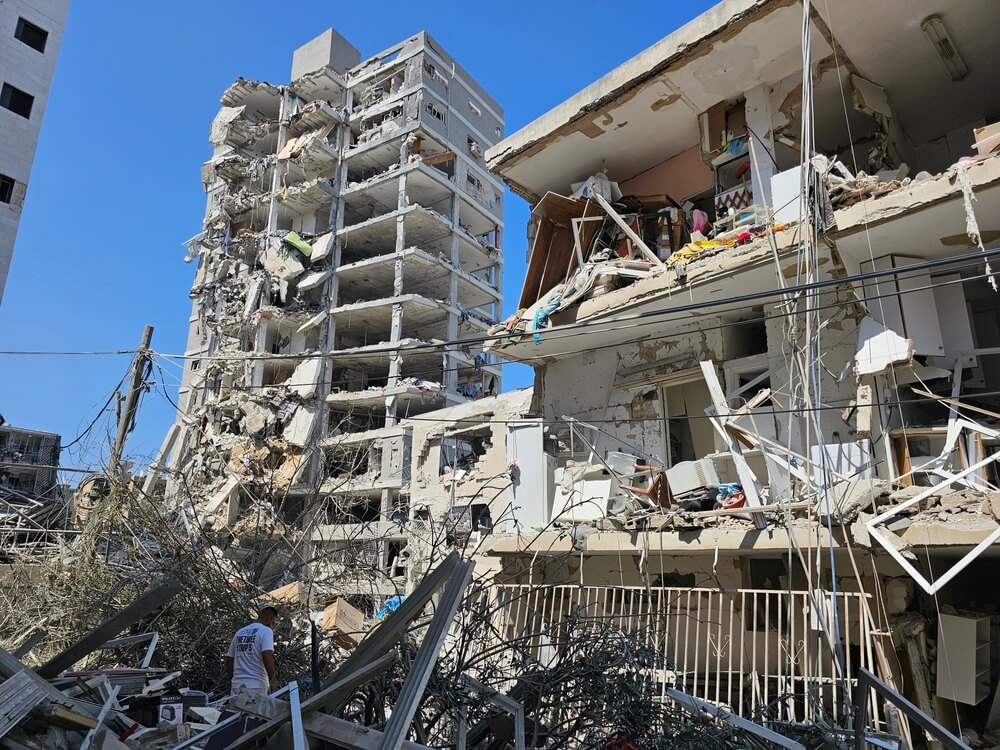
After watching Russia bombard Ukrainian civilians and cities for 4.5 years with ballistic missiles and drones, and seeing Iran do the same to US bases and Gulf State populations in the Middle East, Australia’s military has started to take missile defence and countering long range drones seriously.
That’s good, because we know – because people like Defence Minister Marles have told us – that China’s military has plenty of ballistic missiles and long range drones capable of reaching Australia whether launched from the Chinese homeland and from various PLA ships, submarines and planes.
The Defence organisation has proudly announced a new $10 billion “Medium Range Ground Air Defence Project’, catchily named LAND 6504 to buy an “initial medium range air defence capability in the early 2030s” with the planned system scheduled to be fully operational around 2035.
But Defence, supported by its Government ministers, is proposing a solution to Australia’s missile defence gap that has 4 extraordinary problems. The biggest problem is the last one – our military is planning protect itself, not us…but read on.
Problem Number 1: time
The first obvious problem is it’s taking so long to get any real capacity to defend even Australian military bases against missile and fast long range drone attack. Richard Marles keeps telling us that Australia’s strategic environment is deteriorating rapidly, and describing it in speeches and lengthy in revisions to his National Defence Strategy document. So, urgent action against big vulnerabilities would make more sense than this business as usual and very slow approach to weapon acquisition.
Problem Number 2: traditional solutions that are partial, eyewateringly expensive, or unavailable
The second problem is the potential weapon systems Defence is examining to equip our military. They include Israel’s Iron Dome – a short range system optimised for destroying Hamas and Hezbollah rockets fired into Israel, the US Patriot missile interceptors, Kongsberg’s proven NASAM’s system, or repurposed naval SM-2 missiles fired from ground launchers. All these missile solutions were around a decade ago, and all have limitations.
Patriot missiles have two key problems. The first is that each on is eyewateringly expensive. Back in 2022, the individual interceptor missiles were estimated at $AUD5.7-6.4million each, and the battery to fire them from at around $1.5bn per unit. And, even if the Australian defence program budget could afford much of this, Lockheed Martin can’t make enough to even refill the US stocks used during the short first intense part of the US-Iran war for the next 5 year sor so, so any plan that relies on Australia getting Patriot stocks in any numbers doesn’t just look outrageously expensive, it looks deeply flawed. $10 billion doesn’t get you far in Patriot interceptor land, even if the US makes you a higher priority than their own military…..
Problem Number 3: how can Defence still not notice Ukrainian solutions?
Now to Problem Number 3: where are Ukrainian interceptor options in this list of potential Australian solutions? 4.5 years into the Ukraine war and Australian Defence thinkers still can’t seem to notice what the Ukrainians have achieved and what they are capable of. Ukraine is exposed to increased Russian ballistic missile strike partly because the Trump Administration is refusing to supply it with Patriot interceptors. That’s partly because President Trump is now openly siding with Vladimir Putin in the war, but also because of the production and supply problem with Patriots – and multiple other US weapons – exposed by the Iran war.
Ukraine’s solution is to design and build its own ballistic missile interceptors and to partner with multiple European nations to do this rapidly and in a way that enables large scale production of interceptors at prices far lower than the US Patriots.
Ukraine’s hugely successful domestic missile builder, Fire Point, is designing and building FP-7.X ballistic missile interceptor system, with late 2027 set as the date for initial intercepts of Russian missiles. It’s working in close partnership with 10 nations, including Germany, France, Norway and Canada in the Integrated Anti-Ballistic Missile Coalition, which will give Ukraine access to key components and technologies for the interceptors.
The urgency of war will keep this high priority Ukrainian program on schedule, and the technical excellence demonstrated by Ukrainian defence industry in multiple areas of design and production over the last 4.5 year makes success look very likely. It also seems very likely that Ukraine will develop and field new and more effective counter missile systems between now and 2030, as well as continually adapting and improving the FP-7.X.
So, how can Australian planners not be even noticing – and not prioritising – potential Ukrainian solutions for our own missile defence needs and simply falling back on traditional systems from traditional – and troubled – providers? An initial in-service date of 2032 looks like a very slow long term project to Ukrainians, so Australia certainly should consider what they might offer. The potential supplier list not including any Ukrainian options simply demonstrates the Australian Defence organisation’s almost wilful continued failure to learn or change.
Problem Number 4: the big one – The Australian Defence Force exists to protect Australians, not just itself
Problem Number 4 is the killer. LAND 6504 is to provide the Australian military with a limited form of self defence for Australian bases and facilities against now present and known missile threats that can reach Australia. It might also help protect American submarines and US military personnel based at HMAS Stirling. It is not about protecting any Australian citizens or population centres from the kinds of strikes we’ve seen against civilians and civilian infrastructure during the Ukraine war or the US-Iran war.
Our military – and the Government ministers who preside over it – seem to have forgotten that their core purpose is to secure and protect Australia and Australians, not to secure and protect themselves.
Should a conflict break out that has missiles and drones raining down on Australian military facilities – like the submarine base in Western Australia or the Navy base in Sydney Harbour or the fighter base in at Newcastle airport, it’s almost certain that such attacks won’t be limited to forensic strikes against just military targets.
Cowing and intimidating the civilian government and population is obviously now an expected part of war (and it’s not new news for any war historian either).
So, are we really meant to cheer Richard Marles and Defence bureaucrats on as they spend $10 billion on missile defence systems to look after themselves while exposing the rest of us to attacks they see as credible?
Of course, a comprehensive continent-wide missile defence system, like Donald Trump’s ‘Golden Dome’ overly ambitious initiative – is way beyond the means of Australia’s defence resources. But that should not mean that we are left with absolutely nothing to provide even a tightly prioritised and partial defence of key population centres and critical infrastructure.
Watching Australia’s military protect itself on its bases in a time of war while leaving the Australian population exposed and attacked seems simply unacceptable. Seeing Ukrainian citizens and cities being attacked despite huge efforts from the Ukrainian military to protect them illustrates the issues pretty graphically.
The Australian Defence Force is not the Self Defence Force. Its purpose is to protect Australians, not just itself. It’s ridiculous anyone needs to remind them of this as they spend billions of our dollars.