
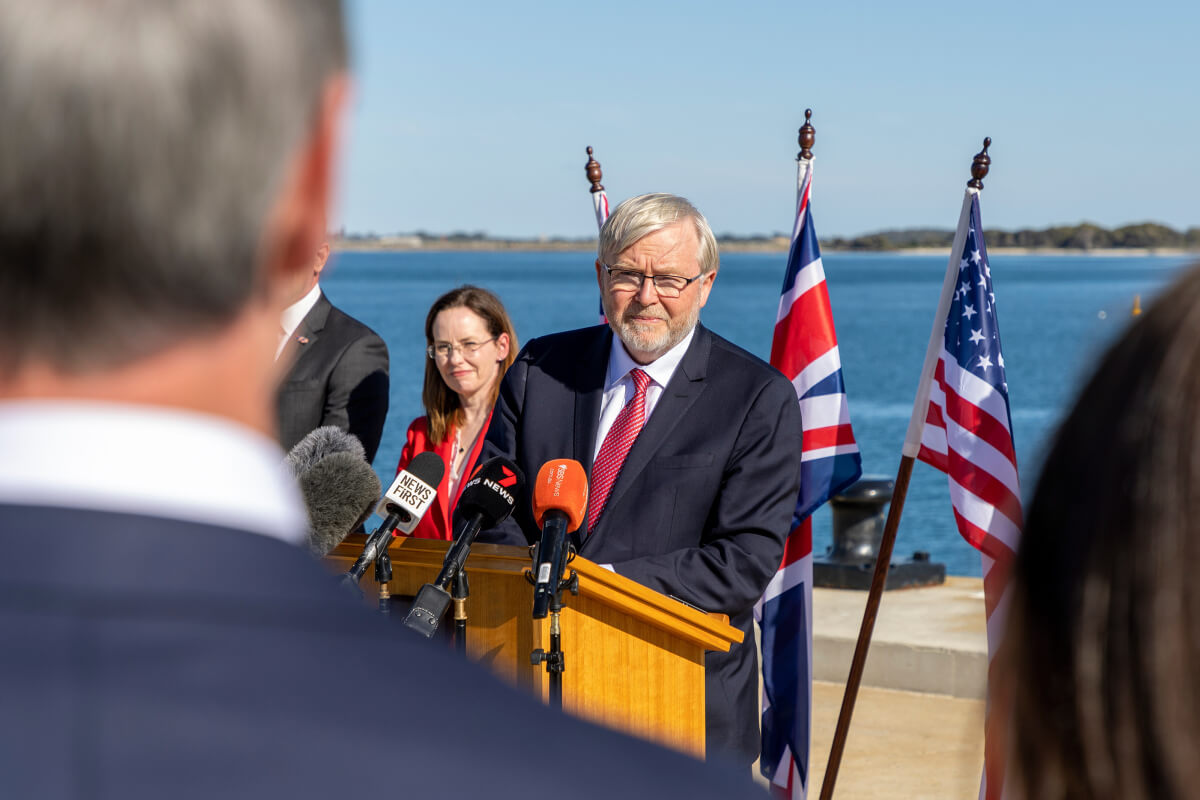
Kevin Rudd’s 3 years as Australian ambassador in Washington have shown he can ride rollercoasters and survive.
In 3 short years, Kevin Rudd has had a box seat not available to any other Australian to watch the whiplashing changes in the US – and in American behaviour in the world – from his office a few blocks from the White House as it’s demolished and remodelled.
The first year was working with Biden’s America, which valued its allies and partners enormously and was working to craft a collective response to a rising China and aggressive Russia. Since then, Trump has followed a hugely different America First path, littered with unexpected aggression and rapid shifts in attention.
Luckily, K Rudd is an obsessively hard worker with enormous reservoirs of self-confidence. Anyone less driven and thick-skinned wouldn’t have recovered from the start he had with Trump 2.0 – his now-deleted public comments about Donald Trump being a “traitor to the West” and “the most destructive president in history”.
Rudd delivered as Australian Ambassador. AUKUS is intact – and whatever the secret US review demands of Australia – AUKUS has been endorsed, for now, by President Trump. The delayed, high-risk face to face meeting between Anthony Albanese and Trump turned out to be a celebration, not a chance for Vice President Vance to replay his Zelensky performance by shouting about Albanese failing to respect Trump or pay his alliance dues by spending more than 2% of GDP on defence.
Success has many fathers, so plenty of Canberra folk will claim the credit. But from here it looks like Rudd used all his political and networking skills in combination with his sharp analytic mind to set the conditions for Albanese’s success. His immersion in DC and the new Trumpian poles of influence meant he understood the value to President Trump of a simple, positive meeting.
He also saw the way that sweeteners and diversion could shift the leaders’ conversation away from uncomfortable truths of Australian free riding on American security spending and power. And so, enter stage left, the Australia-US critical minerals deal and commitments to buy shedfulls of US defence industry products over the next ten years.
The political result for PM Albanese was brilliant: he managed the radioactively dangerous Trump and emerged not just unscathed, but smiling. South Africa’s president Ramaphosa, Ukraine’s Volodymr Zelensky and Spain’s Pedro Sanchez were all probably placing calls for advice. And, quite unexpectedly, if they’d called Rudd’s office instead of Mr Albanese’s, they’d have called the right number.
That was unexpected because deft political management wasn’t a notable strength during Rudd’s own political career – he tended to alienate colleagues with his overly strong-willed focus on policy, combined with a tendency to digress. That could bog down debate and decision making, and also result in loss of support – which eventually ended his political leadership. But Kevin Rudd is obviously a learning animal who is energised by setbacks. So, his time as ambassador seems to have succeeded because of the lessons and scars he carried out of politics.
On the downside, though, Mr Rudd stepping down a year early tells us other things. His deep analysis of China’s direction under Xi Jinping will have made the last year of Trumpian whirlpools disturbing and depressing. China continues working to be less dependent on others while making others more dependent on its products and tech.
Meanwhile, America under Donald Trump is showing a tendency to use power in disconnected outbursts (tariffs, bombs, abductions) that leave the fundamental economic, scientific and power balance moving in Beijing’s direction.
Focusing US power on the Western hemisphere, with a side serve of the Middle East, while weakening America’s relationship with Europe only leaves China and Russia more empowered. Rudd will have noticed this and will know that Trump 2.0’s aggressive, self-obsessed and unpredictable America is here to stay.
On Australia and America, Rudd probably sees that the positive Albanese-Trump meeting vibe obscures a cloudy future.
Australia is handing billions to US submarine companies, and billions more to firms like Lockheed Martin and Northrop Grumman for weapons made in the good ol’ US of A over this next decade. We’ll also greenlight US companies to extract and ship critical minerals to reduce a critical American industrial dependence on China.
Unfortunately, in net terms, Australian policy towards China seems all about increasing our own dependencies wherever we can as fast as we can (the almost logarithmic rise in market share of Chinese-made car sales is one indicator). And there’s a jarring disconnect between Australia’s complacently low defence spend and growing reliance on America as Trump becomes increasingly less alliance-minded and unilateral.
So, Rudd’s successful relationship management has only delayed some collisions.
As ambassador, Kevin Rudd spoke his mind. He gave confronting assessments of Xi’s regime and got away with it by saying these were “personal” views.
His replacement is Greg Moriarty, the long serving Secretary of Australia’s troubled, sclerotic Defence Department. He’s very unlikely to get the same licence from Penny Wong or carry the same policy heft. The incoming ambassador’s history and rise have followed a well-worn bureaucratic path, which is much more about implementing the directions of more powerful masters than bringing sharp insights and changed policy forward, particularly if they might trouble business as usual.
Secretary Moriarty’s gifts include keeping bureaucratic ponds still when viewed from above. He’s been adept at reducing parliamentary, audit and public information available to assess the Defence organisation’s performance (adopting measures to withhold unclassified information as “Not For Publication”, for example). Political masters from both sides of politics have valued his work.
So, the Washington Embassy will be a much quieter place without Kevin Rudd. That’s something prime minister Albanese, Penny Wong and Canberra’s Public Service mandarins may welcome.
It will fit nicely with the government silence that is now wrapped around anything but the most superficial features of our relationship with America. Expect to hear even more of the go to line “I don’t intend to provide a running commentary on the Trump Administration” mixed with heavy doses of “full steam ahead on AUKUS”, and maybe even nostalgic invocations of “One Hundred Years of Mateship”. Expect little on anything of substance.
In contrast, as Kevin Rudd takes up his new role at the Asia Society, constraints on his thinking will reduce more. He’ll be free to give views again on the America he’s had a chance to see close up and to continue his forensic assessment of Beijing and the China challenge. Let’s hope he uses less self-censorship than he had to practice as a careful inside player during his time at the Massachusetts Ave Embassy.