
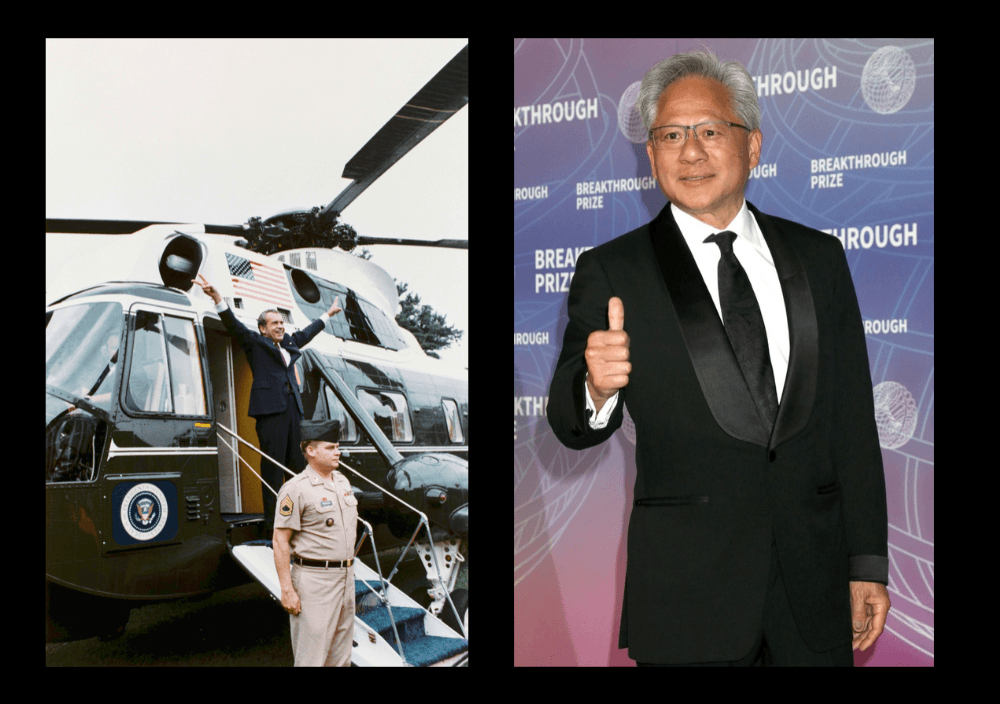
“It’s not the crime that gets you, it’s the coverup”.
That line was from Richard Nixon during the 70s era Watergate scandal that started with a bungled burglary and ended with Mr Nixon leaving office in disgrace, waving a victory sign from Marine One before departing the White House lawn.
Jensen Huang, CEO of one of the most important global companies, Nvidia, might have Mr Nixon’s words echoing in his head right now, as he goes over the last couple of years and what he and the company he leads said and did not say about his relationship with alleged Chinese spy Alice Huang.
As recently as 1 November 2026, the official company line from Nvidia continued to be that the interactions between the Huangs were “not unusual” and that the Nvidia CEO meets with thousands of executives each year, so there was nothing to see here.
Nvidia – and Jensen Huang – had been sticking with that line since October 2025 when the story about Megaspeed’s huge purchases of Nvidia chips, the company’s close connections to Chinese tech companies hunting for US chips, and Ms Huang’s opaque background broke publicly. In fact, Nvidia went further, saying the company’s compliance team had looked into Megaspeed and found no ownership concerns and “no evidence of diversion” of Nvidia chips to China. Everything was fine.
The cover stories lasted until this week, when the Nvidia CEO revealed to the world – and his wife and family – that he had been having an affair with Alice Huang. Nvidia, as it did last year, announced it would do another investigation. It’s hard seeing anyone having confidence in another company-own investigation, given how well the last one has held up to given recent revelations.
But the obvious question about Mr Huang’s affair again comes from the Watergate era. It’s the one Senator Howard J Baker asked of Watergate’s central figure: “What did the President know and when did he know it?” For Jensen Huang, answering this must get into what he knew – or suspected – about Huang’s background and role, and what he did and did not do when it came to influencing US export control rules for China and exporting Nvidia chips to Chinese customers.
In this case, who knew what when is still a question for the US President, Donald Trump to answer. And its also a question senior members of his Cabinet will need to answer.
And Nvidia company staff like John Rizzo – who, as Nvidia’s head of Public Policy Communications, told us all for a year that there was nothing unusual in Mr Huang and Alice Huang’s relationship (until we heard the opposite) have some explaining to do. Jensen Huang is now reported as hiring the US PR company Heller, a company with a track record of helping customers deal with sexual scandals, about a year ago – around the time the New York Times broke its original story. And he reportedly asked Nvidia comms staff to copy Heller staff into inquiries received about Ms Huang, so someone else at Nvidia certainly knew something.
Separate to any legal or security issues investigations reveal, Nvidia is a publicly traded company, so timely and truthful disclosures of market-relevant information is an obligation company officers have. Nvidia shares fell over 4 per cent once Mr Huang revealed the affair, so this does seem to pass the market-relevant test. Disclosures don’t seem to have been timely and perhaps not accurate either.
Back to the President and his men, though. The US Commerce department had been investigating Nvidia and its sales of chips to China-linked entities since at least April 2025. By October 2025, the New York Times had enough concerning information about Megaspeed, the company headed up by Alice Huang, to publish a story about the role that firm seemed to have in powering Chinese AI tech companies’ data centres, and the concerns about both Nvidia and Megaspeed’s compliance with US laws.
It’s highly unlikely that no one briefed President Trump, National Security Adviser Marcio Rubio, Pentagon Chief Pete Hegseth, Treasury Secretary Scott Bessent or Vice President JD Vance in the aftermath of the Times’ story. That’s because of the priority the Trump Administration has been putting on AI, the centrality of US-China relations when it comes to AI, and Mr Huang’s key role in everything about AI and America’s digital sector. So, it’s very likely some or all these Administration figures knew of the concerns around Nvidia, Megaspeed, Jensen Huang and Alica Huang either before or at least by May this year. US agencies clearly have more information about the events than the US and international media.
But even if we give the officials working in places like the Commerce department, the State Department, the Treasury, the Pentagon, and US intelligence agencies a free pass for somehow failing to notice the controversy or brief any of their political leadership, sometime before June 2026, the President and at least some of his Cabinet knew about the espionage allegations around Alice Huang and about Jensen Huang’s close relationship with her. Secretary of State Marco Rubio had a memo put together around May 2026 for the President that went through the issues. Beyond writing and receiving the memo, however, it looks like they did nothing.
President Trump had received advice from Jensen Huang in the lead up to his December 2025 decision to allow Nvidia to sell advanced – but not its most advanced – AI chips to China. America winning the AI race against China has been one of the few consistent themes Mr Trump has committed to over a pretty chaotic 2026, so we know he would have paid attention to Jensen’s views. And the president has let that December 2025 decision stand ever since, with the US Government receiving a 25% cut of any sales.
Far from putting any distance between himself and the Nvidia CEO over the last twelve months, Mr Trump added him to his entourage for his May visit to China to meet with Xi Jinping, and put him at the top table in the state dinner he held for Xi Jinping at the White House in September. Who knows, given he’s expressed confidence in Jensen Huang since the latest details of his affair broke, Mr Trump may even take the embattled CEO with him to meet Xi Jinping in Shenzen next week.
What this looks like is not just a cover up by and inside Nvidia but also somewhere inside the Trump Administration. This goes well beyond wilful blindness. And it looks very likely that there is a rather big and consequential fracture between US institutions that may have diligently investigated and reported on the facts around Nvidia, Megaspeed and the two romantically-involved CEOs and the political leadership that the investigating US institutions work for.
It’s not a new idea that the Trump Administration has a difficult relationship with key institutions that make up the American Federal government (remember the war against the “deep state”?). And it’s not news that the Administration, led by the US President himself, has politicised key institutions like the Department of Justice in unprecedented ways.
But we now have some very real-world consequences from the dismantling of institutional checks and balances in the US system of government. Along with a textbook example of how an ultra-rich businessman with direct access to a national leader can act in ways that damage not just an important company, but national – and international – interests too.
As we watch events unfold in the emerging Nvidia scandal, there are reasons to relearn the Watergate lessons. Two in particular seem central: it’s not the crime that gets you, it’s the coverup; and, when things go badly wrong and public or private power has been badly misused, the way through is a transparent, forensic accounting by competent, independent bodies, supported by capable, ethically-driven institutions at the heart of government. You notice the absence when it matters most.
But even in a country like Australia, there’s a need to also consider the role that inordinately wealthy, powerful business figures, not all Australian, play in our own government’s decisions — and with various political parties, through political donations and through special access to key figures like our prime minister. It’s wise to consider the checks and balances we should all want around that before our own Megaspeed moment.