
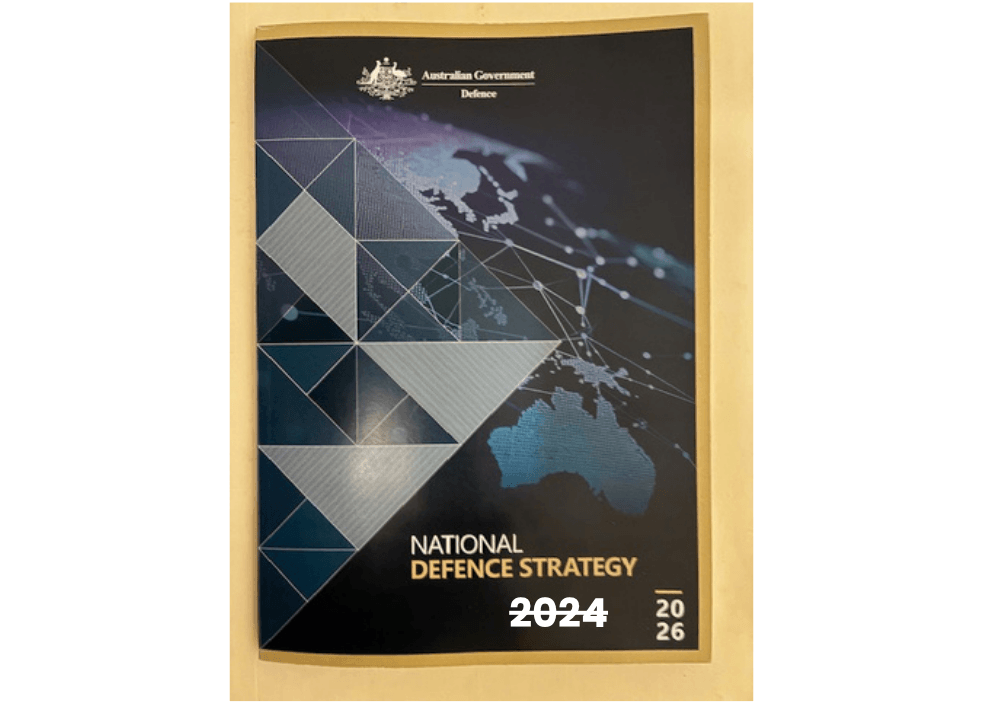
Having read the 215 pages of the Australian Government’s revised strategy and investment plan, two things stand out as particularly important. The first is the almost complete absence of engagement with the changed America that is now our major ally.
There is one page devoted to the Aust-US alliance and no mention of the America First, unilateralist approach of the Trump Administration. No mention of the Trump Administration at all. Instead, there is the assertion that Australia and America ‘share strategic interests and a mutual respect for each other’s sovereignty’. Even this deliberately concise formulation seems inaccurate on both interests and in exactly how mutual any respect might be.
In reality, America is now dismissive of the value of its alliances and openly critical of its long standing allies, including Australia, Japan and South Korea. President Trump and his most senior officials are openly canvassing ways to punish allies who they assess as not being supportive enough of America’s war in the Gulf. But you don’t get an inkling of any of this in the 215 pages or in Mr Marles’ presentation to the National Press Club today.
Asked about America during the Q&A, Richard Marles got quite mystical, almost religious, about the alliance, saying it was “organic and institutional” and again refused to acknowledge the major shift in US policies and behaviour the world is experiencing. This new America has obvious and important implications for Australia’s security and our alliance, if only because America is now simply less reliable as a partner than it was as recently as 2024.
The second equally mystifying takeaway from the strategy and plan is it is unclear what additional military power Australia is meant to get for what Mr Marles tells us is $53 billion in new funding over this next ten years. The basic force structure remains as it was in 2024, and remains entirely dependent on American resupply of things like missiles and interceptors (all the things that were used at such an intense rate in the dumpster fire of missile and munitions stocks that has been the Iran War so far and which America now can’t make enough of for itself).
There’s no big new investment in air and missile defence, for example, despite this being an area of known and growing vulnerability for Australia and its military. (Editor’s note: page 76 of the investment plan tells us $210m has been approved for “active missile defence”, and that there is a $7-10bn provision for something – probably a new medium range system – some time between now and 2035-36).
The answer to this puzzle of claimed huge increases with nothing much to show for it is that the claimed increases seem mainly to come from:
a. funny money – $20 billion in ‘alternative financing’ (ie. other people’s money, who want a commercial or better rate of return in exchange for the Government using it) and
b. the fact that compared with the 2024 versions of these documents, the new ten year profile has two years added in at the end of the decade that are each $10s of billions bigger than the two years from the 2024 plan that have elapsed since then and so dropped out of the rolling ten year plan. Ten years of inflation pumps up both these “out year” numbers considerably compared to the FY24/25 and FY 25/26 years that drop out, helping enormously with top line growth claims.
Then there’s arm waving about veterans’ pensions, military superannuation and off-the book financing that is now added in to beef up the top line claim of 2.8% of GDP on defence that under the same creative accounting apparently reaches 3% of GDP in 2033, according to Mr Marles’ speech today. A combination of forensic accountants and clairvoyants seems required to make sense of these numbers and where exactly they might be drawn from. No simple tables showing the calculation are provided, adding to the mystery and enigma. Mr Marles claimed he had no attachment to any percentage figures when asked to explain them.
The reality is likely to be far more mundane – a Defence budget that, measured as it has been for decades, is still bumping along at 2.1% for the next few years and climb slowly to perhaps 2.3% of GDP by the mid-2030s. We’ll have to wait for the actual FY26/27 Defence Portfolio Budget Statements to drop in the May Budget to know more, assuming Mr Marles isn’t busily airbrushing these formal budget documents to obscure the basic information we used to see in them.
Even in the highly topical areas of drones and counter drone systems, the plans provide very thin gruel. The basic outcome here is an ADF that is continuing to pursue a strategy of buying small numbers of very expensive uncrewed systems -Ghost Bat, Ghost Shark and the American Triton long range maritime surveillance drone – for billions of dollars ($1.8 billion on Ghost Shark approved so far, $1.1 billion on Ghost Bat so far, likely to spend around $10 billion in combination over the decade and only deliver tens of each for this).
In contrast, in the government’s own words, ‘investment in smaller uncrewed systems alone will total $2.2 billion- $3.1 billion across all domains’ over the ten years for now. And that modest spend is starting slowly: Army uncrewed tactical systems have had $42 million in approved funding so far.
So, any idea that the ADF is embracing the need to have thousands of cheap drones of diverse types or large numbers of dispersed cheap counter drone defences to cover its forces and maybe even vulnerable civilian facilities or populations is plain wrong. In contrast, the plan retains and doubles down on projects to buy expensive US missiles and interceptors, even as we see American production spoken for to restock America’s own military in the aftermath of the Iran War, making timely deliveries to Australia in the next decade – or in a time of conflict – a very bad bet. No shift in thinking or planning has occurred within the bowels of Australia’s Canberra Defence Headquarters.
Overall then, we have been served up Enron-level creative financing that is designed to tell the Americans we’re spending far more than we were on defence, combined with wilful blindness about a changed America that has become politically and materially unreliable. And all this is wrapped up in an underwhelming rehash of the Government’s 2024 defence plan.
It’s been a big day for arm waving, denial, flim flam and self congratulation. And that’s been accompanied by a level of creative accounting that in the private realm would attract the interest of Tax Department auditors.
The world has changed, but the Government’s and Defence’s plans for Australia’s security haven’t.