
The danger of great war means the “great” leaders of this century must do a better job than their predecessors in the first half of the last century.
How “jingoism, fear, fatalism and sheer stupidity” could spark World War III
Our dangerous era of great power rivalry threatens to ignite World War III??!!
Incredulous question marks and horror exclamations mark the idea of WWIII. We blundered into that monumental insanity twice last century! Not again this time?
Three new books — one by a historian and two by journalists — examine the bloody prospect that great war could again define the century. The journalists paint from the front pages. The historian reaches back to compare today’s contests with the forces that erupted in the First World War.
The journalists Gideon Rachman and Peter Apps bring to their books the travelling habits and writing rhythms of columnists who deliver instant history every couple of days. Both have walked the cities they write about; both are brimming with quotes from the politicians, soldiers and strategists who must plan for war. The warnings offered by Rachman and Apps, like their ample footnotes, are drawn from the headlines.
The catastrophe that set the course of the twentieth century frames the thinking of Odd Arne Westad, professor of history and global affairs at Yale University. Westad fears a repeat of 1914 blunders will deliver what he capitalises as a “Great Power” war — more destructive than other conflicts because of its intensity and scale, the weapons used, and its tendency to spread across the globe:
“A Great Power war today would make all other current wars pale in comparison, even if the ultimate weapons of mass destruction were not to be used. Millions would die. Human development would be set back by a generation and our children would spend their lifetimes putting the pieces of progress back together again. If there are lessons from history, now is the time when we need to heed them, so that we do not end up in another Great Power war because of the fatal combinations of jingoism, fear, fatalism and sheer stupidity that set off the first major war of the twentieth century.”
The three titles map that great war dread. Westad’s book is The Coming Storm: Power, Conflict and Warnings from History. Apps, the Reuters global defence commentator, offers The Next World War: The New Age of Global Conflict and the Fight to Stop It. Rachman, chief foreign affairs columnist for the Financial Times for two decades, starts with an acid quote attributed to Trotsky — “You may not be interested in war. But war is interested in you” — and his book is War Is Interested In You: The Breakdown of International Order and the Threat of World War Three.
Apps argues that the contest for the world has begun. “Even if we avoid outright conflict and disaster, it now looks very much as though international confrontation rather than cooperation will be the order of the day for years if not decades.”
Rachman offers three fundamental reasons why war has returned as a major driver of international politics:
- A shift in the global balance of power is “encouraging challenges to the US-dominated world order that emerged at the end of the Cold War.”
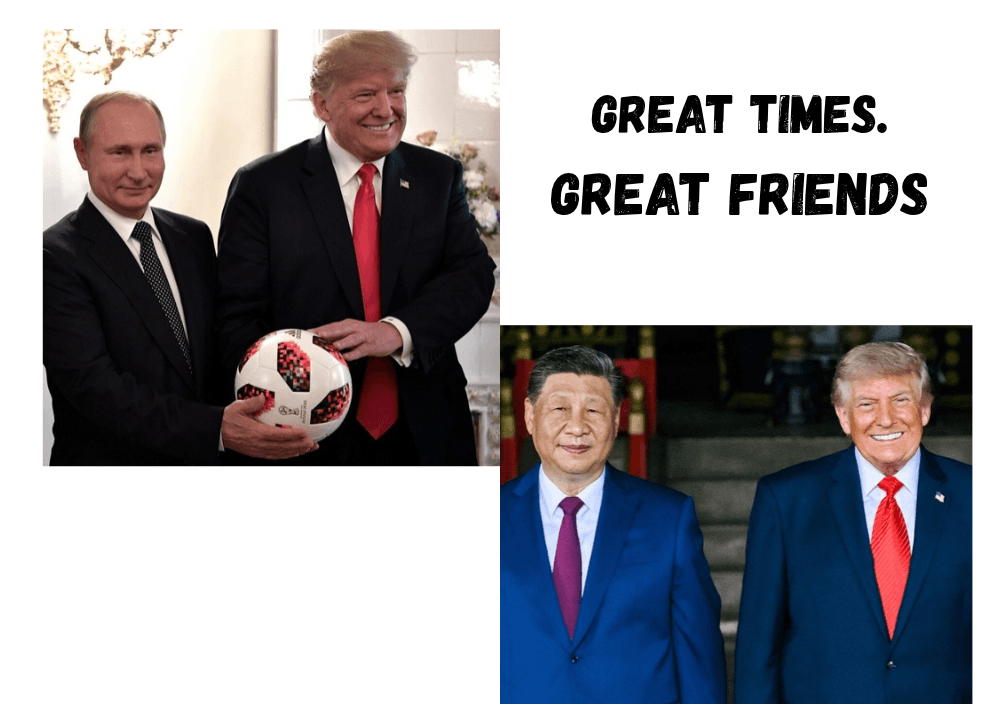
- A group of strongman leaders “see war as a legitimate and necessary tool to achieve national greatness.” Vladimir Putin, Donald Trump, Benjamin Netanyahu and Xi Jinping “believe that force rather than international law should be the decisive factor in international affairs.” They are not Hitler or Napoleon, Rachman writes, but all of them “believe that they are historic figures, whose destiny is to make their nations ‘great again’.”
- A law-governed world is giving way to a might-makes-right world. “As the global balance of power shifts and strongman rulers become more common, so international rules and laws are breaking down.” The strongmen see war as “a natural and necessary part of human affairs.”
*****
How to understand what we face? Westad turns to “one of the biggest disasters in human history.” The First World War killed or injured forty million and “destroyed a world where many people believed in progress and gradual advance and replaced it with a cynical and desperate world, in which nations and ideologies were natural and necessary enemies.”
The historian proves that a jeremiad doesn’t have to be long and mournful. Westad delivers a tight book on “the most important issue of our time, the question of war and peace.” His introduction is titled “Warnings from History,” his three chapters “The Rise of the Great Powers,” “Fears and Resentments” and “Causes of War.” The conclusion seeks hope under the heading “The Case for Peace.”
Starting with the grouch shared by all historians — that people forget history — Westad observes that today less than half of one per cent of the world’s population has experienced Great Power war. “Most people who are of age today have grown up in relatively stable worlds that were presided over by either one or two superpowers,” he writes. “Those worlds were not peaceful, but they were to some extent predictable.”
No longer, he declares:
“We are entering a phase where multiple Great Powers jostle for supremacy within regions and within human endeavours such as nuclear technology, artificial intelligence, or space exploration. Trade, which was becoming freer for two generations, almost back to where it was before World War I started, is increasingly more restricted and fragile and trade wars are breaking out among major powers.
“The world is unlike anything any of us have experienced in our lifetimes. But it does look quite a bit like the world of more than a hundred years ago, from the late nineteenth century to 1914. Back then we also had a world of many Great Powers that clashed with one another and sought to dominate their neighbourhoods. Nationalism and populism were on the rise, and many people felt that the globalisation of the day had not worked for them. Protectionism and tariffs increased and growing numbers blamed the citizens of other countries for their problems. Immigration and terrorism were among the big issues.”
Westad sees China standing where Germany had reached in 1914, rising “from almost nothing to become one of the world’s leading powers.” Like Germany under the Kaiser, he writes, China’s assertive foreign policy is not an unmitigated push for conquest. As much as pride and ambition, it is driven by fear and hubris: “Xi Jinping is afraid that he will lose control at home and that the US and its friends and allies are aiming to encircle China and destroy its rise through producing economic stagnation and political dissonance.” China’s answer is to seek “a predominant position” in Asia.
In turn, China provokes fear in the United States: “While still the most important global power, the US is going through an era of political and social unrest and a deep fear of decline.” Its unpredictability is adding to the multipolar complexities: “Just as Britain before 1914, the US is today deeply uncertain about its role in the world and insecure about its domestic and imperial order.”
Using the outbreak of the First World War as the model, Westad identifies “potential flashpoints for Great Power conflict, from Taiwan, Korea and the South China Sea, to the Himalayas, Ukraine and the Middle East.”
Our world is as messy as the international scene that created the First World War, Westad says, and today’s leaders are no better. Facing complex and confrontational times, leaders must manage the transition to multipolarity without creating spheres of influence based on brutal might-makes-right calculations. To avoid Great Power conflict, today’s version of the president, kaiser or czar must know how to deter, but also “how to buy time and avoid uncontrollable escalation.”
*****
Peter Apps begins his warning with a frightening estimate: “During the writing of this book, several people have asked me how likely I believe a major war to be. My personal belief is that the risk stands at around 30 to 35 per cent over the coming decade.”
If you had a one-in-three chance of winning millions of dollars over the next decade, you’d be ecstatic. But a one-in-three possibility of a world war means the millions in play are people’s lives.
As in the early years of the Cold War, Apps writes, “the world looks like it’s entering a cycle in which repeated and sometimes overlapping crises can fuel repeated escalation.” While still short of the visceral terror of the most alarming Cold War years, “the prospect of the world being torn apart by multiple atomic blasts is once again no longer unimaginable.”
Apps predicts the most dangerous time may be the arrival of a new US president in 2029. He thinks the “sheer unpredictability” of Donald Trump “may act as an effective deterrent” for Xi Jinping and Vladimir Putin until then. Trump will continue to damage the US, and a new president in 2029 will face compounding uncertainties.
Xi and Putin are ageing leaders seeking to deepen their legacies. Apps sees “a highly credible chance that whoever is in power in Moscow or Beijing may wish to test the next US president as they enter office.” If Russian and Chinese leaders “believe that they can take something by force, then they will try to do so — and perhaps unleash catastrophe.”
The response to perilous times is to find a balance between “complacency and panic,” a formula offered to Apps by the British strategist Lawrence Freedman. But what if WWIII is already under way? The Reuters columnist reports a belief in Eastern Europe that a new world war has started and is escalating from Ukraine to elsewhere.
Apps rejects the view that Russia’s 2022 invasion of Ukraine marks the start of a new great war: “Firstly, because I dislike the idea that endless escalation is inevitable, but secondly because the death, destruction and disruption we have seen so far, horrific though it is, would be dwarfed by the consequences of a true new global conflict. Still, it is increasingly undeniable that a serious battle for the future of the world is already under way.”
Gideon Rachman’s work on the threat of WWIII builds on his three previous books. In Zero-Sum World (2010) he warned that the global financial crisis of 2008 would cause a backlash against globalisation, a growth of populist parties and a surge in international tensions. In Easternisation: Asia’s Rise and America’s Decline (2016) he showed how the economic might of Asia was undermining Western power, describing “a dangerous rise in diplomatic and military tensions” as China challenged America and Japan.
Later, in The Age of the Strongman: How the Cult of the Leader Threatens Democracy Around the World (2022), he documented how authoritarian nationalists thrive on “the rhetoric of violence,” undermine liberal principles and increase the risk of conflict. The strongmen stalk the stage, brandishing weapons and stirring anger.
Today’s wars and flashpoints, Rachman notes, “have so far been largely separate regional conflicts,” but a world war would link conflicts on several continents at the same time. The emerging link he sees is an “axis of adversaries” or “axis of upheaval” joining China, Iran, North Korea and Russia. “The four members of the ‘axis’ have similar aspirations,” he writes. “All of them want a regional sphere of influence free of encroaching American power.”
When North Korean troops joined Russia on the front line in 2024, Ukraine’s president Volodymyr Zelensky described it as “the first step to a world war.” While Zelensky “had an interest in dramatising what was at stake,” Rachman says, “his statement was more than mere hyperbole.” The four axis nations are united in the effort “to challenge the US-led world order.”
Russia deploys Iranian-designed drones to attack Ukraine. North Korea sends troops, missiles and ammunition. While not supplying complete weapon systems, China provides Russia with technology “crucial to fighting a war, such as semiconductors and radar equipment.”
All of the axis powers are authoritarian nations opposed to the West’s promotion of democracy, “which they see as barely disguised attempts at regime change through Western-sponsored ‘colour revolutions.’”
*****
Comforting observations about the strength of the West and democracies smash into the spectre of Donald Trump. He stomps through these three books, blindsiding America’s friends and offering comfort to foes. He capriciously abandons Ukraine; would he throw Taiwan to China?
Trump teaches the world what it means not to rely on the US. He imposes tariffs on allies and demands they pay for America’s protection. A for-profit presidency proclaims: show-me-the-money. The mafia method needs little policy and no principles.
Trump may be the symptom of a trend that will outlast him — an American retreat from the central role it has played in global affairs for eighty years. Adversaries step up while the US steps back.
Rachman observes that Trump is “clearly prepared, in some circumstances, to align with the axis of adversaries and against America’s traditional allies.” Trump’s international approach is “more a set of instincts than a coherent grand strategy,” a worldview “driven by a few long-held beliefs and prejudices, an insatiable appetite for attention and ‘wins,’ and an eye for business opportunities.”
Apps sees America’s relations with its allies becoming more factious and transactional: “Among almost every major democracy, there was a feeling of crisis and looming dread about the future. The question was: what were they prepared to do about it?” The loss of confidence in the US, he writes, means talk about getting nuclear weapons is “subtly gaining traction.” Apps lists Australia as one of those countries that might go nuclear, along with “South Korea, Poland, Ukraine and even Germany and Japan.”
Westad notes that Trump is “cutting loose former partners in Europe and elsewhere to concentrate on America’s own problems.” The historian says the US is caught between a confrontational view of its main rival, China, and Trump’s “wish to do far less in international affairs overall. In an almost exact parallel to early-twentieth-century Britain, the US wants to be respected as the number one country while also wanting to do less and less to defend that position.”
The war Trump launched against Iran in February showcased America’s formidable military strength but also the limits of hard power, Apps writes: “This was warfare as only the US could fight it. Only the world’s pre-eminent superpower could conduct high-tech military action on this scale half a world away, justifying its actions through its own ruthless priorities. Iran, though, proved more resilient than expected.”
Apps quotes the judgement of Amr Hamzawy of the Carnegie Endowment for International Peace: “The Iran war is becoming one of the pivotal moments in history that are measured not merely by the outcomes of military battles, but by the profound impact they leave upon the political and symbolic standing of major powers.”
American bombs and missiles have not delivered what Trump wants in Iran — a conclusion made even sharper by Trump’s hazy blustering about whatever those aims are. Apps writes that Xi Jinping took advantage of this strange dynamic:
“The Chinese leader was soon welcoming multiple leaders from every region of the world to Beijing at an ever-faster rate, proclaiming China as a more stable alternative against what he called the “law of the jungle,” and defender of a “multipolar world.” In reality, Moscow, Beijing and Washington were all simultaneously confronting limits to their military capability to achieve their political aims, even as all three poured more and more effort into the tools of military coercion.”
In attacking Iran, Rachman writes, Trump casually “reversed the arguments he had made for many decades about the risk of a third world war. He had once endorsed the idea that it would be dangerous folly for the US to attack Iran.” In his victory speech in 2024, Trump had proclaimed: “I’m not going to start a war, I’m going to stop wars.”
Rachman says America’s European allies have simultaneous worries — that Trump is “too warlike in the Middle East and too intent on peace at any price in Europe.” A “particular danger of our era,” he says, is the mismatch between Trump’s flirtation with spheres of influence and the reality of the American alliance system built since the Second World War, with 750 US bases in eighty countries: “If it came to it, would America really not intervene in the case of an attack on Japan? Or Poland? Or Britain? Nobody can really be sure of the answer to the questions any more. That creates uncertainty. And uncertainty creates danger.”
*****
Confronting the same awful prospect, the three writers offer similar approaches, defined by caution, reason and hope.
The main lesson from the First World War, Westad says, is that “sudden and dramatic changes in Great Power constellations may lead to war” but there are always choices. The decision for war has three main elements: estimates of relative power; attitudes and beliefs; and the immediate cause or crisis. From this mix, war “may emerge from misperceptions and miscalculations.”
Very few leaders inherently believe war is the best outcome for their country, Westad writes, but they are pushed by “fear of humiliation, fear of losing, fear of deception, fear of being too late. World War I went from crisis to conflict mainly because of debilitating fear. The ability to learn to live with fear and uncertainty is a key element of strategy but one that is hard to attain.”
Surveying the gathering storm, Westad offers this conclusion on what could trigger another great war:
“The lack of experience we have with Great Power multipolarity makes the years ahead very dangerous. The worry is not so much accidental war or large-scale wars of conquest. It is that in an increasingly complex world, the definitions of interests that Great Powers are developing are both broad enough to be dangerous and narrow enough to be hard to retreat from. Unlike a cold war, where ideologies, in the end, made for enough flexibility to avoid cataclysmic war, the mix of nationalism and interest-based politics in today’s world makes it harder for Great Powers to retreat in times of crisis and easier to believe that, given the stakes on one’s own side, the other guy will blink first.”
Gideon Rachman says he is not predicting that WWIII is inevitable, but analysing developments that are well underway:
“The Russian invasion of Ukraine has already fundamentally altered the world; so has the war between the US, Israel and Iran. But the main reason why it would be wrong to be fatalistic about a third world war is that there remains a great deal of choice for both political leaders and the nations they lead. The growing dangers of conflict are impossible to ignore. But the future is, fortunately, not yet written.”
Peter Apps takes some comfort in how the Cold War played out in the twentieth century. “Luck and common sense could hold,” he writes, and WWIII “might yet be postponed and deterred indefinitely.”
Apps ends by describing the first months of 2026 as delivering “sound and fury, leaving the world even more combative and disjointed. The coming months and years would likely prove at least as testing. A new world war was eminently preventable, but that would require effort and innovation. And time might be running out.”
Great power politics is back. And that means the chance of great war between great powers is also back. War in Ukraine. War in the Middle East. A damaged president in Washington, rejected by midterm voters, will seek glory (and gold) beyond America. China constantly rehearses an ever-bigger naval blockade of Taiwan while Japan proclaims it’d go to war to keep Taiwan free.
Sitting uneasily between war and peace lies the “grey zone” of constant cyberwar, black ops and hacks, sabotage, propaganda and misinformation.
Trust is in short supply in a time of truculence and turmoil. The international order sags, shifts and splinters. Rules are contested. Norms are ragged. The international arc is raw and rough. The danger of great war means the “great” leaders of this century must do a better job than their predecessors in the first half of the last century.
The rhymes of history threaten to become another great funeral dirge. •
The Next World War: The New Age of Global Conflict and the Fight to Stop It
By Peter Apps | Wildfire | 472 pages | $34.99
War Is Interested In You: The Breakdown of International Order and the Threat of World War Three
By Gideon Rachman | Bodley Head | 336 pages | $39.99
The Coming Storm: Power, Conflict and Warnings from History
By Odd Arne Westad | Allen Lane | 256 pages | $49.99
This review first appeared in Inside Story.