
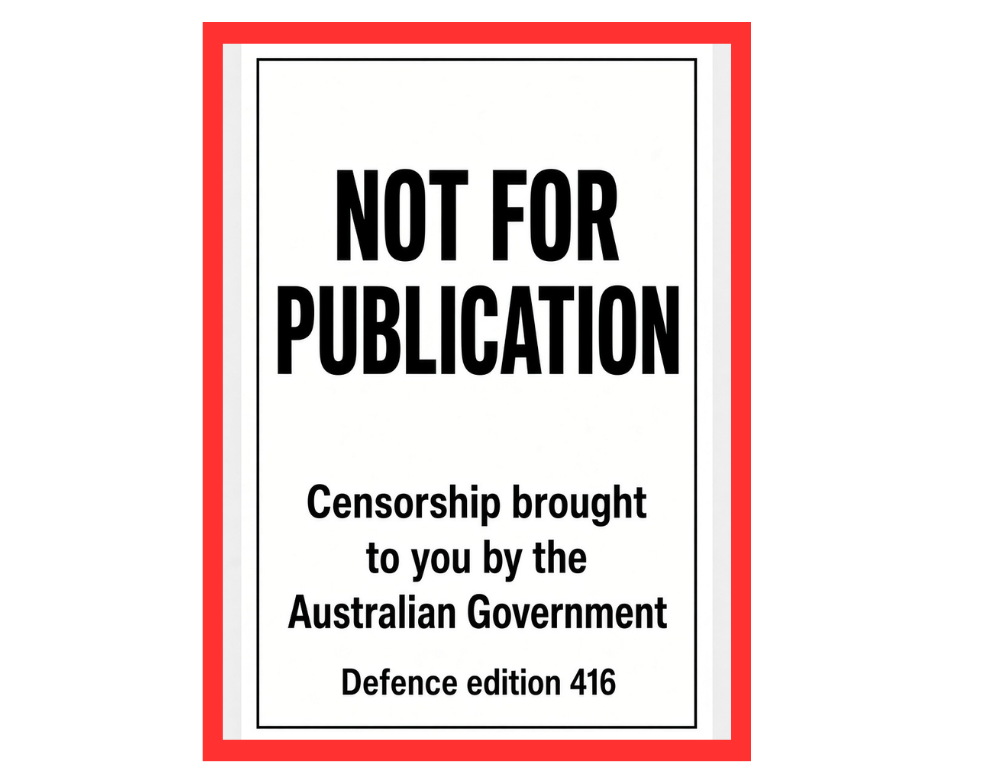
Defence officials are often accused of being unimaginative and bureaucratic. But when it comes to new ways to hide information and obscure even simple issues and activities from the public, Defence officials can be very creative.
This hasn’t been lonely work. Defence officials have been operating in an encouraging environment for censorship under the Albanese Government. Despite its protestations about being the most transparent government in Australian history, Mr Albanese’s outfit is proving to be the most secretive – outdoing even the Government of former prime minister Scott Morrison.
Given the drive to keep information about Defence’s performance from the public, it’s not surprising that officials might be searching for new ways to censor and withhold information. That search must have got harder, given the big toolkit officials have already built. But Defence leaders seem to have thought they’d found a way.
Last week, a Defence Deputy Secretary – that’s a very senior rank held only by experienced public servants, just under the Secretary in charge of the Department — gave evidence in a pretty ho-hum public hearing on property sales at the Federal Parliament.
At the end of her time before the Committee, Celia Perkins rolled out a groundbreaking and potentially quite broad attempt at censorship and secrecy, telling the Senators:
“I would note, for the record, that the Defence witnesses appearing before the committee today are pleased to take your questions but they do not consent to the reposting of our evidence to social media sites or the reproduction of our likenesses for the purposes outside the framework of the parliament and the transparent public proceedings of this committee”
Yes – the official seems to have been trying to stop video footage or even transcripts of their evidence from being sent out on platforms like Instagram, X, Facebook or Tik Tok by asserting personal control over it. Maybe Defence is concerned that someone under 16 might access it and be traumatised – who knows??
The statement was read out from a document or notes that this senior official had with her, so it wasn’t some spur of the moment outburst. That means it had been thought through and prepared ahead of time. Perhaps even subject to consultation within the echelons of the Defence leadership.
What is so extraordinary about this claim isn’t just that it is wholly wrong. Or that it was rapidly and completely rejected by the Senators and the clerks of the Senate.
The extraordinary thing about this claimed power to control what use anyone made of the official’s statements after an open hearing in our country’s Federal Parliament is that the official somehow thought it was appropriate to make the claim at all.
Maybe it’s understandable given the mountain of other times and ways that Defence officials and their government masters have prevented any informed public debate on their policies, programs or performance by withholding even basic – and completely unclassified — data from the public.
A government that talks transparency but practices secrecy and censorship
After all, as mentioned, Prime Minister Albanese leads a government that discloses less and hides more from the public than Scott Morrison ever did. Our current government completely refuses more requests for information than it grants. And its refusal rate on requests to release information is double what the statistics show from a decade ago.
And nowhere in the Commonwealth Government makes more sweeping claims to secrecy than the Defence Department, its ministers and its senior military and civilian officials.
It’s now part of the expected routine with any Defence announcement or media engagement to hear that they can’t tell us much without risking grave damage to our nation’s security. As an example, here’s Pat Conroy actually telling us that “too much information is unhelpful in the public domain” – probably because in the case he’s being questioned about, that information shows Defence is failing to protect even its key airbases from simple drones – something Mr Conroy might find it unhelpful for the public to know…..
In the silence, we just need to trust them and let them get on with spending the hundreds of billions of dollars we give them to build an effective defence force in any way they see fit. And praise them for their fine work.
Defence ministers and officials are well-practiced in invoking national security, operational security, classified information and even commercial confidentiality to withhold information. That lets them congratulate themselves without anyone being able to say anything different.
Officials also use – and overuse – other tools like the powers to restrict information under the FOI laws. And they are increasingly saying that privacy concerns under the Privacy Act prevent them from naming the names of anyone accused of corruption or misconduct.
Right now, Defence’s own military courts are issuing suppression orders to stop journalists naming a retired military officer who is accused of some kind of misconduct or wrongdoing – when similar charges against an ordinary Australian citizen would be heard in open court with the name of the accused a matter of public knowledge.
A recent manoeuvre that has proven extremely effective in muzzling even the independent National Audit Office is Defence’s invention of a new “Not for Publication” label that is slapped on information about major defence projects’ milestones and delivery dates. This novel new device, which is applied to information that is wholly unclassified, has ended the Auditor-General’s production of its annual Major Projects Report.
That report was the primary way anyone outside Defence found out anything about the progress and problems in Defence’s big projects which spend hundreds of billions of taxpayer dollars. It routinely disclosed failures, problems and delays and made ministers and officials uncomfortable by revealing their failings.
So it’s simply a coincidence that those officials found a way to kill it. It turns out that if a project fails in a forest but no one can be told it happened…….maybe no one needs to be held accountable and life can trundle along nicely for all concerned.
With this as normalised and supported behaviour, trying out novel new forms of censorship might make sense within the Defence institution’s echoing corridors.
But outside the bubbles of the ministerial wing of Parliament House and the Defence Department’s Canberra headquarters , the now pervasive withholding and censoring of information about our nation’s Defence organisation and its performance is corrosive and damaging.
Not only do Australian taxpayers and voters have the right to know whether the $62.6 billion we’ve given Defence for just this year is being spent badly or well, we also have a right to know how well or badly the public servants we trust to run Defence are performing in this use of national treasure. And they have a responsibility and obligation to give us the information to judge this.
The Pentagon released 500 pages of “supporting documentation” on just the US Navy’s shipbuilding programs as part of its engagement with the elected representatives in the US Congress looking at this year’s US Defense budget. That’s just normal practice in the US system, and the information incudes detail about the Navy’s highly classified programs – like the construction costs, dates and delivery details for the Columbia Class ballistic missile submarines.
Meanwhile, Defence here has censored and stopped the Audit Office releasing just tens of pages on Defence’s top 30 projects across the Navy, Army and Air Force in its annual reporting, withholding information the US routinely releases.
Disclosure of names is more than possible – it has been done, because it’s in the public interest
Turning to the increasingly frequent claims from ministers and officials that the Privacy Act stops them from naming people involved in any controversy or misconduct, the Australian Capital Territory’s Integrity Commission has somehow found a way in a recent report into corrupt conduct in local building contracting, despite being bound by the Privacy Act like everyone else. Here’s an extract from the Commissioner’s report on Operation Kingfisher:
“Names in this report
People and entities relevant to this investigation have been identified in this report, even where there is no criticism of their conduct. This is because it would otherwise be difficult to make sense of the narrative and to avoid speculation about who was involved in the relevant events. In accordance with the requirement in s 186, I am satisfied that it is desirable to do so in the public interest and will not cause unreasonable damage to their reputation, safety or wellbeing.”
So, it is absolutely possible to name officials accused of wrongdoing or misconduct – and it is in the public interest. Overuse of Privacy Act justifications for censoring and silence just don’t hold up under examination.
Remembering the basics about Australia’s system of government
On top of the sheer scale of public money involved, officials working for the Federal Government in Defence are part of our democratic system. And in that system, the government of the day, the people elected to Parliament and the public servants who work for the Commonwealth’s departments and agencies are all responsible to the Australian population for what they do on our behalf.
It’s core to any public servant’s work for them to understand that they are required to perform their work with openness, honesty and transparency. Narrow, thoughtful exceptions around actual secret information and the deliberations of Cabinet are necessary. But officials and ministers are far too ready to reach for the secret or classified label for material that might be simply embarrassing or uncomfortable to disclose. In an open system of government the default is disclosure, not secrecy.
Performance is improved through openness and accountability. Corrupt conduct, incompetence, insider trading and poor performance thrive in the darkness – as the Royal Commission into Victoria’s Big Build seems likely to uncover.
Our public officials are required to hold themselves and their colleagues to account when there are shortfalls and failures. And they must expect others – in the Parliament and in the Audit Office for example – to hold them to account using the independent powers these parts of our system of government possess.
Public servants now understand very well that they are accountable to the ministers of the government of the day. But with this most recent example of overreach and attempted censorship from Defence, they seem far less clear about their responsibilities and obligations to our Parliament and the Australian public. There is a more than a whiff of entitlement to behave as if the Defence Department is their own private business, not a public institution wholly owned and accountable to the Australian people.
Yet officials’ responsibilities to the public and the Parliament are central to how they should think about and perform their role in the public service every working day.
The best case path from here
The most interesting things to watch in the aftermath of this disastrously misjudged and wrongheaded attempt to censor the workings of our Parliament is what the Defence leadership and the ministers responsible for it – Richard Marles and his assistant Pat Conroy – do about it.
The new secretary, Meghan Quinn, knows she is the official who is responsible for all matters of administration in her department. With this latest performance, it must be clear to her that a major education and training program is required to correct officials’ understanding of basic things about their roles and responsibilities. If someone as senior and experienced as this deputy secretary can make such a misjudgement, then there seems to be a systemic problem.
Maybe this overreach in attempted censoring of the Parliament will be the event that resets the Government’s path on public disclosure of government information. Maybe we’ll see Secretary Quinn and Deputy Prime Minister Marles realising that openness and transparency are the medicines needed to turn Defence from a troubled organisation into a high performing one.
Maybe the Audit Office will find that it can release a new Major Projects Report because Defence has suddenly rediscovered that basic information on these projects is actually “For Publication”.
And maybe that can be the start of reducing the decline in public trust in Government, ministers and public officials.
The idea that an informed public and an informed Parliament is key to our national defence is a simple one. But giving effect to it will require a major behavioural shift from the Albanese government’s ministers and from every member of the Australian Public Service.
This is about Defence, but it’s bigger than just the leadership of that opaque but important institution.