
“The Asia-Pacific can no longer be classified as fully at peace.”
from IISS’ Asia-Pacific Regional Security Assessment 2026
That Asia is no longer fully at peace is the first sentence in the annual security report by the International Institute for Strategic Studies.
The IISS’s first chapter on this “combustible mix” examines the military doctrines of the United States and China, and the “duelling visions” the militaries of the two giants would bring to a Taiwan war.
China plans for a quick win that would deny the US any chance to intervene. The US, in turn, plans for a longer fight to frustrate and foil an invasion. To prevent China from dominating the region, US strategy aims to “‘erect a strong denial defence along the First Island Chain” from Japan, Taiwan, the northern Philippines, and Borneo to the Malay Peninsula.
Contemplating “a major conventional war,” the IISS chapter comments: “China is a peer military competitor and a centrally located major power with modernised conventional forces specifically designed to challenge and resist US forces.The Pentagon has called China its ‘sole pacing threat’ and has identified the ‘denial of a Chinese fait accompli seizure of Taiwan’ as its ‘sole pacing scenario’.”
The invasion scenario assumes China would direct air, missile and cyber strikes against Taiwan, and against US military bases in Japan and Guam. The aim would be to cripple command-and-control, logistics, and air and maritime capabilities so China could mount “rapid amphibious-landing and airborne operations on the island while simultaneously degrading the US military’s ability to respond.”
At that point, the US president faces a huge choice: whether to authorise American attacks on mainland China. American doctrine calls for an attack on what it calls China’s “A2/AD capabilities”: China’s Anti-Access/Area-Denial network, a dense system of networks “designed to make US military operations near China’s borders dangerous, expensive, and ineffective.”
The choice to launch long-range missiles at China’s bases would be a president’s Truman-MacArthur moment. During the 1950-51 Korean war, General MacArthur wanted to bomb Chinese supply lines and industrial centres, and drop atomic bombs along the Yalu River to block Chinese troop movements. Truman said no and the general had to go.
The IISS judgement is that attacking China might slow but not defeat a Taiwan invasion. Beijing “would see an attack on mainland China as escalatory. And by that stage, degrading the PLA’s long-range anti-ship and land-attack capabilities might not be sufficient to stop Chinese military operations.It might merely enable US forces in the region to initiate offensive or counter-offensive operations.”
The timetable conundrum for Beijing is that a lodgement of its invasion force would likely stiffen Taiwanese resolve rather than force a surrender. China would aim for a victory in three days, IISS judges, whereas America might only need to prolong the conflict for a matter of weeks:
“Planning for denial over weeks instead of three days would allow for more comprehensive crisis management, increase the chance of ultimately achieving denial, decrease the risk of nuclear escalation and minimise the chance of the US becoming entangled in a strategically costly war.
“Whatever the American calculations on timing and duration were, Washington would be compelled to balance the risks of escalation and alliance cohesion against that of diminishing credibility. Regional US allies witnessing the US fight and lose may doubt its ability or appetite to defend them and thus be more inclined to accommodate China’s interests and reassess their defence ties to Washington. At the same time, conflict with China would risk escalation, potentially to a nuclear level, given the strategic importance of Taiwan to Beijing. Even a limited nuclear exchange would be catastrophic for the region.”
At the Shangri-La defence dialogue in Singapore at the weekend, the dominant factor was the relatively successful Beijing summit between Donald Trump and Xi Jinping. The ominous words, though, were Xi’s warning. “The Taiwan question is the most important issue in China-US relations,” Xi told Trump, according to state media. “If mishandled, the two nations could collide or even come into conflict, pushing the entire China-US relationship into a highly perilous situation.”
Shangri-La noted a striking difference in tone on Taiwan from US Secretary of War, Pete Hegseth.
Last year at the dialogue, Hegseth cast aside the long-standing American policy of “strategic ambiguity” to declare America would go to war to stop China invading Taiwan.
Hegseth said the Trump administration’s military policy was to pivot from Europe to Asia, to deter China’s threat and thwart Beijing’s quest for regional supremacy. The key words from Hegseth at Shangri-la 12 months ago were: “President Trump has said that Communist China will not invade Taiwan on his watch. Our goal is to prevent war. And we will do this with a strong shield of deterrence …. But if deterrence fails, we will be prepared to do what the Department of Defense does best—fight and win—decisively.”
No “fight and win” declaration 12 months later. Hegseth did not once mention Taiwan when he was on stage. A question on the proposed $14 billion arms sale to Taiwan got him to say it was the US president’s decision whether or not to agree to this. That was it.
Instead, the secretary of war said the US aimed for a “genuinely stable equilibrium” that denied China the ability to “impose its hegemony.”
The argument for military balance rests on big economic interests.
Modelling by Bloomberg Economics in February found that a Taiwan war would cause economic losses totalling US$10.6 trillion, erasing 9.6% of global GDP. This would exceed the impact of the COVID pandemic or the 2008 global financial crisis.
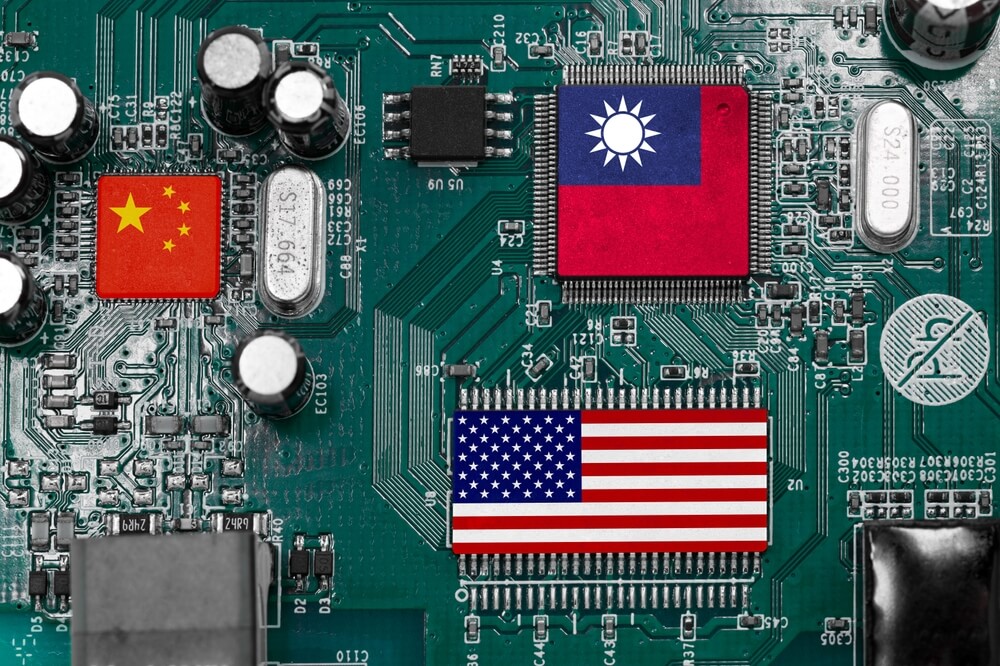
Taiwan produces the advanced semiconductors that power everything from AI data centres and smartphones to cars and aircraft. A war would cause a collapse in US-China trade, tariffs imposed by US allies on China, and severe disruptions to shipping in the Taiwan Strait.
Bloomberg projected Taiwan’s economy would shrink by 40%, China’s would contract by 11%, and a 6.6% hit to the US, driven by chip shortages and supply chain disruptions. The study estimated South Korea’s GDP could fall 23%, Japan’s 14.7%, the European Union’s 10.9%, and India’s 8%.
Such modelling doesn’t seem to worry investors. Taiwan’s stock market has just surged past India to become the fifth largest in the world, standing behind the US, China, Japan and Hong Kong. AI optimism means investors see Taiwan as a buy, as the world’s largest chipmaker.
Hope that those silicon chips keep Taiwan and the world happy, and China and the US never come to that moment when all their military chips are on the table.
Graeme Dobell is reporting for SAA from Singapore’s Shangri-La defence dialogue, by IISS.