
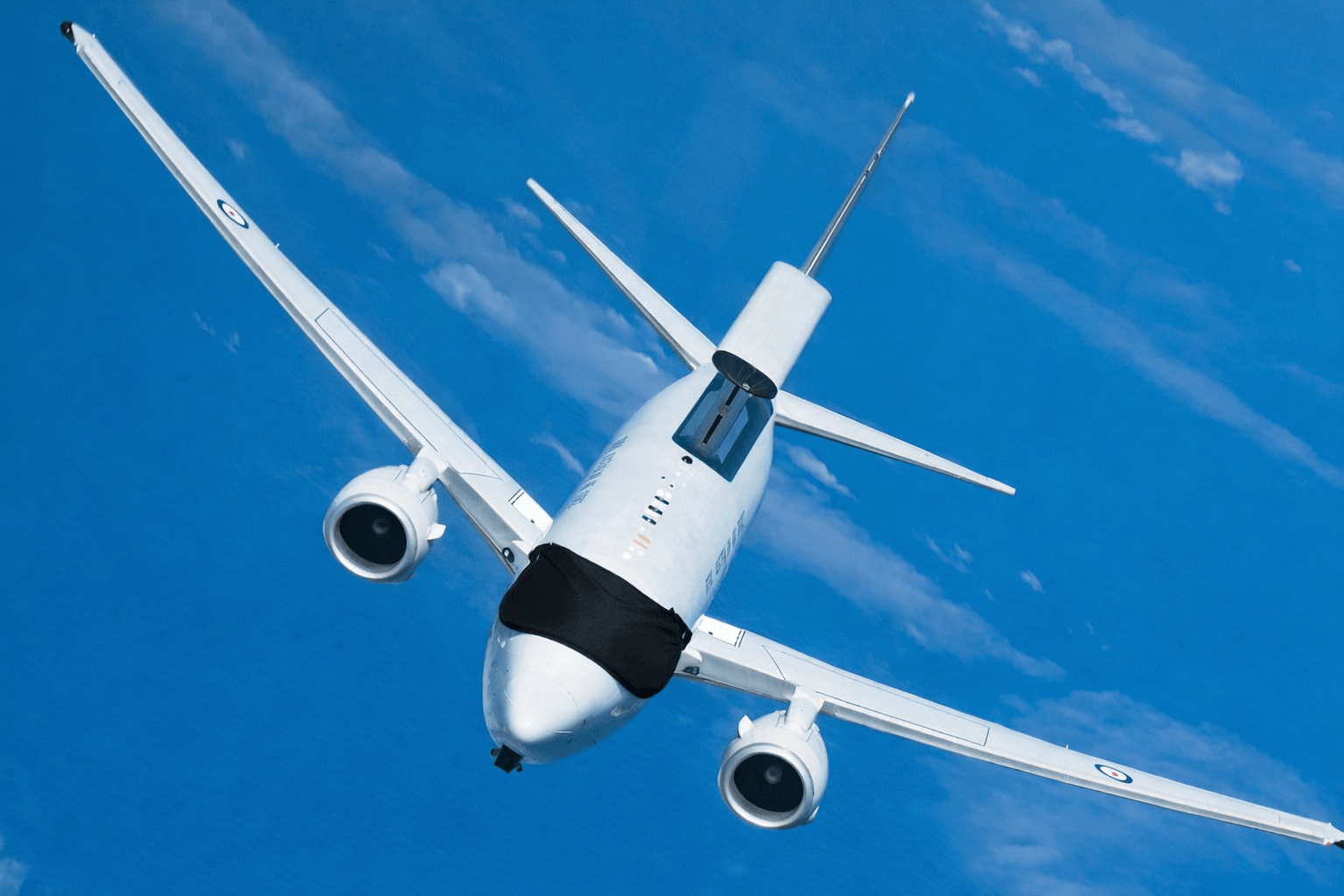
Is it believable that the world’s most advanced airborne early warning and control aircraft, the Royal Australian Air Force’s E-7A Wedgetail, is going to be flying around in the Middle East but limited to only providing defensive information about incoming missiles and drones and then only to the United Arab Emirates?
No. Although that is what the Australian public is expected to believe listening to the prime minister and his senior ministers.
Maybe it’s what they believe. If so, they need a more accurate briefing. Or they have imposed some very unusual limits to working with our major ally—limits that will be very obvious and very annoying to our partners—and very restrictive given what the Wedgetail has done as part of coalition operations against Islamic State in the recent past.
Richard Marles, the Minister for Defence, tells us that Australia has received requests from the UAE, the United States and other governments to deploy the Wedgetail aircraft, but has been at pains to say that “the request that we’ve responded to is the UAE”. This line has been repeated by the prime minister and other senior ministers.
We haven’t heard that the government has refused or agreed to the American request for the aircraft to be deployed.
At the same time as the Albanese government is sending this aircraft to the Gulf, we continue to hear that “the Albanese Government has been clear that we are not taking offensive action against Iran and we have been clear that we are not deploying Australian troops on the ground in Iran”.
Here’s Pat Conroy, Minister for Defence Industry, on Newcastle radio: “It will be flying extended periods of time to detect, using its radar, incoming missiles and drones, then providing that information to the command control system of the UAE who will then use missiles and other platforms to destroy those incoming rockets. So, this is purely defensive. It is purely about identifying threats to the UAE and other Gulf states and then providing that information so those threats can be dealt. So, it’s defensive, it protects the UAE, and protects the 115,000 Australians that are in the Middle East”.
In the joint media release announcing the deployment, the Government told us
“Australians will remember the E-7A Wedgetail was recently deployed to Europe as part of Australia’s assistance to Ukraine.
As it did there, the E-7A Wedgetail will provide long range reconnaissance capability which will help secure the airspace above the Gulf.”
Plugging in to US networks isn’t optional
That all makes sense. The Wedgetail is probably the most capable military platform for providing airspace management that helps ensure collisions and friendly force incidents are minimised in the densely populated airspace around the Gulf states and Iran. And its active and passive sensors can spot, identify and track mobile targets in the air, at sea and on the ground (if they are emitting electronic signatures or have a decent radar cross section).
But to do this job, the Wedgetail and its crew will need to be plugged into the US command and control and data stream—both to receive information about US and Israeli activities and to provide threat data and airspace deconfliction data to them. This means that the Wedgetail’s operational activities will be informed by US and Israeli decisions but will also help enable and inform those decisions.
The idea that the Wedgetail will receive data from the US and Israeli forces operating against Iran and contribute to the defence of Gulf States including the UAE, but will not provide the detailed, timely and very useful data it collects to the two attacking forces is sufficiently ludicrous to be unbelievable.
The Wedgetail’s capabilities match US and Israeli war needs
Why would the Americans request deployment of the E-7 Wedgetail aircraft?
There are signs that airspace management and operations in the US and Israeli air campaign are under strain: the US has now lost an air-to-air refuelling aircraft in a collision over Iraq. Certainly airspace management of US and Israeli aircraft would be a ‘traditional’ role for and AEW&C aircraft like Wedgetail.
But Wedgetail will likely play a more hands on role in the US and Israeli campaign. Despite the US and Israel hitting thousands of targets inside Iran in the 13 days of the war so far, the Iranian military has continued to launch missiles and drones against Israel, US forces and populations centres, oil infrastructure, ports and shipping in the Gulf states.
So the current forces being used in the attack clearly are struggling to eliminate Iran’s missile and drone forces. These are either mobile or ‘pop up’ out of hidden facilities. The Wedgetail’s long range sensors and data processing ability make it perfect to help detect and identify these fleeting or hidden targets. It doesn’t need to fly into Iran to do this.
While Australian government ministers are focusing on the defensive role that the Wedgetail can play with the UAE—spotting incoming missile and drones—that same set of sensors will identify the points of origin of those missiles and drones—and these will be inside Iran. I find it impossible to believe that that data is not of intense interest to the American and Israeli forces.
I have not heard that the Australian government has decided that any such data collected by the Wedgetail will be somehow quarantined inside Australian and Emirati digital systems and not available to the US and Israel. And I don’t think I ever will hear that.
The US military knows the Wedgetail’s value from its success countering Islamic State forces
To give an idea of how much more valuable the Wedgetail is in a conflict than as simply a provider of defensive information for air defence, it is useful to look at the aircraft’s celebrated role in countering and defeating Islamic State in Syria and Iraq.
Islamic State did not have ballistic missiles and used drones in very limited ways. It was mainly a mobile ground force. So there was no air or missile threat for Wedgetail to defend against. But the Wedgetail was nonetheless deployed over 2015 to 2019 as an integral part of the counter-Islamic State mission and widely praised for playing an essential role in directing strikes and supporting the Iraqi Security Forces fighting against Islamic State.
This fight countering Islamic State is how the US military came to understand and value the Wedgetail’s capabilities and is no doubt a large part of why the US requested the current deployment. But the Albanese government tells us that the aircraft is in the Gulf to meet the UAE’s request….
To give real insight into the Wedgetail’s role and value in countering Islamic State, here is an excerpt from a Royal Australian Air Force account of what the aircraft did:
The RAAF’s “No 2 Squadron’s commanding officer stated ‘the Wedgetail had responsibility for the command and control of all Coalition aircraft in the battlespace management area, routinely managing more than eighty combat aircraft during a single mission. In an integrated force, the Wedgetail shared information with other Coalition aircraft, which allowed the force to have situational awareness across air, land and sea domains.’
The operational success of the Wedgetail made it the aircraft of choice with Coalition partners after its arrival in the Middle East in 2014. The aircraft operated over Syrian and Iraqi airspace in support of Coalition forces attacking Daesh ground forces, with an availability rate in excess of ninety per cent.
With aerial refuelling, the Wedgetail completed a record-breaking seventeen-hour mission over Iraq and Syria, the longest of any Boeing 737 in the world.
The Wedgetail was so reliable that whenever the United States Air Force (USAF) operated its F-22 Raptor fighter in-theatre, it invariably asked for the Wedgetail to support the operations. The Wedgetail’s Middle Eastern operations demonstrated unprecedented availability of a software-intensive technology of this complexity in a hostile operating environment.”
The Government’s “It’s sleepy time” protocol for Australian military working with the Americans
So, this uniquely capable, valued aircraft is now going to be flying in the area of operations during a war but in a highly constrained role that would not allow the US—or the Israelis—to take advantage of capabilities they need and that they know the Wedgetail possesses.
There must be some seriously unhappy Americans in the Pentagon and at CENTCOM if this is the case.
And there must also be some very clear operational rules of engagement for the Wedgetail crew and commanders that closely constrain what they collect and who they give it to. These would be great for the Australian public to see—with classified elements redacted, of course.
Those rules will need to be different to the “it’s sleepy time” standard operating procedure that we have heard is in place for Australian crew members on American nuclear submarines (The three Australian crew members of the US submarine that sank the Iranian frigate Dena were ordered to their bunks for the time the sinking took place—apparently to meet Australian Government directions).
An aircrew taking a nap while in flight has other dangers. Perhaps it’s a case of “We only collect the data, Lord knows what happens to it after it leaves the aircraft”. If so, then that is very like Admiral Nelson putting the telescope up to his blind eye to avoid seeing a signal he didn’t want. It would be wilful blindness.
Something doesn’t add up.
Of course, the Government’s policy line of Australian forces playing no role in offensive operations could rely on the fact that the Wedgetail is unarmed and is only collecting and providing data. But if it is collecting and disseminating information that enables strikes into Iran, then it is almost impossible to stretch reality and deny it is enabling the attacks. It is an integral part of what militaries call “the kill chain”, helping to “find and fix” targets that armed systems then “finish”.
Keir Starmer in the UK is trying to say that his approval for US B-1 and B-52 heavy bombers to use UK bases is purely “defensive”. But this is nonsense. Those heavy bombers are part of the attacking force operating over and into Iran and there is simply no way to characterise a B-52 on bombing missions as defensive while keeping a straight face
So, with the Wedgetail now deployed to the Middle East, Australia is a part of the Iran war. But you won’t hear that from our government.