
In a recent article, I argued that whilst nuclear-powered submarines are powerful platforms, there are many important things they can’t do, like shoot down drones or remove sea mines (which Iran used to close the strait of Hormuz).
SSNs are extremely expensive tools designed for specific tasks. Every dollar spent on them is a dollar not spent on other tools for other tasks.
Critics said that whilst opportunity cost is ‘the most legitimate concern over AUKUS’, that article failed to delve into the specifics. Well, I report on defence capability and acquisition for a living. I can be specific.
Everything that follows has occurred since AUKUS was announced in 2021.
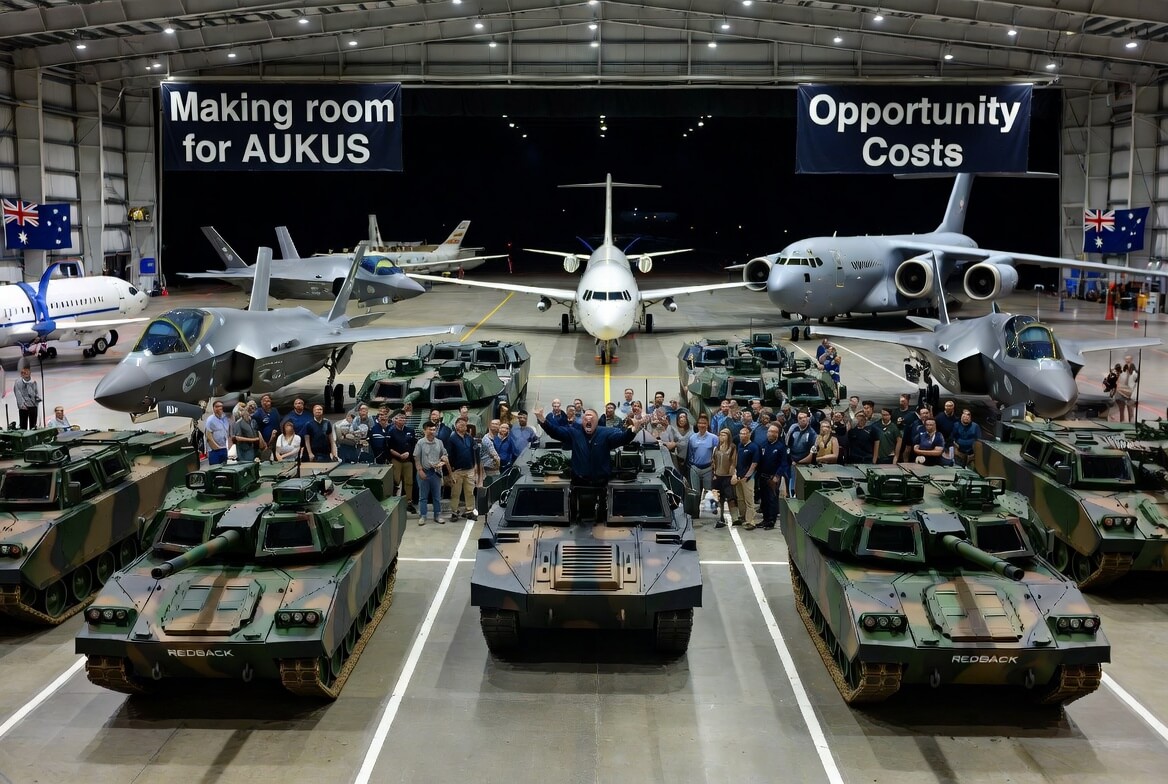
The acquisition of a dozen MQ-9B armed drones is cancelled without replacement. A fleet of seven Triton remotely piloted aircraft has shrunk to four. The fleet of ten Spartan airlifters is too expensive to operate. The Hawk lead-in fighter replacement is delayed. A fourth squadron of F-35s is no longer under consideration.
A replacement for the C-17s is cancelled. Air launched multi-domain strike is cancelled. A replacement for the EA-18G Growler fleet is cancelled. The E-7A Wedgetail upgrade is cancelled.
The plan to replace Army’s Vietnam-era M113s with 450 infantry fighting vehicles is reduced to 129. A second regiment of self-propelled howitzers is cancelled. Sixteen light helicopters for special operations are cancelled. The new Landing Craft Medium appear to be delayed. Service discretionary funds were cut.
The medium range ground-based air defence acquisition is back to square one. The ballistic and hypersonic missile defence acquisition has disappeared. The ADF still has no ground-based system capable of engaging targets past the range of our two NASAMS batteries. We still can’t build our own interceptors to replenish used stock.
A plan to acquire nine Hunter class frigates is reduced to six. The acquisition of twelve offshore patrol vessels is halved. One of RAN’s two hydrographic ships is decommissioned without replacement. The acquisition of maritime uncrewed aircraft systems is cancelled without replacement. A plan to acquire two new replenishment ships is cancelled without replacement.
A plan to acquire eight new minehunters is cancelled and two current minehunters are decommissioned. The refit of the Collins class submarines is descoped. The upgrade of the Anzac class is cancelled and ships decommissioned before construction starts on their replacements.
Two years ago, Navy’s sustainment budget was estimated to be $2.7 billion short of requirements out to 2028. The same year, both Canberra class ships were left stranded in the Pacific following total power failures and our two replenishment ships simultaneously broke down. A year later, fleet sustainment costs still rose twice as fast as indexed funding. This year, sustainment funding has dropped $283 million.
Acquisition funding is down $724 million. Wider project maintenance and training budgets are cut ten per cent. Sustainment funds for aircraft are dropping; last year an unknown number of C-17s broke down. Plans to build a sovereign Australian military satcom system were cancelled, then reduced to just one narrowband frequency with no wideband at all.
Our supply of 155mm artillery ammunition would last less than a week at rates of expenditure seen in Ukraine. RAAF Base Tindal would run out of fuel within a few weeks. We still have no strategic fuel reserve. Our strategic fleet tender program is stalled. The Henderson Defence Precinct is subject to private investment. Defence infrastructure upgrades in Canberra are cancelled so we can fund existing builds. The government is selling off huge swathes of the defence estate to try and raise $3 billion; ironically, the same amount we have already sent in non-refundable donations to (so far unsuccessfully) boost UK and US submarine construction rates.
Even the Defence mail system is being dismantled.
Australia’s defence industry is also suffering. In 2025, the combined revenue of the top twenty small-to-medium sized defence companies in Australia dropped almost 50 per cent from the year prior. Above-the-line contractors have been purged without equivalent skilled ADF/APS staff to fill their roles.
For all that, we will get two deployable SSNs.
Yes, SSNs are powerful. They can do things no other platform can do. The question is, how exactly are they better than all the capabilities we’ve lost (and will lose) to pay for them? I haven’t seen this answered anywhere.
They won’t provide protected mobility to infantry. They won’t provide wideband satcoms. They won’t provide battlefield airlift or constant uncrewed aerial surveillance. They won’t provide air defence, replenish ships at sea, remove sea mines, deploy helicopters, train new pilots, conduct hydrographic research, deliver the mail. These capabilities are all eroding as money flows into nuclear-powered submarines instead. More will follow as AUKUS now consumes up to a quarter of the entire integrated investment program.
It would be easy to read all this and say, well, not everything is attributable to the cost of AUKUS. Our defence strategy has been reviewed. Efficiencies have been found.
That’s true. Maybe we don’t need 450 infantry fighting vehicles or nine anti-submarine warfare frigates. Maybe the new Collins refit plan makes sense. Many individual decisions, viewed in isolation, have merit. You could also point to acquisitions made since 2021, like the Ghost Shark, Mogami frigates or HIMARS, and make a similar point. It’s certainly not all bad news.
But let’s not miss the forest for the trees: the atrophy, the job losses, the cancellations without replacement, falling sustainment budgets, the foregone possibility for new acquisitions to be additional to those lost.
I’m sure there will also be the usual vague reasons why this article should be dismissed out of hand: it’s a ‘bad argument’ that ‘misinterprets the facts’, a ‘false premise’ or ‘false equivalence’ that ‘misunderstands the strategy of AUKUS’. Or maybe, once again, I have not ‘accurately understood the problem’ nor the role of SSNs nor maritime geography. None of these lines engages with all the specific opportunity costs we’ve already incurred. Instead, they seem designed to dismiss anything that isn’t simple, blind support for the SSN acquisition.
Don’t get me wrong, SSNs really are incredible machines. You don’t need to be Sun Tzu to read a map and grasp the logic behind AUKUS. Our maritime territory and wider interests are vast. 99 per cent of our trade travels over sea routes that are now under pressure from a non-aligned power for the first time since World War Two. Yes, if money was no issue, SSNs could absolutely help address this challenge.
Unfortunately, money is an issue. This isn’t about what nuclear-powered submarines can do. It’s about what they can’t do; what is being sacrificed on their behalf.
How can we withstand disruption to our sea lanes if we can no longer afford new mine warfare ships, persistent uncrewed aerial surveillance, or long-range air defences? How can we protect our maritime interests if we can longer afford to sustain the surface fleet and our ships keep breaking down? How can we improve our resilience if we have a week’s worth of ammunition, a month of fuel reserves, no strategic fleet tender, no sovereign satcoms?
Will SSNs make this country safer after all we lose to afford them?
Some say Australia’s defence challenges ‘deserve a debate about the actual choices before us.’
Sure. Here is that choice: either we take an enormous defence budget to the next federal election via huge debt or cuts to public spending; or AUKUS keeps cannibalising the rest of our defences.
Arguments for the SSN acquisition must pick one or the other. What specific areas of public spending should be cut for SSNs? Which specific defence capabilities should be lost?
On our current path, we are weakening our ability to do anything but send our tiny fleet of nuclear-powered submarines racing frantically around the ocean. Let’s hope they’re worth it.