
SAA has launched its Outlook for Australian defence businesses, covering the domestic environment, the bigger picture global developments, and approaches to the growth markets in Europe and Japan.
The report examines the drivers of the growing global defence spend and the policy approaches being taken around this in key markets. It provides 5 key insights to any Australian business putting together a business strategy in 2026. If you prefer a PDF version, use this link. Or just read the web version below:
The Bottom Line for busy people
The global defence market is booming. But for Australian defence companies, getting a share of that growth is becoming harder – unless they understand the new rules of the game.
There is a strange paradox facing Australian defence businesses.
Almost everywhere, governments are increasing defence spending. The wars in Ukraine and the Middle East, China’s rapidly expanding military power and the increasingly unpredictable behaviour of the United States are forcing governments to spend more on defence and, increasingly, on defence industry. And the annual Australian Defence budget is growing – it’s $62.6 billion now and on track to be over $100 billion in the mid-2030s – moving from 2.02% of GDP to around 2.33% (not the larger figures created by the current government inflating things with non-Defence spends like the veterans’ budget and creative accounting like unidentified “alternative financing”).
That growing spend should be the land of opportunity for Australian defence companies in a business sense, even if the wider implications are a more dangerous world and region, because the driver is the return of war, with all the destruction and suffering that causes.
But the growing local and international defence spend isn’t great news for Australian defence companies’ bottom lines or growth, except where they have found offshore customers who value their innovation and their solutions. Ukraine is an example.
The problem is that the countries doing the spending are increasingly determined to spend it on their own defence industries.
At the same time, Australia is doing something rather different. While its defence budget is growing, much of that money is already committed to a small number of enormous, slow-moving programs dominated by foreign primes.
And while simply listening to government ministers’ speeches would create the impression that building an Australian defence industry is important, the actual policy, budget and institutional settings around Defence default towards those big foreign primes, with no substantial national policy for preferencing actual local industry in a way that results in contracts.
And the country that Australian defence planning relies on most heavily – the United States – has a defence industrial base that is proving much less capable of rapidly expanding production than many people assumed.
So Australian defence companies are confronting a global defence market that is getting much bigger while the doors into that market are getting narrower. And the door into the home market remains closed unless you’re happy being a minor supplier to a big prime.
That means companies need to understand the new environment – and change how they operate in it. That starts with building a business with these 5 insights:
- If being a niche supplier to the big primes works for you, keep doing it. There’s steady money to be made from being a sub-contractor to big foreign primes that get the lion’s share of Australian defence investment, focused on the big, slow programs like AUKUS and the Hunter frigates. If it’s your happy place, stay there.
- Decouple critical supply chains from US defence production where you can. The US is struggling to meet its own defence needs, so it’s in no shape to make you a priority. If your ability to deliver depends on scarce US defence components, you have built someone else’s supply-chain problem – and government intervention – into your business. Find alternatives, use multiple suppliers.
- Think about “form, fit and function”: Gucci and high-end “Superfakes” have lessons for you. Scarcity has created a market for high end alternatives to luxury goods like handbags and watches. In a world where there just aren’t enough Patriot interceptors, that can happen in the defence sector too.
- If you want to sell to the Australian military, you are probably out of luck. Australian government policy is solidly against any real form of sovereign defence industry preference and instead defaults to spending on the big foreign primes. That’s structural and institutional, so live with it.
- If you want to sell overseas, partner locally. Governments across the world have strong policies driving a preference for national industries to supply their militaries as they spend more on defence. Without a local partner, you won’t go to the dance.
The world is re-arming.
Start with the obvious point: defence spending is rising rapidly. Global defence spending is into its 12th year of year -on-year growth after reaching a record spend of $US2.9 trillion in 2025 (that’s AUD4 trillion). The US alone planning to spend $US1.5 trillion ($AUD 2 trillion) on the Pentagon in this budget year, an increase of some $US400 billion in a single year.
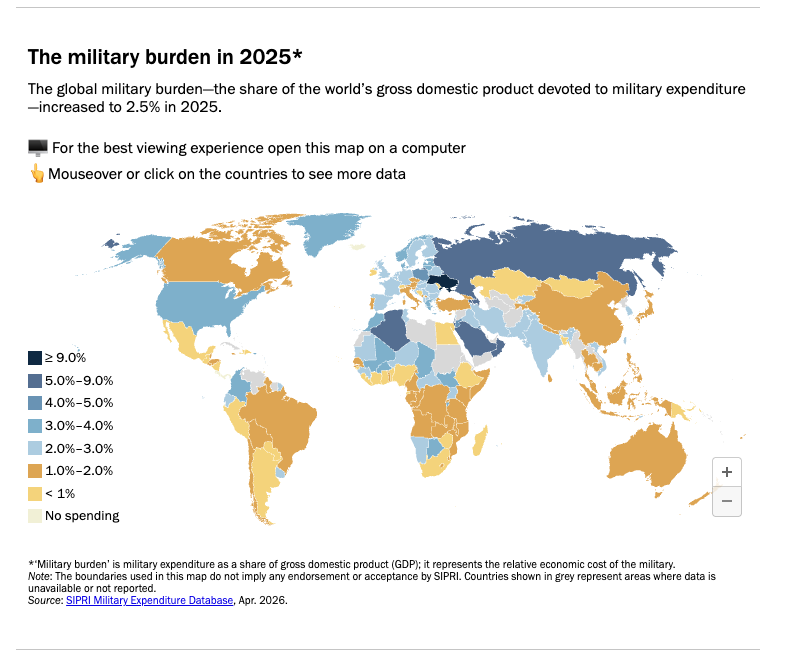
Source: SIPRI
Russia’s continuing war against Ukraine has forced European governments to confront the uncomfortable reality that their militaries and defence industries have been hollowed out over decades. America’s shift away from its European allies is compounding the change required across Europe and has made it urgent.
The Middle East has demonstrated again how quickly stocks of missiles, interceptors, drones and other munitions can be consumed in modern conflict. It’s also straining the logistics around keeping US Navy ships and aircraft on operations over extended periods, with longer term costs and consequences for US military readiness and capability, accompanied by big future bills.
Underneath all of this is China’s continuing military expansion and increasingly assertive behaviour around Japan, Taiwan, the Korean Peninsula and the South China Sea, reaching down into Australia’s immediate region over the last 18 months.
The result is a global push to spend more on defence.
Europe is the most obvious example, with the total spend on defence in 2026 across Europe projected to be EURO 454 billion ($AUS732 billion). Germany is rapidly increasing its defence spending. Poland has already moved aggressively, including through major acquisitions from South Korea. Other European governments are doing the same.
Japan is also moving away from its historic post-war restraint on defence spending and building much greater military capability.
And, as mentioned, in Washington, the proposed US defence budget for the next financial year is heading towards an extraordinary — perhaps hard to sustain — level of spending.
This should create enormous opportunities for defence companies, but this comes with an important qualification.
The money is increasingly being spent according to national industrial priorities.
That is the part of the story Australian defence businesses need to understand.
The new rule: governments REALLY want to buy local.
For decades, defence globalisation operated on the assumption that the best military equipment could be bought from wherever it was made – except of course from potential adversaries. For many militaries, notably Australia’s and many NATO partners, this meant buying American.
That assumption is disappearing in most US allies’ national capitals and defence ministries as a consequence of American decisions, policies and actions.
European governments increasingly want their defence spending to build European – and preferably national – industrial capacity.
That makes sense when governments look at Ukraine and ask some very basic questions:
What happens if we run out of ammunition? Or if the effective but expensive systems we buy from America are either simply not available because of US decisions, or cannot be purchased in the volumes we need during conflict? What if even if US policy allows their supply, the US industrial base just can’t produce them in time?
A military that cannot replenish its missiles, artillery shells, drones and spare parts, and repair and replace damaged and lost systems quickly is not a military with much staying power. Those militaries lose wars.
So, governments are increasingly treating defence industry as part of national security rather than simply as another supplier market.
The United States has been doing this for decades. The Trump Administration’s “America First” approach has intensified it, but the underlying policy is much older than President Trump’s second term in office – and older than Donald Trump himself.
The US defence budget is overwhelmingly designed to support American companies and American production to equip the US military. This is not new news, just news that comes with more direct implications in 2026 than in previous decades since the end of the Cold War.
And that means an Australian company cannot simply look at the enormous size of the US defence budget and conclude that there is a huge addressable market.
For an Australian business, much of that money is behind a very high fence.
If you want to access it, you generally need to become genuinely useful to an American company – or establish production and people in the United States.
That is not necessarily bad business.
But it is very different from assuming that a growing US defence budget automatically creates opportunities for Australian industry, or that AUKUS and moves like changes to US ITARS rules are actually creating an integrated industrial base between the US, the UK and Australia. America has a deeply thatched set of laws, rules and policies that cement in preferences for purchasing form US firms for its defence.
America First approaches add a further layer to the existing tiramisu cake. Any Australian defence company doing business with the Pentagon has to be prepared to build existing or surprising new tariffs or obstacles into its business plans, despite notions that the US and Australia are building closer defence industry connections driven by AUKUS. The latest new tariff that will affect Australian companies in the defence sector applies to drones and drone components imported into America. The UK is still subject to the new tariffs but at a reduced rate, while Australia has no special treatment).
The other problem with America: it cannot simply make more, or even enough to supply itself.
There is an even more important reason for Australian businesses to rethink their relationship with US defence supply chains.
America’s defence industrial base is not the industrial colossus many people assume it is.
The US economy remains extraordinarily innovative and productive. But decades of post-Cold War deindustrialisation have left parts of the defence manufacturing base surprisingly thin.
The Pentagon itself acknowledged the problem in 2024, before the obvious vulnerabilities the war with Iran has revealed.
Its National Defense Industrial Strategy warned that the post-Cold War period had brought a contraction in US production capacity and exposed serious weaknesses in manufacturing and supply chains. The strategy specifically called for more resilient supply chains, greater investment in small and medium-sized businesses and new US entrants into defence production. The theme has continued under the new leadership in the Pentagon, with a focus on accelerating munitions and missiles production.
The reason this matters is that the giant defence companies are not self-contained industrial empires.
Lockheed Martin, Boeing, Northrop Grumman and the other primes depend on large networks of smaller subcontractors and sub-subcontractors.
Many of those companies built their businesses around the relatively low production tempo of the post-Cold War period.
They cannot double or triple output simply because the Pentagon suddenly has more money.
That creates bottlenecks and is now a binding constraint on US rearmament in the areas most affected by the US-Iran war.
And the problem is particularly obvious in missiles and munitions.
The wars of recent years have demonstrated how quickly sophisticated weapons can be consumed. Replacing those stocks will take years, even if the United States is only trying to build back the inventory levels it had before its war with Iran started in February.
The US needs much larger inventories to have credibility to deter a major conflict with China – and the production to meet this larger need will take years longer than simply restocking. So, for at least the next decade, any US Administration will need to be ruthless in prioritizing its own military needs over supplying allies and partners – even an Administration that is far from the unilateralist outfit we see under President Trump.
For Australia, this creates a simple but uncomfortable problem. The moment we most need American weapons and logistics is likely to be the moment American industry is least able to supply them.
And even if the US Government is politically willing to supply Australia, American production will necessarily have to meet American military requirements first.
That is not an indictment of America. It’s what any sovereign state must do.
The mistake is for Australia to build its military on the assumption that this will not happen.
Australia is growing its defence budget – but not its freedom of action.
The 2026 Integrated Investment Program contains around $425 billion over the decade, alongside a stated emphasis on greater self-reliance and a more resilient sovereign defence industrial base.
On the surface, that sounds like excellent news for Australian defence businesses, until you look underneath the headline number.
Much of the future investment program is already committed to a small number of very large programs – particularly naval programs.
The AUKUS submarine program, Hunter-class frigates and the new Mogami-class general-purpose frigates absorb enormous amounts of future investment. The maritime programs in the Plan take up 41% of the total future investment funding, which is a larger share than the investment allocated to Army, Air Force, space and cyber capabilities combined. And the budgets for those programs are locked up decades into the future.
This gives an important insight into the structure of Australia’s defence market.
If you are a company that wants to supply the big established programs through the big foreign defence primes, there can be substantial opportunities, particularly in the big naval programs.
If you are not interested in becoming a subcontractor or perhaps a sub-subcontractor to the large primes running those programs, the amount of genuinely discretionary money available to buy your product can be much smaller than the headline defence budget suggests.
That is the fundamental difference between a large defence budget and a flexible defence budget.
Australia has the first.
It has much less of the second.
And Australia’s industry policy makes this worse.
This is because of another problem beyond the depressing mathematics around the Defence budget between now and the 2040s.
The government’s definition of Australia’s “sovereign defence industrial base” remains extraordinarily broad, to the extent that it is largely empty.
The 2026 Defence Industry Development Strategy explicitly maintains the existing definitions of defence industry and the sovereign defence industrial base. Here it is:
“Australia’s sovereign defence industrial base
Australian defence industry is comprised of businesses with an Australian-based industrial capability and an Australian Business Number (ABN), providing products or services used in, or which can be adapted to be used in, the Australian Department of Defence supply chain and/or an international defence force supply chain. This is Australia’s sovereign defence industrial base. Only in limited circumstances is Australian ownership critical to sovereignty.” Source: 2024 Defence Industrial Development Strategy page 3.
That means the definition is not about where a company is headquartered, who controls it or which government ultimately has jurisdiction over it, or even where its production occurs.
The practical consequence is that the Australian operations of large foreign defence companies are treated as part of Australia’s sovereign industrial base, with minsters like Pat Conroy saying this explicitly. It’s part of the policy design to have the effect that Australian defence dollars used to buy systems through Lockheed Martin Australia that produced in America can be characterised as spent on sovereign Australian industry.
This is the core problem I have written about before: a foreign company with an Australian Business Number is not necessarily an Australian sovereign industrial capability.
A US company remains subject to US law.
A UK company remains subject to UK law.
A European company remains subject to the priorities of its home government.
And when a crisis comes, that matters.
America has a highly developed set of laws and policy tools for diverting any production to its own ends – or those of other partners it chooses to supply – regardless of what orders other governments have placed, or contracts have been signed by US companies. The Defense Priorities and Allocation System, based on the Defense Production Act of 1950, is a foundational example – any contract or any sale under the US Foreign Military Sales system can be overridden where US decision makers see this as required for national security. These far-reaching powers to override other customer’s contracts and orders are being used right now to divert supplies to the US and Gulf State partners, with European and other militaries being left to simply cope with the changes, uncertainties and delays.
The words of the Australian Government’s 2026 Defence Industrial Development Strategy, like it’s very similar 2024 predecessor, say it is designed to strengthen Australia’s sovereign industrial base and self-reliance. It includes new funding for industry development, procurement reforms and support for Australian sovereign defence industry.
Those measures and that sentiment are welcome.
But the basic question remains unresolved: what exactly does Australia mean by sovereign?
A much more useful definition would be simple:
Australia’s sovereign defence industrial base consists of companies headquartered in Australia, with production capacity in Australia, able to supply the ADF and capable of being directed to do so by the Australian Government in a crisis.
That does not mean foreign companies operated domestic operations or local shopfront offices in Australia are unimportant.
Far from it: Australia needs foreign partners.
But foreign partners and sovereign Australian industry are not the same thing.
Confusing the two makes it harder to build the industrial resilience Australia needs. But confusing the two is at the core of Australian Government policy in defence.
Europe: opportunity, but only if you enter through the front door in good company
For Australian companies looking offshore, Europe is an increasingly interesting market.
But it is not an easy one.
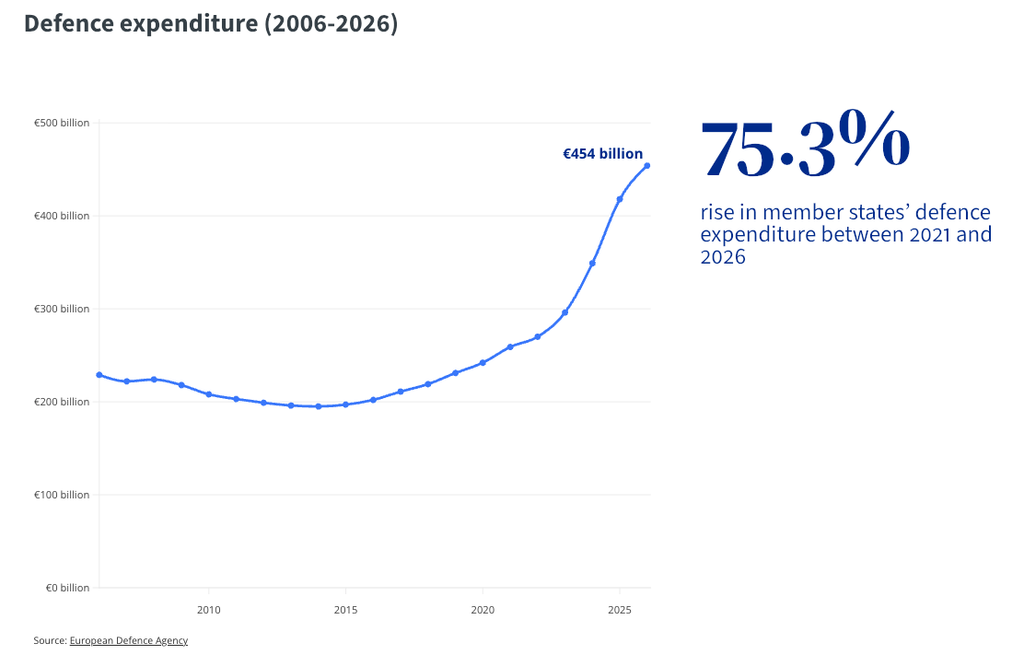
EU members’ defence spending. Source: European Defence Agency
European governments are spending more because they have realised that they have serious capability and industrial gaps, and this creates demand.
But it also creates political pressure to make sure the new money builds European industrial capacity.
So, an Australian company trying to sell directly from Australia into a European defence ministry is working against the grain.
The basic hierarchy is increasingly: national industry first; European industry second; everyone else after that.
American systems and products are moving towards the back of that queue, except where short term necessity demands otherwise or alternative solutions are not seen on the horizon. America’s NATO partners recently chose Sweden’s SAAB GlobalEye surveillance aircraft over the US Boeing P-8 option, with the fact that SAAB is a European, and not an American, supplier weighing into the outcome.
European government’s preference for local procurement is strongly supported by their populations. Polling across European nations shows that the populations in individual countries want their defence funds spent locally on their own national industries, with a strong preference for this overspending the money in wider Europe. Local solutions in Germany mean contracts going to German companies as the priority – not Spanish, French or Norwegian options.
Where Germany cannot produce what Germany needs, it will look increasingly to European partners.
Only after those options have been exhausted is a company from Australia likely to be the obvious next choice.
This is why Australian companies looking at Germany, Norway, Poland or other European markets should think seriously about local partnerships.
Don’t simply ask: how do we sell our Australian product into Germany?
Ask instead:
Who should we partner with in Germany so that we become part of the German industrial solution?
That question has real opportunities involved in the answer.
Japan-Australia defence industrial partnership – opportunities from the Mogami beachhead
Japan is potentially more promising because the Australia-Japan defence relationship is developing at the same time as a new industrial relationship – and there have been at least a couple of decades of growing government-to-government arrangements and policy work that can now be taken advantage of.
The Mogami program is the obvious starting point, even with the risks of transferring production from Japan to Australia for later ships. The industrial and political complexities of the Japan-South Korea interaction around Austal, Hanwha and Mitsubishi Heavy Industries are also something to navigate as the Mogami program develops.
The Australian and Japanese governments describe the program as a major milestone in defence industrial cooperation, and it is the largest Australia-Japan defence industrial collaboration to date.
In this case, they are right. That creates a genuine industrial beachhead.
Australian companies should be looking closely at the supply chains around the Mogami program and at opportunities to work with Japanese companies.
There may eventually be opportunities for deeper co-production, technology development and export activity.
But this will take time. Imagine, for example, a future effort to co-produce Japanese anti-ship missiles in both Japan and Australia to provide a highly capable alternative to the suite of US and Norwegian missiles that our Navy is betting it’ll have when it needs them. The Type 17 anti-ship missile used by the Japanese Self Defense Force’s own Mogami frigates, would be an excellent system to co-produce with Japan and to equipe the Australian Mogami warships with, for example.
Japan’s defence force is not simply an offshore customer waiting for Australian companies to arrive, and Japanese defence companies aren’t building their emerging export plans around partnerships with Australian companies beyond the specifics of eth Mogami contract.
Building trust, understanding Japanese industrial practices and establishing relationships with Japanese companies takes years.
The opportunity is real, but the shift in national Japan’s policy, the marked shift towards not just allowing but supporting defence exports and the changed corporate behaviour this supports and requires, is very new. It has not yet rippled through Japan’s defence corporate sector. And Australian defence companies also need to learn how to work with Japanese partners and with both Australian and Japanese government policy and regulatory environments.
That will take hard work, research and a willingness to find and work with Japanese partners.
The international competition is capable, ruthless and supported by their home governments
So, the picture is of growing defence budgets internationally, accompanied by strong policy preferences for procuring from local industry and building national capacity.
While this still leaves room to win export sales, Australian companies face intense competition from other nations’ defence sectors enabled by support from their governments.
Two powerful competitors are worth thinking about: South Korea and Ukraine.
South Korea has the existential need to have a capable military ready to win a conflict with its aggressive neighbour, North Korea. South Koreans have turned their nation into a technological and industrial giant and turned some of that strength towards its defence sector. The result is South Korean companies design and build an entire order of battle that can equip a modern military, and they have invested in a production system that can scale and produce volume when wartime needs require this. Often, their defence industrial capacity is delivered by companies that have parallel very capable commercial arms r producing systems for civil use – shipbuilding is a good example.
This deep industrial capability also means that they can equip other militaries – and they are winning a growing share of European and global defence business as a result. That export success is enabled by strong local demand from its own military.
A look at Poland will show this success. Poland chose South Korean solutions over traditional sources like Germany in its recent rearmament because of the technical excellence and rapid delivery track record South Korean defence companies can demonstrate.
In addition, the South Korean government is a deep, invested partner of South Korean companies pursuing overseas markets, and South Korean defence firms are cashed up enough – and smart enough – to invest in local production in key markets like Europe.
Ukraine’s defence sector is now perhaps the most creative and productive defence industrial base on the planet, with its growth, diversity and technical excellence driven by the pressure of Ukraine’s existential war with Russia. Two years ago, Ukraine was a partner who needed assistance. It still values foreign financial, political and military assistance, but its defence companies are now highly sought after partners and suppliers across Europe. Now, given newly demonstrated vulnerabilities in US and Gulf state capabilities, Ukraine is a prized partner and supplier to Gulf State nations.
European governments and companies are entering joint production and partnership agreements with Ukrainian partners, designed to support Ukraine now while also building their own military and industrial capacity. Drones and counter drones are clear examples. Ballistic and cruise missiles, uncrewed ground and sea vessels and missile interceptors may be next.
Where two years ago, focused Australian government policy and action could have built a bridge between Australian and Ukrainian defence companies for mutual success, now Ukraine’s dance card is full, because others have seen the opportunity. So, Ukraine’s incredible people and companies are now more likely to be competitors with Australian businesses interested in international opportunities.
That’s a bleak conclusion to reach because of failure to take up an obvious opportunity, but it’s how the analysis goes.
And, as with South Korea, the Ukrainian government and Ukrainian military are the backers – and best customers – of Ukrainian companies in the defence sector, because it works and isn’t vulnerable to capricious decisions around supply like those that have come out of Washington DC since Russia’s invasion began.
What should Australian defence companies do?
So, what does all this mean for an Australian defence company?
There are five practical lessons.
- If being a niche supplier to the big primes works, keep doing it.
There is nothing inherently wrong with being a specialist supplier to BAE Systems, Lockheed Martin, Boeing, Northrop Grumman, Thales or another major defence company.
If the business is profitable, sustainable and gives you a strong position in a growing program, stay there.
But understand the risks and the limitations.
You are part of someone else’s supply chain, and if that supply chain ultimately depends on the US or another foreign government’s priorities, you are exposed to decisions that you cannot control.
You also face the risk that the prime who wants you as a sub-contractor now will drop you quickly if they have an in-house alternative or need to push the work you do to a local company in a market where the home government wants to get a slice of the program for its own companies.
2. Decouple critical supply chains from US defence production where you can
For companies developing their own products, this may be the most important lesson.
America is a shadow of its former status as the “arsenal of democracy”. Its over-concentrated remaining defence primes have built very profitable business around slow moving, decades long procurement programs run by the Pentagon. The US Government approach to procurement has provided incentives for this approach, and the industry has built itself around them.
A further result is that these US primes have failed to retain capacity to shift production to new solutions quickly. And they are unable to expand production of even high-demand systems quickly because of their dependence on large numbers of small niche suppliers. These are structural issues for the US defence sector to solve, and they show no sign of being solved fast.
So, if your ability to deliver depends on scarce US defence components, you have built someone else’s supply-chain problem into your own business. And you’ll need to follow the news to hear when your order from your American supplier is now not for you. The contract you had is an interesting artifact, not a legally enforceable undertaking.
Find alternatives.
Use multiple suppliers.
Look for commercial components where military specifications are not genuinely necessary.
Design products so that scarce, bespoke components can be substituted for with more widely available components not caught up in US defence primes’ supply chains.
The objective should be resilience, not unthinking vulnerability.
3. Think about “form, fit and function”: Gucci and high-end Superfakes have lessons for you.
There is a useful lesson for defence companies from the luxury goods industry.
Luxury products like high-end Gucci or Fendi handbags, Rolex watches or Chanel outfits are scarce, expensive and difficult to obtain.
A market has developed for products that reproduce the form, fit and function of those scarce goods through a different manufacturing and supply chain. Yes, there’s a cheap fake market that supplies Gicci-like bags that break after a few weeks and “Rolex” watches that have bamboo bearings inside, but there are also high-end copies of similar quality and high functionality, and alternative brands that emulate the styles and quality at fractions of the price. This is described as the rise of the Superfakes.
The defence sector can have its own version of this phenomenon.
If a particular US missile, seeker, rocket motor or other component is scarce, is there an opportunity to make an alternative that performs the required function but does not depend on that constrained US supply chain?
That is not about making an inferior copy.
It is about solving the underlying military problem with a different design and industrial solution. And it’s about admitting that no amount of wishing and even fast cash can expand production of systems like Patriot or SM-2 missiles to meet even US demands.
So, if your own nation’s military plans are based on access to ready supplies of such US systems, then just when you need these most, you won’t have them.
The companies that can respond to this obvious critical gap between supply and demand credibly will have an enormous market. That can be the rise of the defence Superfake: bad for big incumbent defence companies, but great news for militaries after capability and assured supply, combined with slimmer spends.
When RTX can’t supply rocket motors and is busy managing a massive, decade long order backlog, but you can, and you offer similar performance characteristics built with a supply chain that doesn’t compete with RTX’s, you have an attractive product on your hands.
When Boeing can’t expand its seeker production for PAC-3 systems, but you have an alternative, the phone is going to ring.
And when you solve the missile defence, long range strike, electronic warfare, unmanned ground manoeuvre, or counter drone problems with novel alternative solutions that avoid the industrial vulnerabilities of struggling large firms – and capricious but damaging policy decisions by foreign governments — you will position your company, and country, for success.
Ukraine has many examples of this approach, from the designer/makers of the Flamingo series of cruise missiles to the mass of creative companies working directly with military teams who are defending Ukraine and carrying the war deep into Russia. This tightly connected set of fast, deep partnerships is providing military advantage to Ukraine in its war and also produces a technological and industrial advantage for Ukraine as a defence supplier and partner that is hard to match.
4. If you want to sell to the Australian military, you are probably out of luck.
Use any Australian Defence engagement for other purposes. Get beyond the sentiment in ministerial and senior official speeches about how important building a self-reliant defence industry in Australia is in the Australian policy world. The Advanced Strategic Capabilities Accelerator and the range of small development grants and prototyping demonstration days Defence runs are not paths to major contracts for volume procurement of Australian solutions for our military. They are mainly avenues for smart Australian companies to get some valuable but limited development money, along with some kind of positive association between your product and your home country’s military. Announcements of multi-billion dollar programs for everything from missiles to counter drone systems sound fantastic but on examination show tiny actual contracts in the $10s of millions for tiny volumes of systems going to Australian companies.
So, instead of landing the grant or an ASCA seed money contract and expecting any program based around your demonstrated success finding its way into Defence’s over-subscribed Integrated Investment Program, be more brutally realistic – your bankers and backers are likely to be. Any front-end funding from Defence is better seen as a springboard to selling to foreign militaries, not our own.
The latest internal changes inside the Defence organisation make this truer not less true: the theme around the emerging new Defence Delivery Agency and the lightly rewarmed capability development process is one of greater centralisation of decision-making in a tiny number of very senior officials. This institutional design has almost no room for small and medium firms to get any airtime or access unless you are a hitchhiker with a big prime.
5. If you want to sell overseas, partner locally.
This is the simplest lesson of all.
If you want a share of Germany’s defence spending, partner with a German company.
Work out how to produce there and don’t simply propose to export form Australia. And work out how you can deliver faster than local German competition.
If you want to participate in a Japanese defence program, build a relationship with credible, ambitious Japanese companies.
If you want to access the US market, consider what genuine US presence or partnership is required. Austal’s Mobile Alabama shipyard is an obvious example. Bu be ready to have to adjust any business plans as new US tariff and other trade control measures affect you. Don’t expect carve outs for Australia, despite the warm words of defence partnership and mateship.
The world is moving towards defence industrial nationalism, everywhere but here in Australia.
And US partners and allies are working hard to reduce their dependence on US supply. Again, this is happening everywhere but here in Australia, where government policy and spending is doubling down on our already large dependence on US military systems and resupply.
Australian businesses need to simply accept the reality of a changed world and changed international business environment, which is unfortunately accompanied by static policy and spending plans here at home.
The opportunity is there – but Australia needs to understand the new game
The international market is growing for defence products, but it’s shifting from how it operated in the past.
It is not the old global market. Many countries will equip their militaries with Russian or Chinese weapons, but others, mainly the world’s democracies, won’t. South Korea, Ukraine and other capable defence producers like Turkey seem likely to continue to grow their global exports. Interest in Chinese options is growing as their technological strength gets demonstrated (Pakistan’s use of Chinese fighter jets and missiles in last year’s conflict with India is proving to be a powerful marketing tool).
Politics and local interests have always played a role in defence spending, but the new model is much more political and much more focused on the source of the supplies and the flow of supply after the initial sale. It’s shifting to be much less US-centred. That’s a hugely important development.
Governments want capability AND national industrial resilience.
They want supply chains they can control – or which are at least not obviously in the control of others who act against their interests, whether deliberately or negligently.
They want factories in their own countries. The smarter ones don’t just want assembly halls to put foreign systems together, or even factories, they see the value of diverse small designers, creators and producers who are less vulnerable to single-point failures and who, between them, provide multiple solutions to practical military problems.
They want local jobs and local technology, but for the purpose of providing military power now, not in distant decades.
And, increasingly, they want to know that the companies they depend on will still be able to supply them when a crisis comes.
That creates both a problem and an opportunity for Australian businesses.
The problem is that Australia itself is not yet giving local companies preference in its own defence market.
The opportunity is that Australian companies can be much nimbler than the large primes.
They can develop the small, the smart and the many – and have seen their solutions proven in places like Ukraine.
They can innovate quickly.
They can build alternative supply chains.
They can provide capabilities that large, slow-moving foreign defence companies cannot produce quickly enough – or at all.
But they need customers.
And they need a strategy.
For an Australian defence company, the practical choices are increasingly clear: be a good niche subcontractor to the foreign-owned big end of town if that is a sustainable business, or, if this isn’t a happy niche for you: build supply chains that do not depend on scarce US defence industrial inputs.
Do not rely on supply chains that are at the behest of the Pentagon or the big US primes, because these are already over-stressed, and US law and US decisions will always divert scarce inputs to their own needs.
Look for inputs that can substitute for scarce components or systems through alternative supply chains. Design around commercial “commodity-like” components and systems, as these can be sourced from the wider economy and not from the constrained military industrial sector where multiple bottlenecks exist now and will only grow.
And if you want to sell overseas, partner with local industry there rather than assuming you can sell directly from Australia. Be prepared to locate your company in the customer’s jurisdiction.
For the Australian Government, the lesson is even simpler.
If it really wants a sovereign defence industrial base, it needs to define sovereignty properly and spend a meaningful share of the defence budget buying from companies that are sovereign Australian businesses. There’s no sign it is about to do that.
The world is rearming. That’s dangerous and something we’d all be better off to not see happening, although for defence companies it means the budgets are there.
But outside Australia, the countries doing the spending are increasingly making sure that their own industries get first call.
Australian defence businesses need to understand that reality as they build their business strategies.
A PDF version of the report is available here: Australian defence business outlook 2026.